Glenwood renovation house
The Birthday PartyThe Glenwood renovation house is a property being renovated by Mitch Hamilton and Scott Bowers in Glenwood. At first it appears to be an empty work site: tools and offcuts of wood are stacked inside, its windows are shut, and construction is incomplete. But objects found there—the cowboy hat discovered in a kitchen unit and a small piece of red fabric embedded in basement concrete—draw the investigation toward the house and make it a crucial place in the search for Charlie Hamilton.
Setting and Condition
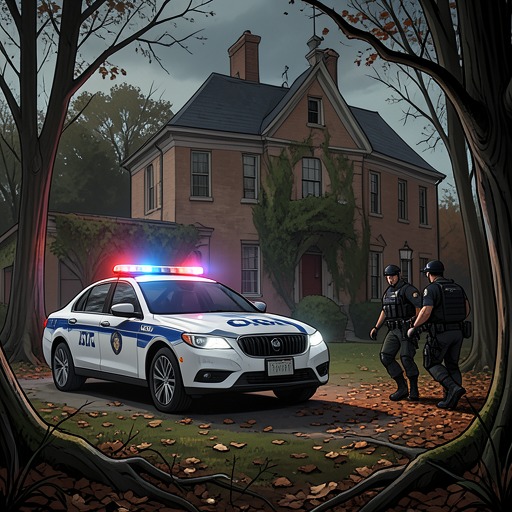
When Chase Cooper arrives, rain is beginning under heavy gray clouds, though the heat and humidity remain oppressive. The property is described as a good-sized house with mature trees across its front lawn, less grand than the house on Lexington Lane but substantial in scale. No cars are in the driveway, and the closed windows reinforce the impression that the building is vacant. Through the new glass, Chase sees the reflected clouds; inside, stacked construction tools and wood offcuts mark the house as a renovation in progress rather than an occupied home.
The unfinished state of the building shapes Chase’s search. The power has not yet been connected, so the basement is dark when he reaches it. He has to use his phone’s flashlight, and the room’s emptiness makes the few objects there stand out: unopened paint cans sit in one corner, while the floor itself bears the more important trace. The house is not presented as a settled domestic space. It is a structure still being altered, with its surfaces and rooms offering evidence of work—and of what that work may have concealed.
The Cowboy Hat and the Search
The first major clue associated with the house is Charlie’s little cowboy hat. After a contractor named Kenny reports that a member of his team has come forward, Detective Brown tells Chase that the worker found it at the renovation property. The reward for information has prompted the disclosure. The hat was found in a kitchen unit on Sunday morning, but the worker gave it to his daughter and did not realize it could be relevant to the investigation. By the time Chase hears about it, the delay raises a practical concern: the hat may have been exposed to his family’s DNA, and it has not yet been brought to the station.
The discovery gives the house a direct connection to Charlie’s last known setting. When Detective Brown later tells Kathy Hamilton that a contractor found a little girl’s cowboy hat in the kitchen, Kathy pictures Charlie wearing it on the pony, balanced above her blonde pigtails. The object turns an otherwise anonymous construction site into a place tied to a specific image of Charlie at the birthday party. Brown says the police have brought in all the contractors who ever worked on the house for questioning. The workers are therefore both possible sources of information and part of the effort to establish how the hat came to be there.
The Basement Discovery
During his own search, Chase checks the basement last. It has no windows, and with the electricity still disconnected he moves carefully by phone light. A small piece of material catches his attention beneath a paint can. At first it resembles lint, but it does not move when he blows on it; when he shifts the can, he finds that it is stuck in the floor.
The concrete around it appears to have been repaired recently. Its color differs noticeably from the rest of the floor, and the surface is uneven. Closer inspection shows that the material is not loose debris but a tiny red fragment submerged in the concrete. Chase recognizes the significance because Charlie wore a red dress at the birthday party. The discovery changes the basement from an empty, unfinished room into a site where the building’s altered surface may preserve a trace of Charlie’s clothing. The fragment does not, by itself, explain who placed it there or what happened in the house, but it gives investigators a specific physical reason to scrutinize the repair.
Investigative and Narrative Significance
The clues emerge from different parts of the property and through different routes: a worker’s delayed disclosure brings the cowboy hat in the kitchen to police attention, while Chase’s direct inspection reveals the red fabric in the basement concrete. One is an object recognizable as Charlie’s; the other is a fragment that acquires meaning through its match to what she wore. Together, they make the renovation house more than a backdrop to the investigation. Its ordinary fittings—the kitchen unit, paint cans, unfinished rooms, and repaired floor—become places where evidence has been left, noticed, or overlooked.
The house’s unfinished condition also governs the pace of discovery. Contractors have had access to it, one worker initially treats the hat as an unremarkable possession to pass to his daughter, and the basement’s darkness forces Chase to search with a phone light. What first looks like an empty property gradually becomes legible through small discrepancies: a hat in a kitchen unit, concrete of a different color, and red material fixed beneath its surface. By the time Kathy hears about the hat, Brown says the investigation is getting closer to the truth; at the house, Chase’s discovery gives that expectation a further, more troubling physical basis.