Jack Miller
The Birthday PartyJack Miller, Kathy Hamilton’s father and Connie Miller’s husband, moves between practical caretaker and forceful protector as the search for Charlie Hamilton brings old family fractures into view. His support is tangible—a promised reward, work on the lawn, and a threat to involve the police when Chase Cooper comes to the house—but the crisis also forces Kathy to recognize the damage in her parents’ marriage and the extent of Connie Miller’s control. By the end, Jack supports a family future no longer organized around the Hamilton name.
Family Background and Presence
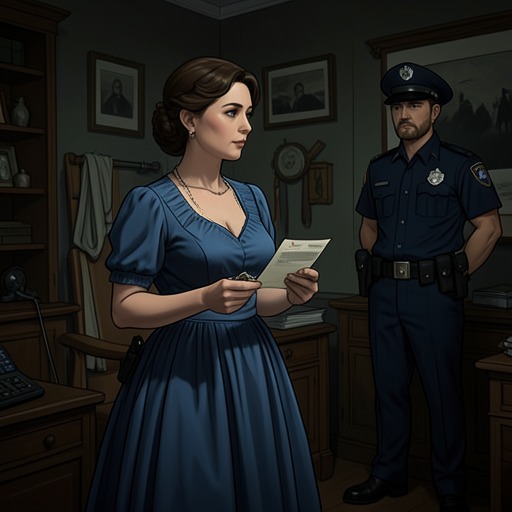
When Jack Miller arrives at Kathy Hamilton’s home after Charlie Hamilton has gone missing, it is his first visit there since the disappearance. His arrival carries more feeling than Kathy expects from a man she has rarely seen cry and who does not tell her that he loves her. He hugs her tightly; she thinks he may be holding back tears. The sight unsettles her because she is accustomed to relying on his strength, not witnessing his distress.
His wife has recently had a stroke, and Kathy sees its physical effects: Connie Miller moves more slowly, her hand shakes, and the polished appearance she once maintained has given way to practical clothes and shoes. Kathy observes that Connie remains mentally sharp. The contrast between her mother’s physical frailty and her continuing authority helps frame the family tensions Jack has lived alongside.
Practical Support During the Search
Jack’s care often takes the form of action rather than emotional discussion. He criticizes the state of Kathy’s lawn, pointing out that he and Connie gave her and Mitch Hamilton the house when Kathy was pregnant with Fay Hamilton. The gift had been significant when Mitch was establishing himself in real estate and Kathy earned less. Yet the help carries an expectation of influence: Kathy recognizes that her parents treat their contribution as a reason to judge how she and Mitch maintain the property. Jack’s concern about the neighbors’ opinion also shows how readily household appearances become a matter of family pride.
When Jack and Connie decide to offer $25,000 for information about Charlie, he argues that money may persuade a friend or neighbor of the person responsible to come forward. Kathy says the police do not support the idea, but Jack considers the reward worth pursuing. His confidence in a financial incentive contrasts with the uncertainty of the investigation; to him, an immediate, practical measure is preferable to waiting for the police alone to produce a result.
Before Megan Carter arrives, Jack announces that he will mow Kathy’s lawn himself. The gesture lets him contribute without having to manage the uncomfortable meeting. Kathy recognizes this as characteristic: when a situation becomes awkward, he would rather undertake manual work than step into its emotional center. That habit does not mean he is indifferent; across the crisis, practical tasks are among his clearest forms of care.
Protection and Family Conflict
Jack’s protective instincts become overt when Chase comes to the house during Kathy’s painful recollection of their earlier relationship. Kathy hears her father order Chase to leave and threaten to call the police; he also warns Chase to stay away from his daughter. The intervention gives physical force to a loyalty that Jack does not usually express through tenderness. It also places him between Kathy and a relationship she still feels emotionally vulnerable about.
His protection exists alongside a more complicated history. Kathy’s therapist has connected her childhood food-related difficulties to her parents’ arguments, and Kathy reflects that they should have shielded her from their marital problems—or separated when her father strayed. The text suggests that Jack had an affair, though Kathy’s understanding of its extent is an inference rather than a detailed account. Later, when she considers her parents’ marriage, she finds herself imagining that he may have sought happiness elsewhere. That shift complicates her judgment: she can recognize the harm of his choices while also seeing him as someone subject to Connie’s control.
The Family Secret and Its Cost
The crisis repeatedly exposes Jack to the consequences of decisions made within his family. Kathy reveals to the police that Charlie was adopted, despite Mitch’s anger, because she believes the information will emerge eventually. Jack is not shown directing this disclosure, but the secret’s unravelling belongs to the wider family reckoning: the household’s public identity has rested on concealed relationships and carefully managed appearances.
The later revelations reshape Jack’s place in the family. Megan Carter tells Kathy that she was adopted as a baby and that her birth name is Hope Hamilton. Kathy recognizes that Megan is the daughter she was forced to give up. Jack’s response to this discovery is not recorded as a separate confrontation, but the eventual family decisions show that he accepts the new relationship and the changes it brings. He is present when Kathy considers taking the Carter surname, and he supports her choice despite the pain visible in his expression.
Reckoning and a New Family Name
Connie’s role in the danger to Megan and Charlie turns Jack’s long-standing marital accommodation into a moral crisis. When Kathy asks whether Connie put the idea of killing them into Evan Harris’s mind, Connie acknowledges advising him to eliminate the problem. Kathy also concludes that the $25,000 reward was hollow: Connie knew it was unlikely to be claimed. Jack has had enough. He tells Connie that the Hamilton name is no longer special, rejecting the prestige she has used to define who belongs in the family. Kathy sees, in that moment, how Connie has controlled him too; her view of his past infidelity becomes more complicated, even as Connie’s betrayal remains unmistakable.
At the cemetery, Kathy asks whether she can change her surname to Carter. Jack smiles and agrees, though his expression still carries pain over what Connie did without his knowledge. Fay Hamilton has also said she no longer wants the Hamilton name, and Kathy suggests that Fay Carter would suit her. Mitch, too, is ready to leave the Hamilton name behind and return to Bowers. Jack’s support of Kathy’s decision marks a quiet but consequential break with the family identity Connie defended. Rather than insisting that his daughter preserve the name, he accepts her choice to build belonging around her renewed relationship with Megan Carter.