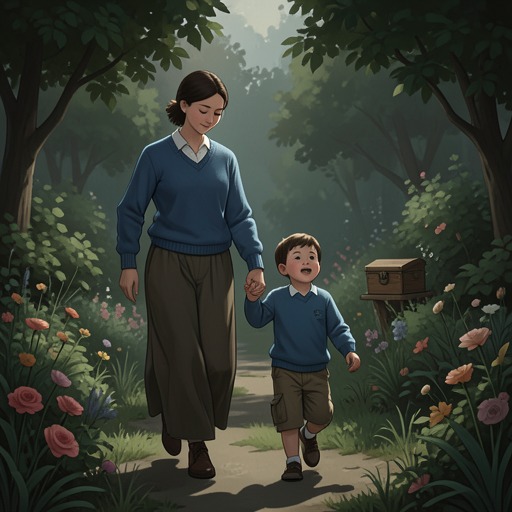
Kathy Hamilton—Charlie Hamilton
The Birthday PartyKathy Hamilton’s relationship with Charlie Hamilton begins as an adoptive mother’s growing attachment to a young child and becomes a test of what motherhood means when biological origin, adoption, and everyday care pull in different directions. Kathy comes to regard Charlie as her daughter through the life they share, not merely through the arrangement that brought Charlie into her home. When Charlie disappears, that bond is strained by guilt and public scrutiny; when Megan Carter’s place in Charlie’s life becomes impossible to ignore, Kathy must accept that loving Charlie does not make her the child’s birth mother. Her eventual willingness to support Charlie’s return to Megan preserves the relationship while relinquishing the assumption that Kathy must occupy its central maternal role.
Identity and the beginnings of the bond
Charlie has lived with Kathy and Mitch Hamilton for six months when Kathy tells the police that Charlie is adopted. Kathy’s preference for the child’s given name, Charlotte, offers an early indication of how she understands their closeness: the name feels right to her, though she eventually accepts the shortened Charlie that everyone uses. The distinction is affectionate rather than a rejection of the name by which Charlie is known. Kathy’s attachment is already taking shape in the ordinary routines of family life.
At breakfast, Charlie savors her cereal and laughs at Mitch’s bad jokes. When he runs out, she wipes the milk from her lip with her sleeve and asks Kathy how much longer it is until the birthday party. The scene places Kathy in the familiar position of a parent sharing a child’s morning: Charlie turns naturally toward her, and the anticipation of the day belongs to the family’s routine. Kathy’s care also appears in practical instructions. When she drops Charlie at Scott Bowers’s home, where the party is taking place, she reminds her that Megan will pick her up because Kathy and Mitch have to work, tells her to keep her hat on in the sun, and warns her not to eat too much candy. The mundane reminders register as parental attention precisely because they are specific to Charlie’s comfort and habits.
Kathy knows the details of Charlie’s party clothes: pink cowboy boots, yellow shorts beneath a red dress patterned with zebras, and a cowboy hat; Charlie’s blonde hair is in pigtails tied with white ribbons. The description is more than a list for identification. It reflects Kathy’s close attention to the child she is raising, while the clothing will also become part of the painful memory of the day Charlie disappears.
Disappearance, guilt, and the truth of adoption
Before the party, Kathy receives a message from Mitch reminding her of their appointment and telling her he loves her. The reminder briefly draws her attention to their crumbling marriage, but Charlie’s efforts to get out of her car seat return her to the immediate work of caring for her daughter. After Charlie goes missing, the ordinary plans Kathy had made for the coming week acquire a different weight. She had intended to shop with Charlie for vacation clothes and take her to lunch, including a special ice-cream sundae. Remembering the occasions when she had refused Charlie one because of her teeth, Kathy wishes she had given in. The lost treat matters because it stands for the small pleasures she expected to share with Charlie again.
Kathy spends a night in Charlie’s room. Mitch comes to find her, and neither of them argues; they cry for Charlie and hope she will find her way home. Kathy’s guilt centers on the party: she wonders whether one of them should have stayed with Charlie, or whether both parents should have attended. The two eventually fall asleep together on Kathy’s bed, holding one another. Their shared grief does not undo the circumstances of the disappearance, but it briefly makes their parental fear more important than their marital conflict.
Under pressure as the search continues, Kathy tells Chase Cooper that Charlie is adopted and has been living with the Hamiltons for only six months. Kathy feels that the truth would emerge eventually, but she also explains why she and Mitch had not raised it earlier: they did not think it relevant, and repeatedly having to explain that they were not Charlie’s biological parents felt like reinforcing a painful distinction. They considered themselves Charlie’s parents, believed she had fitted into their family, and knew that Fay Hamilton adored her. Kathy insists that they love Charlie and want her home safe. Her disclosure is therefore not a withdrawal from the relationship; it is an attempt to make the facts of the adoption known while affirming the family bond she believes they have built.
The bond through Charlie’s eyes
Charlie’s school notebook gives the relationship a perspective beyond Kathy’s own account. In a piece about her favorite person, Charlie describes a woman with black hair, brown eyes, and freckles who buys her ice cream and paints her nails bright colors. She says this person needs looking after like her china dolls and that seeing her makes her feel warm and happy; she identifies her as Mommy. A photograph of Megan, taken six years earlier when she was pregnant, appears beneath the writing. Together, the child’s words and the photograph connect the affection Charlie expresses with the woman whose identity is coming back into view.
For Kathy, the notebook’s evidence of Charlie’s love does not erase the years and circumstances that have separated Charlie from Megan. Instead, it clarifies that Charlie’s attachment to Kathy and her connection to Megan can both be real. Kathy later apologizes to Megan for not taking better care of Charlie on the day of the party and for Megan not having been invited. She says that she loves Charlie, while acknowledging that Megan loves her in a different way as her mother. Kathy’s words distinguish the care she has given from the biological and maternal history she cannot claim.
Choosing a future that includes Megan
Kathy comes to imagine Charlie living with Megan again when she returns. She does not want to disappear from Charlie’s life: she says she would love to see her regularly and that she and Mitch will support both Megan and Charlie wherever they need help. The change is consequential because Kathy moves from describing the Hamiltons as Charlie’s parents to accepting that Megan should raise her daughter. She recognizes that Megan’s overdose was a mistake, not a reason to make her watch Charlie grow up with another family. Kathy also recognizes that pretending to be Charlie’s mother must have been painful for Megan.
The decision does not make Kathy’s attachment vanish. She continues to regard Charlie as a beloved child who has become part of the Hamilton family, even as she accepts that Megan’s place cannot be replaced by that love. The relationship is therefore not resolved by choosing between a real bond and an unreal one. Kathy’s care is meaningful, but it does not require Charlie to remain in her household or Megan to be excluded from motherhood.
Recognition and the meaning of family
The later revelation that Megan was adopted as a baby, and that her birth name is Hope Hamilton, changes the family history surrounding Kathy and Charlie. Kathy’s connection to Charlie has developed within an adoption story, but it is also bound to Kathy’s own loss: Megan is Hope, the daughter Kathy was forced to give up. The discovery does not retroactively make Kathy Charlie’s birth mother; it reveals a separate, deeper relationship between Kathy and Megan that had been hidden from both women.
At the cemetery, Kathy raises the possibility of changing her surname to Carter. The suggestion points toward a new form of belonging shaped by recognition and choice rather than by an attempt to hold Charlie within the Hamilton household. Across the relationship, names, caregiving, adoption, and biological connection each mark a different part of family identity. Kathy’s movement from claiming Charlie as her daughter to supporting Charlie’s life with Megan does not negate their affection. It makes that affection compatible with the child’s connection to her birth mother, while the revelation of Hope gives Kathy and Megan a chance to acknowledge the mother-daughter bond that preceded Charlie’s adoption.