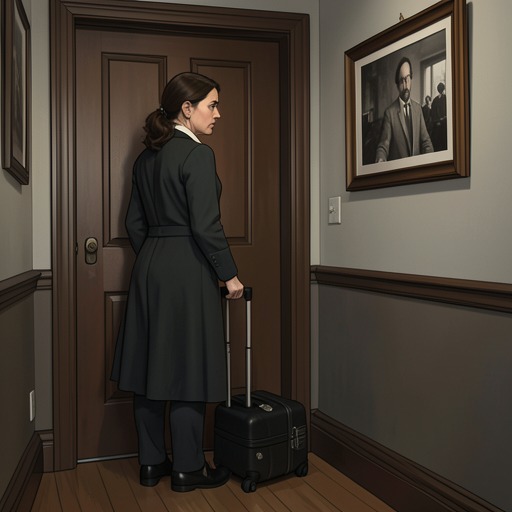
Kathy Hamilton—Connie Hamilton
The Birthday PartyKathy Hamilton and Connie Hamilton are mother and daughter, bound by the Hamilton name and a shared family history but separated by distrust, criticism, and Connie’s determination to control what the family preserves. Their relationship moves from familiar, uneasy friction to a decisive rupture: during the search for Charlie, Kathy discovers that Connie’s influence reached far beyond family disagreements, and that the respectability she protected concealed deliberate betrayal.
Family Identity and Early Tensions
Connie is a forceful presence in Kathy’s life. Even a routine phone call leaves Kathy wary rather than comforted, and she recognizes that she does not feel better after speaking with her mother. Their exchanges show how affection and irritation coexist: Connie asks after the family and sends love to the children, but her concern readily becomes judgment of the people Kathy welcomes into her home.
That judgment is clear in Connie’s complaints about Megan Carter, whom she calls a bad influence on Kathy and Fay Hamilton. Kathy defends Megan and asks her mother to try to get along with her. The criticism is also hypocritical: Kathy has caught Connie smoking behind her back more than once, despite Connie’s disapproval of Megan’s smoking. Connie maintains that her manners conceal how she really feels. Her joking complaint about church sermons similarly sits alongside a deeply religious life, carefully shaped to avoid upsetting God, even as she is willing to upset other people.
The Hamilton surname carries unusual weight in their relationship. Connie and Kathy both kept it after marriage rather than taking their husbands’ names. The family’s wealth began with Connie’s great-grandfather’s involvement in local railroad construction and grew through investments and business; generations of philanthropy made the Hamiltons prominent and respected in Maple Falls. A library bears the family name. Connie treats that inherited identity as something worth preserving, and her later actions reveal that the family’s prestige is not merely a source of pride but part of her judgment about who belongs.
Crisis and a Brief Opening
Charlie’s disappearance brings Kathy and Connie together in a setting where their usual tensions become difficult to maintain. At church, Kathy arrives with Mitch Hamilton and Fay while overwhelmed by fear and by the feeling that the town is watching the family. Connie checks on her, and Kathy admits that she is stressed and tired and unsure whether coming was the right decision. The exchange is not a reconciliation, but it makes visible the pressure both women are living under.
Connie’s response to the crisis also unsettles Kathy’s established picture of her mother. After Kathy leaves the church, Connie stays behind to pray with Reverend Stanley, who later tells Kathy that her mother was visibly upset and that Kathy’s father had worried about her. Kathy feels guilty, recognizing that her parents love the children and are affected by Charlie’s disappearance too. When Kathy returns to church, she sees tears in Connie’s eyes. Because Connie rarely cries, the moment registers as evidence of how severe the situation has become.
The family’s tensions briefly appear capable of being set aside. Reverend Stanley urges Kathy not to shut her parents out and frames the crisis as a chance for the family to bond and strengthen one another. Yet this appeal for closeness cannot resolve what lies beneath the conflict. The temporary signs of shared grief coexist with a history in which Kathy has learned to expect criticism rather than comfort.
Inherited Conflict and Repeated Harm
Kathy’s understanding of her childhood changes as the family crisis exposes more about her parents’ marriage. An argument between Connie and Kathy’s father leads Kathy to infer that he had been unfaithful. She has little sympathy for Connie, in part because Connie responded to Kathy’s discovery of Mitch’s affair with a similar lack of compassion. Kathy also recalls her therapist’s view that her parents’ arguments while she was growing up triggered her difficulties with food. In retrospect, she believes they should have protected her from their marital conflict, or separated after her father strayed.
That history becomes a mirror for Kathy’s own marriage. She had learned of Mitch’s affair and then tried to carry on as if nothing were wrong, keeping the secret rather than confronting the damage. Looking at Fay’s anxiety and need for therapy, Kathy wonders whether her own silence repeated the pattern that had hurt her as a teenager. The realization is not that she can undo the past, but that she has a responsibility to stop passing its harms forward. Her resolve to break the cycle contrasts with Connie’s insistence on maintaining authority over the family’s choices.
A confidential therapy note from Kathy’s adolescence further records a moment of emotional withdrawal after family revelations: she concluded that she could depend only on herself, and stopped believing that setting goals would help. The note describes that self-reliance as a possible coping response to disappointment, not a settled resolution. In the adult relationship, the same difficulty appears in Kathy’s reluctance to seek comfort from her parents while still feeling the pull of family obligations.
The Secret That Breaks the Relationship
The most consequential breach comes when Kathy learns that Connie had been involved in the decision to conceal Kathy’s first daughter’s birth and adoption. Connie had told Kathy that the baby would eventually destroy the family. Kathy confronts her over the loss of her choice and over the lasting consequences for both herself and Megan. She argues that being made to give up her daughter altered her life and Megan’s, and points out that Connie would have allowed a son to remain in the family to carry on the Hamilton name. The contrast exposes the gendered and dynastic logic behind Connie’s decision: the family name mattered more to her than Kathy’s right to decide whether to raise her child.
The revelation connects that past coercion to the present danger. Megan learns that her birth name is Hope Hamilton and that Kathy is her birth mother. Kathy’s knowledge of the adoption helps her recognize the connection, but the discovery also turns a long-concealed family decision into an immediate relationship: Megan is no longer only someone caught in the family’s current crisis, but the daughter Kathy was forced to lose.
Connie’s betrayal reaches its clearest point when Kathy asks whether she put the idea in Evan Harris’s head to kill Charlie and Megan and conceal the trail. Connie admits advising him to eliminate the problem, while claiming she did not specify how. Kathy understands this as part of a larger plan to remove Megan and Charlie from their lives and to frame Mitch for crimes he did not commit. She also concludes that Connie’s reward offer for information about Charlie was made in the knowledge that it would probably never be claimed. The apparent image of a prominent family helping to search for a missing child collapses under the evidence of Connie’s concealed involvement.
Separation from the Hamilton Name
After Connie’s actions are exposed, Kathy’s sense of the family changes. She sees her father as someone who had also been controlled by Connie, and her anger toward him gives way to a more complicated understanding of his marriage. This does not restore her relationship with Connie; instead, it marks Kathy’s recognition that the family’s outward unity depended on concealed harm.
At Charlie’s grave, Kathy asks Megan how she would feel about Kathy changing her surname to Carter. She also suggests that Fay Carter would suit her younger daughter, who has already said she does not want to be a Hamilton. Kathy’s father supports the change, while Mitch is ready to leave the Hamilton name as well and return to Bowers. The choice reverses the family’s longstanding attachment to its inherited status. For Kathy, the name that once represented local respect and continuity now carries the history of concealment and betrayal. Her decision to leave it behind accompanies a different effort: building a relationship with Megan through acknowledgement and care rather than through the family’s old rules.