Kathy Tells Megan About Being Forced to Give Up Her First Daughter for Adoption
The Birthday PartyKathy Hamilton’s account to Megan Carter of being made to give up her first daughter for adoption turns a guarded family secret into a shared history. Prompted by Megan’s careful questions, Kathy describes the pregnancy, her parents’ response, and the brief time she was allowed with the baby. The disclosure explains a grief Kathy had rarely let herself revisit; it also gives Megan a way to understand how the loss shaped Kathy and how the family’s silences continued to affect the next generation.
The Question Behind the Disclosure
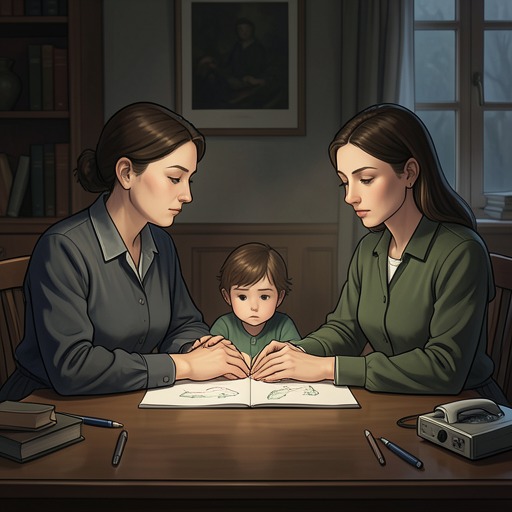
The conversation begins with Kathy speaking about Fay Hamilton’s birth. When she calls it traumatic and says it revived painful memories, Megan recognizes that Kathy may be carrying something she has not yet said. Megan recalls Kathy’s earlier observation that later labor tends to be quicker, then asks whether Fay was really Kathy’s first child. Kathy does not look at her, and at first struggles to answer.
Megan offers to keep what Kathy tells her private and makes clear that she is not expecting Kathy to present herself as perfect. That reassurance helps Kathy move past a silence she has maintained for years. The scene’s disclosure is not extracted by an investigation or a demand for explanation: Megan listens, identifies the opening in Kathy’s account, and invites her to speak without shame. Her gentleness establishes a contrast with the family judgment Kathy is about to describe.
Pregnancy and a Choice Denied
Kathy says she was seventeen, and that the pregnancy followed her first sexual relationship. She blames herself for trusting the person involved and says Mitch Hamilton does not know about the earlier daughter. Megan thinks of Chase Cooper as the likely father, but the passage presents that as Megan’s inference rather than a fact Kathy confirms in this conversation.
Kathy explains that her mother, Connie Hamilton, could not accept the prospect of her raising a child born outside marriage. Family reputation and the anticipated judgment of Connie’s church friends mattered to her mother; Kathy says the consequences of refusing to relinquish the baby were made clear. Keeping her daughter was not treated as an option, and Kathy also says that abortion was not available to her as a choice. She remembers taking months to tell her mother she was pregnant. Until she did, she had enjoyed the pregnancy, felt less alone, and sang to the baby. Once Kathy began to show, her mother told her father for her. Her father was so disappointed that he barely spoke to her until after the birth; afterward, her parents behaved as if the baby had never existed.
The birth itself was traumatic for Kathy because by then she knew she wanted to keep her daughter, while also believing her parents would not allow it. The adoptive family selected the child’s official name, which Kathy was never told. She had privately chosen Hope Hamilton, but never got to propose that name to the waiting couple. She recalls being allowed ten minutes with the baby before handing her to a case worker. The account’s specific details—the chosen name left unused, the short meeting, and the adoptive parents waiting nearby—show how little control Kathy had over the separation.
Grief Made Speakable
Kathy describes the months after the birth as a period of loneliness and emptiness. She knew her daughter did not live with her, yet found herself searching from room to room as if she might have misplaced her. She recalls the physical ache of wanting to hold and feed a baby, and says that having Fay later did not erase the loss. Instead, Fay’s milestones reminded her of the experiences she had missed with her first child, from a first step and first word to the first day of school.
Megan listens through her own tears and recognizes that she cannot offer a simple comfort. Kathy’s grief also changes how Megan understands the distress of people around her while Charlie is missing: the difficulty of finding words for someone else’s loss is no longer abstract to her. The exchange does not resolve Kathy’s grief, but it breaks the silence surrounding it and lets Megan witness it rather than guess at its existence.
The Secret’s Wider Consequences
Later revelations place Kathy’s disclosure within a longer pattern of family conflict and concealment. Kathy recalls that her therapist connected her food-related problems to the arguments she witnessed between her parents. Looking at Fay’s anxiety and need for therapy, Kathy fears that her own decision to conceal the harm in her marriage may have repeated the environment in which she grew up. She resolves to do better and to break that cycle. Her reflection extends the consequences of the earlier adoption beyond her own loss: family problems left unaddressed can shape how the next generation suffers and seeks help.
When Kathy later confronts Connie, she rejects her mother’s claim that the baby would eventually have destroyed the family. Kathy argues that Connie destroyed it by taking away her choice, and says that the decision affected Megan’s life as well as her own. She connects Connie’s control over her teenage relationship with Chase to the later course of her life, including her relationship with Evan Harris. This is Kathy’s understanding of the chain of events, not an independent confirmation that every consequence was inevitable. The confrontation also exposes the extremity of Connie’s continued betrayal: Kathy learns that her mother advised Evan to eliminate Megan and Charlie and hide the trail.
After the family secret and Connie’s actions come to light, names themselves become part of the family’s response. Fay says she no longer wants to be a Hamilton, and Kathy suggests Fay Carter as a new name. Mitch Hamilton is also ready to return to the Bowers name and begin again. These choices do not undo the adoption or restore the years Kathy lost. They mark, instead, a refusal to let the Hamilton name retain its former prestige after the family’s concealed harms have been exposed. Kathy’s disclosure to Megan is therefore both an intimate act of trust and a crucial piece of the larger reckoning with who was denied a choice, who kept the truth hidden, and what that secrecy cost.