Police Search the Bowers Home and Party Site
The Birthday PartyThe police search of the Bowers home and party site is the first urgent effort to examine the house itself after Charlie Hamilton disappears. Led by Chase Cooper late that night, it broadens the search beyond the yard and woods, where Charlie was last seen, and turns the remains of a family party into potential forensic evidence. The operation has to balance speed against the distress caused by officers entering a home after the children have been put to bed—and against the risk that evidence might be lost if the family tidies up.
Background and Urgency
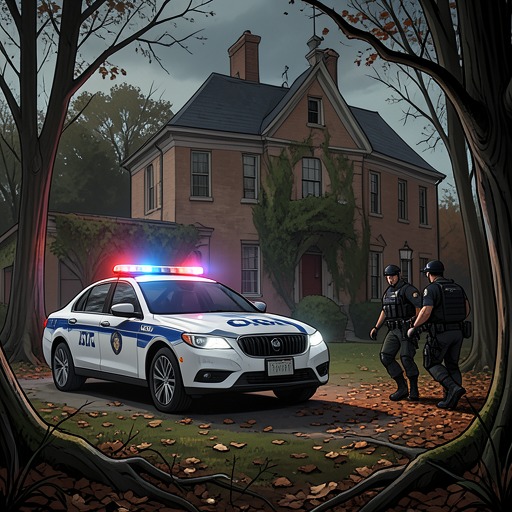
With Megan Carter in an ambulance bound for the hospital, Chase drives through the dark back to the scene of Charlie’s disappearance. The large house on Lexington Lane is lit from behind by floodlights as officers search the backyard; from the front, the house remains mostly dark, with light spilling from its windows and open doorway. The setting divides the property into active search space and a family home still occupied by people trying to make sense of the disruption.
Chase checks the time before going inside: 10:30 p.m. The hour matters because Scott Bowers and Cindy Bowers have young twins, and he considers how frightening a team of officers moving through their home might be. But waiting until morning could allow evidence to be destroyed, whether deliberately or inadvertently. His decision to search now is therefore not an assumption of guilt; it is a response to the possibility that ordinary household activity could alter what investigators need to examine.
From the Party Site to the Woods
Inside, Chase finds Detective Brown in a living room that smells of alcohol. Empty glasses cover nearly every surface, and potato chips have been ground into the wooden floor. The disorder is not simply a sign of a party that has not yet been cleaned up: every glass and food dish may yield DNA or fingerprints. Chase is relieved the room remains untouched, because cleaning could erase traces before investigators have had the chance to collect them.
The first accounts from party guests have produced little useful information. Alcohol has left some unable to remember when they arrived. Charlie, meanwhile, was last seen either on the pony or waiting in line to ride it. Nothing significant has been found in the yard. A K9 unit is searching the woods beyond, but the darkness makes that work hazardous: handlers do not want their dogs trapped or falling into water. A thorough search of the woods will have to wait until first light. The delay leaves a difficult gap in the nighttime operation: investigators can continue examining accessible spaces, but cannot safely complete the search of the surrounding terrain.
The House as Evidence
Chase directs Detective Brown to bring in the forensic team and have them dust glasses, plates, and door handles for prints. The aim is practical and specific: if someone who attended the party later denies having been there, investigators may be able to place that person inside the house. The search thus reaches beyond the question of whether Charlie entered the home; it also preserves material that might help establish who was present.
Chase explains the procedure to Cindy: examining the scene of a disappearance is standard, and it does not mean he suspects either host. Establishing whether Charlie was harmed inside could help rule the couple out as persons of interest and narrow the search for her. Cindy says she never saw Charlie inside during the party. Chase answers that the girl could still have slipped indoors to use the bathroom or watch television, despite having last been seen in the yard. The distinction is central to the search: last known location is a lead, not proof that she never crossed the threshold.
Household Disruption and Significance
Cindy is surprised when Chase asks the couple not to put anything away before the search is complete. She has cleaners scheduled for the following morning, which gives the forensic team time to work; if officers or dogs find evidence suggesting the house is a crime scene, she will have to cancel them. At this stage, the house is not technically a crime scene unless the search produces something to justify that status. The investigation proceeds under uncertainty, preserving the possibility of evidence without treating suspicion as a conclusion.
When the officers move inside, Cindy sees a German shepherd and asks whether they think there is a dead body in the house. Chase says a blood trail is one possibility, not an established finding, and apologizes for the inconvenience while emphasizing that he is trying to find his niece quickly. The exchange makes the search’s human cost visible: a procedure intended to protect the investigation looks, to the family living through it, like an alarming suggestion about what might have happened. By extending the search from the party’s yard into the home while postponing the dangerous woods search until daylight, Chase keeps the investigation moving without claiming that Charlie’s fate or the Bowers’ involvement is known.