The Second Clown Lead
The Birthday PartyThe Second Clown Lead is the moment Chase Cooper learns that Charlie Hamilton’s birthday party may have included an unidentified second clown. The discovery gives the investigation a new question to pursue: not simply when Charlie disappeared, but who had entered the party disguised behind a mask. It offers Chase a possible route toward identifying a person of interest, though nothing in the encounter establishes that the second clown was involved in Charlie’s disappearance.
How the discrepancy emerges
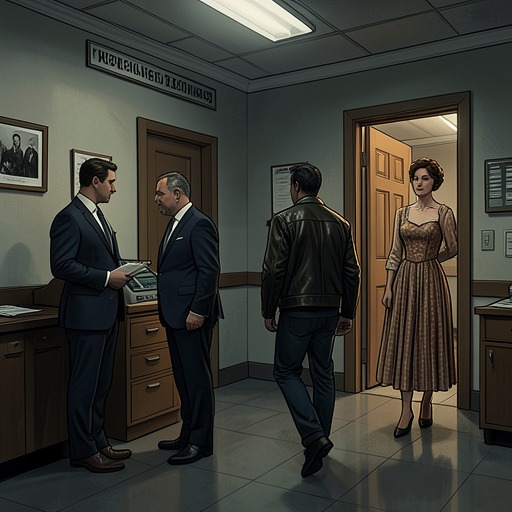
Chase’s conversation with Jim McClean begins with a familiar difficulty in the search: guests have said that Charlie was not present long enough to attract their attention. Jim likewise says he could not pick the missing girl out of a lineup and did not recognize her picture on the news. For Chase, the similarity among these accounts is useful. If Charlie went unnoticed by multiple guests, she may have been at the party only briefly, helping him narrow the time in which she was abducted.
Chase asks when Jim and his associate started and finished work. Jim’s confused response exposes the assumption built into the question: he has no associate. Chase then explains that another clown was present that afternoon. The important shift is from timing to identity. What Chase had framed as a routine question about the hired performers now points to a person whom the hired clown says he did not know.
Jim says that he works alone. He did briefly see another clown, but did not speak to him and assumed the woman who arranged the party had hired two performers. That explanation does not resolve the discrepancy: Cindy Bowers had given Chase the contact details for only one clown. The second performer was therefore not accounted for by the hiring information Chase had received.
The masked figure
The detail that sharpens the lead is not merely that there were two clowns, but that the second one wore a mask. When Chase asks whether Jim recognized him, Jim explains that the mask made recognition impossible. Chase contrasts it with the makeup clowns usually use, and Jim agrees that the masked performer must have been sweating beneath the rubber. He also says the man did not stay long.
Jim’s explanation remains a possibility, not an identification: if Cindy had not hired the second clown, perhaps one of the children’s fathers had dressed up for fun. In Jim’s view, the masked figure was not a professional clown. But that characterization does not tell Chase who the person was, why he wore the costume, or whether he was a parent. Chase’s instinct is that the detail deserves attention, and he asks how Jim knows the masked clown was a man—leaving open whether the performer could have been a woman.
The exchange makes the mask a practical obstacle as well as a clue. It explains why the performer could not be recognized while also distinguishing him from the clown Jim knew as the hired entertainer. Yet the evidence remains incomplete: Jim saw the figure only briefly, did not speak with him, and cannot supply an identity. The lead depends on finding someone else who can connect a guest to the costume.
From interview to urgent follow-up
After leaving, Chase contacts Detective Brown before getting into his hot car. He asks whether any of the guests interviewed so far have mentioned the clowns. Detective Brown reports that they have referred to only one. The contrast between the guests’ accounts and Jim’s brief sighting makes the second clown an investigative gap rather than a confirmed part of the party’s story.
Chase tells Detective Brown that there were apparently two clowns, and that the clown hired by Cindy did not know the other one. He asks for all the guests to be called again as a matter of urgency, with a specific question: does anyone know who wore the clown costume? Chase reasons that the mask makes a parent of one of the children a plausible possibility, but he does not treat that guess as settled. He also raises the alternative that, if the person was not a parent, the masked figure could be their suspect.
Detective Brown understands the possibility and says he will act straight away. Chase’s excitement is physical—his stomach flutters at the thought of having a possible suspect—but he checks himself: he does not want to get his hopes up. The distinction matters. The discovery has changed the investigation’s direction, but it has not yet produced a name or demonstrated guilt.
Significance and limits
The lead connects two kinds of uncertainty in Charlie’s disappearance. The repeated reports that Charlie was not noticed help Chase narrow the likely period of the abduction; the second clown raises the possibility that an unaccounted-for person was present during that period. By returning to the guests with a more precise question, Chase turns a small inconsistency into a testable line of inquiry.
The event ends without identification or resolution. Chase thanks Jim for his time, leaves with cat fur on his shirt, and moves directly from the interview to the call for renewed questioning. He then asks Detective Brown whether local registered sex offenders have been checked. That question signals the investigation continuing along another line; it does not establish any connection between such a check and the masked clown. The second-clown lead is therefore a consequential opening, not an answer: it makes the party’s apparent cast less complete and gives the police a concrete detail to verify.