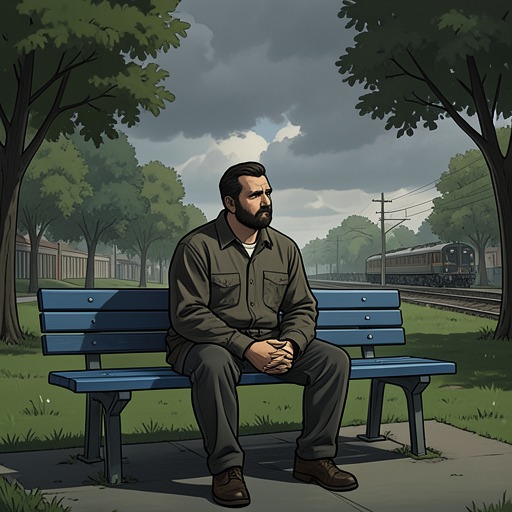
Boredom, Restlessness, and the Desire to Feel Alive
The Black-Eyed BlondeBoredom, Restlessness, and the Desire to Feel Alive name a tension that runs through Philip Marlowe’s encounter with Clare Cavendish: a quiet life can feel like confinement, while danger can briefly restore intensity. The idea is introduced through languid city routines and Marlowe’s uneasy domestic solitude, then made explicit when Clare explains why she became involved with Nico Peterson. Their different responses to restlessness keep the desire for stimulation from appearing either purely romantic or purely reckless.
The Texture of Boredom
The novel first makes boredom atmospheric. On a summer Tuesday afternoon, the city seems almost motionless: cars trickle past Marlowe’s dusty office window, pedestrians amble without apparent purpose, and the telephone seems conscious of being watched. The languor is not an abstract diagnosis but a rhythm built from stalled time and small observations. Marlowe watches a woman cross at Cahuenga and Hollywood, attending to her careful movements and clothes while the street itself seems to offer little to anticipate.
His recent work provides another measure of routine. He has spent a week guarding a nervous businessman without incident, then helped an older woman recover her late husband’s coin collection from her son. The jobs differ in character, but both end without a major disturbance. Marlowe has been paid and has done useful work; still, the narration presents the season as lean. The uneventful quality of the assignments makes the later prospect of Clare Cavendish’s case feel like a possible interruption, while his suspicion warns that excitement may come with a cost.
Clare’s Pursuit of Intensity
Clare gives the concept its clearest formulation when she says she wants Marlowe to trace Nico Peterson, not bring him back. She admits she is unsure she wanted him in the first place. The distinction matters: the object of her request is not simply reunion, but knowledge of where a missing lover has gone. Her uncertainty about wanting Nico complicates the conventional shape of a search for a lost partner and places her own motives under scrutiny.
Asked why she became involved with him, Clare answers that he represented danger. She says she gets bored easily and that he made her feel alive for a while, though in a compromised or shabby fashion. Her clownish, lugubrious expression as she makes fun of herself keeps the admission from becoming a solemn justification. She can recognize the undignified quality of her choice even as she explains its appeal. The episode therefore distinguishes excitement from happiness: danger supplies sensation, but it does not establish that the relationship was satisfying or that she wants it restored.
Marlowe says that he understands her explanation, while Clare recognizes that understanding does not mean approval. Their exchange leaves a measured gap between comprehension and endorsement. Her account is candid but not a complete explanation of the case; Marlowe remains suspicious of the circumstances in which she approached him. The desire to feel alive clarifies one part of her behavior without dissolving the mystery around it.
Marlowe’s Uneasy Independence
Marlowe’s own restlessness appears less as a pursuit of danger than as discomfort with settled life. He still lives in the house in Laurel Canyon, which its owner has allowed him to keep using after leaving for an extended visit to her widowed daughter in Idaho. He feels fairly settled on Yucca Avenue, with eucalyptus trees across the street, yet questions whether he wants to spend his days in a rented house where his chief possessions are a coffeepot and a faded ivory chess set. Stability is present, but it does not automatically feel like home or fulfillment.
The alternatives make that unease sharper. A beautiful, wealthy woman might marry him and take him away, but Marlowe insists on remaining footloose and fancy-free even when the phrase no longer seems to describe how he feels. His thought of Clare in Paris, nursing a bruised heart, places distance between them without resolving his attachment to the case or to her. He is not simply choosing freedom over intimacy; the passage shows that his preferred independence has its own loneliness and discomfort.
His evening routine underscores the contradiction. In a house that feels too empty, he brews strong coffee, drinks several cups, smokes, and paces rather than settling to chess. He values the game for its concentrated coolness and elegance of thought, yet on this evening cannot summon the heart for it. The contrast between chess’s controlled intellectual demands and his restless movement gives his boredom a particular shape: he wants steadiness, but cannot always inhabit it.
Restlessness as Motive and Risk
Clare’s attraction to Nico and Marlowe’s resistance to domestic permanence are not equivalent choices. Clare explicitly connects a lover with danger and temporary vitality; Marlowe describes an ongoing preference for being unencumbered while acknowledging that it feels less convincing than before. Placed beside each other, their positions reveal two forms of unease: seeking intensity through another person, and preserving mobility even when solitude becomes oppressive.
The missing-person inquiry binds these motives to the plot. Marlowe wonders why a woman like Clare would ask him to find a lowlife like Nico, and why she is not embarrassed to appeal to a private detective. He suspects he may be set up, despite being unable to say exactly why. Clare’s explanation makes her past attraction intelligible, but her refusal to ask for Nico’s return leaves the aim of the search open. Boredom thus functions not as a complete answer but as a pressure that prompts choices and raises questions about what those choices are meant to provide.
The novel’s treatment of the desire to feel alive remains deliberately ambivalent. Clare’s words acknowledge the pull of danger without turning it into a cure for dissatisfaction; Marlowe’s settled house and modest belongings show that an apparently chosen life can still feel confining. In both cases, restlessness makes ordinary arrangements newly visible: the quiet office, the rented home, the absent lover, and the possibility of leaving. The concept links these scenes through a shared dissatisfaction, while preserving the difference between seeking a dangerous relationship and guarding an independence that has begun to feel uncertain.