Clare Cavendish
The Black-Eyed BlondeClare Cavendish is a wealthy heiress, a client in Philip Marlowe’s search for Nico Peterson, and a woman whose explanations conceal more than they disclose. Born Clare Langrishe, she enters the investigation with a claim about Peterson that draws Marlowe toward a supposed death and, ultimately, toward Terry Lennox. Her divided attachments—to her mother, her husband, Marlowe, and the man she truly loves—give the case its intimate stakes; the ending makes clear that solving the mystery does not restore what its deceptions have damaged.
Identity and Background
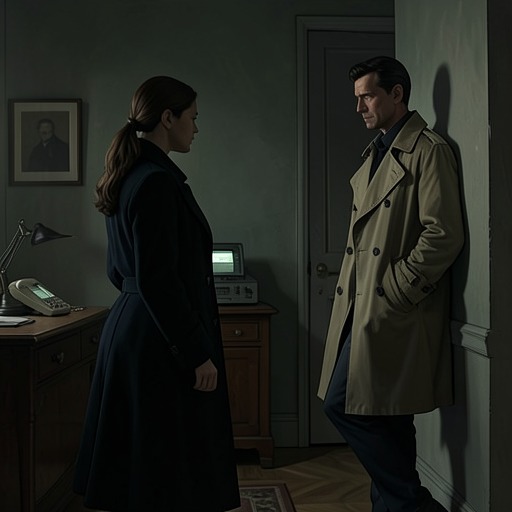
Clare first appears at Marlowe’s office on a slow summer afternoon. He notices her waiting to cross the street, then sees her enter in a cream jacket, navy skirt, gloves, and a small veiled hat. Her striking appearance makes an immediate impression on him, but she meets his gaze with an appraising steadiness rather than simply playing the decorative visitor. She introduces herself by the surname Cavendish, then later supplies the history behind it: her maiden name is Langrishe.
Her mother, Dorothea Langrishe, was a widow when she came from Ireland to the City of Angels with Clare and established Langrishe Fragrances, Inc. The business prospered, and Clare works with her mother—though Dorothea prefers to describe their arrangement as working together. Clare tells Marlowe plainly that the result is considerable wealth and offers to pay whatever he asks to find Peterson. Her money gives her the means to hire him, but it does not give her command over the truths he uncovers.
Clare’s marriage to Richard Cavendish is already marked by discomfort and imbalance. When she introduces Marlowe to Richard, her husband behaves with studied indifference and disdain toward the detective. Later, Clare explains that Richard tells her mother everything, leaving her sometimes feeling that he is married to Dorothea rather than to her. The complaint links the strained marriage to a larger family arrangement in which information and influence pass freely between Richard and Dorothea, while Clare feels displaced within her own household.
The Peterson Commission
Clare’s account of Peterson changes the meaning of her commission as it develops. She says he is dead, then explains that she came to Marlowe because she saw him in the street and he did not look dead. The statement is both the reason she gives for the search and the first sign that the official account of Peterson’s fate cannot be trusted. Marlowe later worries that he may have betrayed her confidence by telling Joe Green about her sighting, a decision he makes when he feels the investigation is going nowhere.
Clare also admits that she was present when Peterson’s death occurred. That disclosure makes her knowledge more consequential than a chance sighting: she has been close to the event whose apparent finality she is challenging. The narrative does not make her account a complete explanation of what happened, and her uncertainty keeps her positioned between witness and participant. Marlowe has to investigate the gap between a death she says she saw and a man she insists looked alive afterward.
She continues to seek Marlowe out beyond the formal commission. After Joe has left Marlowe’s home, Clare arrives alone in a red Alfa Romeo, wearing a light coat, head scarf, and dark glasses despite the darkness. Her arrival turns the professional connection into a private one: she knows where to find Marlowe and comes to speak with him away from the ordinary terms of the case. Later, at Langrishe Lodge, she asks him to come without letting others know. He cuts his headlights and waits beside the conservatory for her to appear through the mist. Her secrecy reinforces the sense that the investigation is bound up with relationships she cannot safely explain in public.
Marlowe and the Strain of Intimacy
Clare and Marlowe’s relationship moves beyond client and investigator, but neither can make it secure. At one point Marlowe thinks of her beside him and recalls her mouth against his; later, alone, he remembers that she had lain in his bed and the fragrance he associates with her hair. His attraction is not incidental to his conduct. He admits that he accepted her original story partly because he did not want her to leave his office and never return, even though he had not believed the lost-boyfriend explanation.
Marlowe’s desire to see her again sits beside a strong resistance to the future her wealth and status might imply. He compares her with Linda Loring, whose marriage proposals he has hesitated to accept, and tells himself that women of Clare’s kind are not for him. His thoughts after their intimacy swing between conviction that letting Clare go was right and recognition that he is grieving the possibility of losing her. When she begins gathering her cigarettes and putting on her hat, he asks her not to go; she trembles, but says she has an appointment. The scene leaves desire and separation unresolved rather than turning their attraction into a settled partnership.
Their final confrontation over Peterson makes the professional and emotional tensions collide. Marlowe asks Clare to level with him about Peterson, while still trying to understand rather than simply punish her. As she prepares to leave, his response is openly sorrowful: he feels he is losing someone precious, despite knowing that he never truly possessed her. His investment in her has grown from the attraction that first made him entertain her commission into a painful attachment, but it cannot make her disclosures complete.
Terry Lennox and the Hidden Story
The apparent explanation for Clare’s hiring of Marlowe is that Peterson was her lover and had disappeared. Near the end, Marlowe confronts her with his belief that this was a line designed to give her a reason to employ him. He says he never accepted it: from her description, he had judged Peterson to be someone she would not have chosen. Clare asks why he pretended to believe her, and Marlowe acknowledges that curiosity was only part of his reason; he also did not want her to walk out of his office and vanish from his life.
Marlowe’s accusation exposes how the commission served another purpose: Clare had been used by Terry Lennox to bring Marlowe into the search. Yet the revelation does not reduce her attachment to a mere device. When Marlowe calls Terry out from concealment, Clare signals silently that he should not say something aloud. Marlowe understands her request and chooses not to add to the damage already done. He is desperate to believe that her intimacy with him came from her own desire, rather than being another act performed for the man she really loved; the narrative preserves that uncertainty rather than supplying a reassuring answer.
The uncertainty ends only in part when Terry is killed. After Everett Edwards III shoots him, Clare enters, sees the scene, pushes her brother aside, and kneels to cradle Terry’s head in her lap. She says nothing and does not weep. For Marlowe, that silent act makes her love plain: her grief confirms what her evasions and appeals could not settle. The revelation recasts her earlier conduct without making it simple. She could deceive Marlowe about the premise of the search and still be genuinely devoted to Terry.
Ending and Narrative Role
Clare’s final appearance concentrates the conflict between family loyalty, romantic attachment, and the consequences of concealment. Terry’s death comes at the hands of her brother, and she responds not by addressing Marlowe or defending Everett but by going directly to Terry’s body. Her posture—kneeling and holding his head—supplies the emotional truth that her words have repeatedly withheld. Marlowe, holding the gun after disarming Everett, denies that he fired the fatal shot; Clare’s focus remains on the man she has lost.
The case does not end with a clean exchange between investigator and client. Clare never pays Marlowe for the work she hired him to do. That unpaid debt is a concrete remnant of an investigation in which the stated bargain never captured the real entanglements: Peterson’s uncertain fate, Terry’s use of Clare to reach Marlowe, and the detective’s own attachment to her. Clare therefore stands at the center of the story’s repeated separation between appearance and feeling. She begins as a wealthy client who can name her price, but ends beside a dead lover, with neither money nor explanation able to undo the consequences of what was hidden.