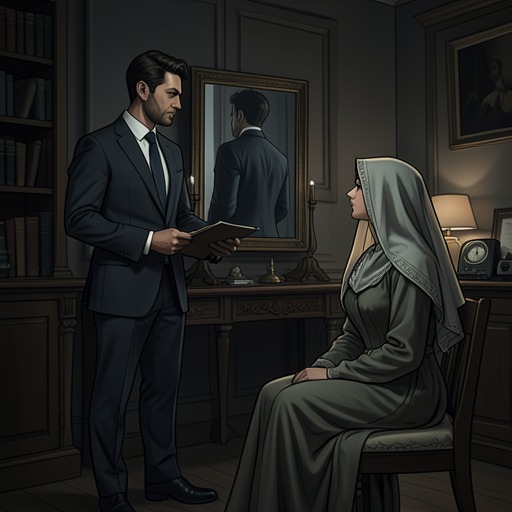
Clare Cavendish commissions Marlowe to investigate Nico Peterson
The Black-Eyed BlondeClare Cavendish commissions Philip Marlowe to investigate Nico Peterson after reporting that she saw the man, presumed dead, alive in San Francisco. The request sets the novel’s central inquiry in motion: what begins as a private search for a missing lover becomes a case involving an uncertain death, dangerous violence, and Marlowe’s growing suspicion that his client’s account is incomplete.
The Commission and Its Circumstances
The encounter begins during a quiet summer Tuesday in Marlowe’s office, when business has been lean. His recent work has included a week as a bodyguard for a visiting businessman and recovering a rare coin collection for an elderly woman, a job arranged through Bernie Ohls. Against this ordinary professional background, a woman crosses at Cahuenga and Hollywood and enters Marlowe’s office without knocking. The contrast between the slow day and the case that follows gives the commission the quality of a sudden interruption in an otherwise stalled routine.
Marlowe later describes the initial request as familiar: Clare came to his office asking him to find her missing boyfriend. He had reservations, but accepted the assignment. At first, the apparent problem seemed to be the commonplace disappearance of a man who had withdrawn from a relationship rather than explain himself. That assumption mattered because it gave the case a simple shape: an absent boyfriend, a concerned client, and a private detective asked to locate him.
A Report That Changes the Case
The commission’s decisive complication is Clare’s claim that she saw Nico alive on Market Street in San Francisco. Until then, Marlowe says, his client and everyone else believed Nico was dead; his stated assignment was to investigate the death because there was a question about whether it had actually occurred. Clare’s reported sighting therefore changes the inquiry from a search for a missing man into an investigation of a presumed death and a possible concealed identity.
Marlowe makes clear that his knowledge at this point is limited. He has spoken to a few people, including Nico’s sister, but that conversation lasted only a few minutes before two men from the south interrupted it. His account emphasizes how little he can establish directly, even as the case begins to attract violence. In retrospect, the sighting is the hinge on which the assignment turns: without it, Nico’s presumed death might have remained settled; with it, Marlowe is sent back onto a trail whose facts do not fit together.
The Investigation Broadens
As Marlowe recounts the case to Clare, he describes a sequence of reversals. He accepts the search, learns that Nico has supposedly died, and then has to reconsider that conclusion when Clare says she saw him walking in San Francisco. He resumes the investigation, only to find that people are being killed and that he himself has more than once nearly been killed. The commission thus carries consequences well beyond locating its subject: it draws Marlowe into a widening chain of danger and makes the original explanation increasingly difficult to accept.
Later, Marlowe’s working reconstruction supplies a possible criminal background to the missing-person case, though he presents much of it as inference rather than established fact. He suspects that Nico, a rich man’s son who had failed in the agenting business, became involved with the wrong people. Marlowe believes Nico may have taken a valuable shipment of contraband being carried from Mexico in a suitcase for Lou Hendricks, and suspects that Floyd Hanson helped provide a substitute corpse to support Nico’s apparent death. He further supposes that Wilberforce Canning may have believed Nico was dead, while Gómez and López came north to reclaim the goods they considered theirs. These theories make the commission’s original question—where Nico is—part of a larger one about who staged his disappearance and who stands to recover the missing shipment.
Trust, Doubt, and the Unfinished Account
The assignment also tests Marlowe’s professional loyalty. After telling Joe Green that Clare had reported seeing Nico alive, Marlowe sits alone and wonders whether he has betrayed her confidence by bringing the police into the matter. He recognizes that involving Joe may have been an attempt to break a deadlock, but still questions whether he should have followed Nico’s trail further before sharing the information. The private commission therefore creates a conflict between discretion toward a client and the practical need to pursue a case that has become dangerous.
By the time Marlowe confronts Clare, he no longer accepts the simple missing-boyfriend explanation. He asks her to level with him because the case has changed from what it seemed at the start, and he believes she is the piece that does not fit. His suspicion is sharpened by their personal involvement: he recalls that she has been in his bed, while also insisting to himself that a wealthy woman like Clare is not someone he is suited to. Attraction and distrust coexist, complicating the professional relationship without resolving its central uncertainty.
The commission’s significance lies in its refusal to stay within the boundaries Clare’s first request appears to set. Her report gives Marlowe a reason to reopen the question of Nico’s death; the ensuing danger forces him to question both the facts and the person who hired him. Yet the investigation does not deliver a clean exchange of service for certainty. Clare never pays Marlowe for the work he was hired to do, and the case leaves him with a sharpened suspicion rather than a fully reconciled account of her motives.