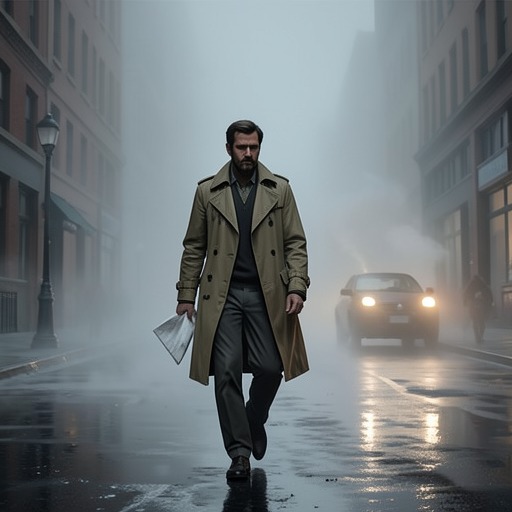
Clare claims she saw Peterson alive in San Francisco
The Black-Eyed BlondeClare Cavendish’s claim that she saw Nico Peterson alive in Frisco overturns the apparent certainty of his reported death and gives Philip Marlowe’s investigation its central contradiction. She says she recognized Peterson walking on Market Street the previous week, but later says she was present when he died. The encounter establishes neither what happened to Peterson nor which part of Clare’s account can be trusted; instead, it makes the gap between a declared death and a witnessed living person the mystery itself.
The Death Marlowe Reports
The exchange begins with Marlowe trying to tell Clare what he has learned. He warns that there is no easy way to put it, then looks down at his hat on the table before stating, “Nico Peterson is dead.” He starts to explain that Peterson died two months earlier in a hit-and-run, but breaks off when Clare answers, “I know.” Her reply reverses the expected direction of the conversation: Marlowe is not the first to tell her of the death, and her knowledge demands an explanation before he can finish his report.
Clare does not immediately explain why she already knows. She turns away, touches the glass her husband has drunk from, moves it an inch, and returns it to its own damp ring. The small, controlled adjustment precedes her admission that she should have told Marlowe. Asked why she came to him if she knew Peterson was dead, she waits in silence, apparently judging how to put her answer. The pause marks the claim as consequential: she is not simply correcting Marlowe’s information but revealing why the official account cannot settle the case.
The Frisco Sighting
Clare says she saw Peterson on the street and insists that he “didn’t look dead at all.” When Marlowe asks where, she recalls Frisco, where she had gone on business for the firm. On Market Street she was riding in a taxi when she saw Peterson walking along the sidewalk. She recognizes him through a familiar manner of movement: he seemed to be in a hurry, apparently on his way to see someone. Her faint laugh accompanies this remembered detail, but it does not resolve what the sighting means or whom Peterson might have been visiting.
Marlowe asks when the encounter happened. Clare pauses to think, then places it on Friday of the previous week. That timing is the crucial pressure on the earlier report: the sighting is not an indistinct memory from before Peterson’s presumed death, but an asserted observation from long after the hit-and-run two months earlier. Clare gives a specific city, street, setting, and day, yet the account remains hers; the scene supplies no independent confirmation that the person in the taxi’s view was Peterson.
A Testimony That Complicates Itself
The later question about Clare’s knowledge of Peterson’s death sharpens rather than clears the contradiction. As Marlowe is preparing to leave, he asks how she heard of the death. Clare responds casually, “I was there when it happened.” The statement cannot be comfortably reconciled with her earlier report of seeing Peterson alive the previous week. The encounter offers no clarification about what she witnessed, how she understands the two statements, or whether either account is incomplete. Its force lies in leaving both claims in play.
That unresolved tension distinguishes Clare’s testimony from a simple revelation that Peterson survived. Her Frisco account challenges the presumption that the hit-and-run ended his life, while her claim to have been present at his death appears to support the very conclusion the sighting unsettles. Marlowe’s surprise when she first says she already knows Peterson is dead, and his return to the subject as he leaves, frame the exchange as the beginning of an inquiry rather than its answer.
Narrative and Investigative Significance
The information arrives in stages. Marlowe first names the death; Clare’s “I know” interrupts his explanation; only after he asks why she hired him does she disclose the sighting. Her later remark about being present at the death arrives as Marlowe is leaving, after the Frisco account has had time to stand as an apparent contradiction. This order makes the conversation itself a piece of investigative evidence: each answer changes the meaning of the one before it, while withholding the reconciliation Marlowe needs.
Clare’s account therefore transforms a reported fatal accident into a problem of identity, observation, and credibility. Peterson is officially dead in Marlowe’s report, recognizable and apparently alive in Clare’s recollection, and also connected to a death she says she witnessed. The evidence does not establish that he staged his death, that Clare misidentified someone, or that her final statement refers to a different event. What it establishes is narrower and more consequential: Clare’s reason for seeking Marlowe is bound to an apparent sighting after Peterson’s death, and her own account makes that sighting harder, not easier, to explain.