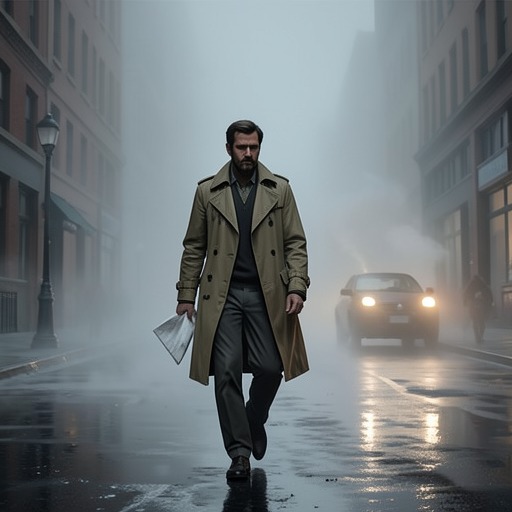
Death, Disappearance, and Identity
The Black-Eyed BlondeDeath, Disappearance, and Identity is the novel’s governing mystery: Nico Peterson has been officially declared dead, yet Clare Cavendish says she saw him alive after his supposed death. The contradiction unsettles the apparent facts of the case, making the dead man’s identity as uncertain as Peterson’s whereabouts. As Philip Marlowe tests what the police record, witnesses, and his client can establish, death becomes both a reported event and a claim that still requires proof.
The Official Account and Its Evidence
The first account comes from Joe Green, who telephones Philip Marlowe the morning after Marlowe asks about Peterson. Joe reports that Peterson died on April 19 in a hit-and-run in the Palisades, near a local club. He adds that the body is buried at Woodlawn and that he has the plot number. The precision of a date, cause, and burial place gives the report the solidity of an administrative fact; Joe even imagines that Clare Cavendish might visit the grave.
That account appears to have more than a grave behind it. Joe later tells Marlowe that the dead man carried Peterson’s wallet and had been identified at the scene by the club’s manager. In a separate conversation, an interlocutor insists that he saw Peterson on the road that night and could not have mistaken him. He adds that Peterson’s sister was shown the corpse the next day and expressed no doubt about its identity. Wallet, witness, and family recognition seem to reinforce one another, but each is still a piece of testimony. The question is not merely whether a man died; it is whether these signs establish that the man was Nico Peterson.
Clare Cavendish’s Contradiction
When Marlowe tells Clare that Nico Peterson is dead, she answers that she already knows. Her knowledge initially makes the news seem less like a revelation than a fact she has concealed. But when Marlowe asks why she hired him if she knew Peterson had died, she gives the reason that reopens the case: she saw him in the street recently, and he did not look dead. Her claim does not explain how Peterson could have survived, nor does it prove that the man she saw was him. It does, however, put a living sighting against the official record.
Clare’s statement also changes what Marlowe’s assignment means. He is no longer simply checking the disappearance of a man presumed dead; he must consider whether the death itself was mistaken, staged, or attached to someone else. His first response is to tell Joe that Clare thinks Peterson is still alive and that the man killed on Latimer Road may not have been Peterson. The distinction between an identified body and the person whose name it carries becomes the case’s central problem.
Marlowe Tests the Story
Marlowe makes the uncertainty explicit in his questions to Joe: if Peterson did not die, who was killed, and was the collision truly an accident? Joe turns the possibilities over and asks whether Peterson arranged the event to disappear. Marlowe does not endorse that theory; he says he does not know what to think. That hesitation matters. The evidence supports suspicion, not a settled explanation, and the detective’s task is to keep the alternatives open without turning one into a fact prematurely.
His decision to involve Joe is itself compromised by the client relationship. After sharing Clare’s sighting, Marlowe sits in his office, trying not to think about whether he has betrayed her trust by telling a police contact before following Peterson’s trail further. He recognizes the choice as a possible mistake, even while reasoning that an investigation stalled by uncertainty may require a forceful move. The identity question therefore bears on more than the evidence: it tests how Marlowe balances a client’s confidence against the practical need to investigate.
The competing testimony does not resolve that tension. One account combines the wallet, the manager’s identification, and the sister’s recognition into a case for the dead man being Peterson. Another insists that Peterson was unmistakably present at the roadside. Against these certainties stands Clare’s later sighting, which the person Marlowe questions dismisses as someone other than Nico. The record is consequently crowded with confident identifications but lacks, in the evidence presented here, a decisive demonstration that reconciles them.
Death, Identity, and the Novel’s Open Question
The mystery’s force comes from the distance between a name and the evidence used to attach it to a body. A wallet can link a corpse to Peterson; a witness can claim recognition; a sister can accept what she is shown. Yet Clare’s report makes those confirmations vulnerable to renewed scrutiny. The novel does not treat a death report as self-authenticating simply because several signs appear to agree. Instead, each apparent confirmation becomes part of the inquiry into who died and whether Peterson’s disappearance was made to look like death.
The narrative’s presentation reinforces that uncertainty. The case begins in a languid summer office, with Marlowe watching a woman cross the street and waiting for the telephone to ring. Soon afterward, a telephone call supplies a crisp date and burial place; later, another street sighting undermines the apparent finality of that information. The movement from ordinary city observation to official report and contradictory recognition makes identity something assembled from partial accounts rather than plainly visible. Marlowe’s first-person investigation keeps the reader close to his questions, but his admission that he does not know what to think prevents his perspective from becoming a final verdict.
The subject also touches the novel’s wider concern with people whose public stories do not settle who they are. In a late-night recollection, Marlowe thinks of Clare and of Linda Loring, whose expectation that love should lead to marriage he resists; he also remembers the violent death of Linda’s sister after her marriage to Terry Lennox. These reflections do not solve Peterson’s case, but they place the mystery amid relationships marked by loss, concealed histories, and uncertain commitments. The author’s note records The Black-Eyed Blonde among Raymond Chandler’s possible titles for future works, a detail that places the book itself among possibilities without explaining the mystery. In the evidence presented here, Peterson’s supposed death remains a pressure point rather than a closed conclusion: a grave and several witnesses support one identity, while Clare’s sighting keeps another possibility alive.