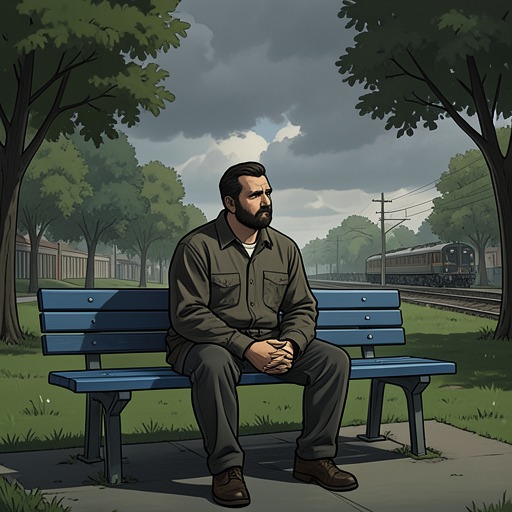
Everett Edwards III’s heroin addiction and overdose
The Black-Eyed BlondeEverett Edwards III’s heroin addiction becomes an immediate medical emergency when Clare Cavendish finds him unconscious in her bedroom. The episode makes visible a longer-running habit that his family has kept partly concealed: Clare knows of his drug use, Richard Cavendish threatens to disclose it to their mother, and Nico Peterson had once supplied him. Dr. Loring’s examination establishes the seriousness of the overdose, but the scene offers no account of Everett’s longer-term recovery or of whether he follows the advice to seek treatment.
Evidence of an Established Habit
When Marlowe sees Everett, he is unconscious, and visible marks on his arm indicate repeated injections over time. Clare says that Everett has taken something and later identifies heroin as what she thinks he used. The marks, together with her acknowledgement that he has been using drugs, distinguish the crisis from an isolated first encounter with narcotics. Marlowe also judges that some of the marks are old, though neither he nor Clare can establish the full history of Everett’s use.
The limits of what Clare knows are significant. Asked where Everett gets drugs, she says she does not know his present source. She can identify an earlier connection: Nico Peterson used to obtain drugs for him now and then, and Everett’s introduction of Nico was how Clare first met him. The account therefore links Everett’s private habit to the wider relationships around the Peterson investigation, without establishing that Nico supplied the heroin involved in this particular overdose or that Everett’s current supply came through the same route.
The Overdose at Home
Clare finds Everett after he has apparently wandered through the house and collapsed on the stairs. She says he has been in that condition for perhaps an hour, though she is unsure. She gets him into her own bedroom, rather than his, and calls Marlowe for help. Her immediate concern is whether her brother is dying. She has not called a doctor before Marlowe arrives and says she did not dare; the reason for that hesitation is not explained in the scene.
The episode is presented through the contrast between Everett’s vulnerable condition and the composed domestic setting around him. Clare stays beside him and tries to manage the emergency, while Marlowe assesses the situation and seeks medical help. Her statement that this has happened before, but never this badly, supplies the clearest measure of escalation: the overdose is not the first sign of his drug use, but it is the first episode she describes as so severe. At the same time, the approximate hour and Clare’s uncertainty leave the precise course of the emergency unresolved until Dr. Loring examines him.
Family Secrecy and Relationships
Everett’s addiction is hidden within a family structure in which information can be used as leverage. Clare says Richard threatens to tell their mother about the drugs when he is angry with her. She understands the threat as one of several ways Richard holds power over her, and fears that the disclosure would break their mother’s heart. The episode thus places Everett’s substance use inside a larger pattern of concealment and strained family relations, rather than presenting it only as an individual medical problem.
Clare’s actions also show the burden that secrecy places on her. She has to respond to the immediate danger while managing what other family members know, and she has not yet summoned a doctor when Marlowe arrives. The narrative does not specify that fear of disclosure caused this delay, so the two facts remain distinct: the family keeps the addiction from their mother, and Clare hesitates to call for medical help. Her distress when she asks Marlowe whether Everett may die makes clear that the emergency is personal as well as practical.
Nico’s former role as a source adds another connection without resolving the chain of supply. Everett introduced him to Clare, and Nico sometimes obtained drugs for Everett. Clare’s present lack of knowledge about the supplier separates that past relationship from the current overdose. The scene establishes a relevant history but does not identify a present dealer, explain how Everett’s habit developed, or assign Nico responsibility for the crisis.
Medical Assessment and Immediate Outcome
Dr. Loring examines Everett and asks whether the drug was heroin; Clare says she thinks it was. He checks Everett’s pulse, pupils, and chest, then gives him an injection of adrenaline. Loring reports that Everett’s heart rate is below fifty and his breathing rate below twelve, and judges that he had been close to death for a period that night. His assessment turns Clare’s fear into a specific medical warning: Everett’s youth and relative health have helped him survive this episode, but Loring believes continued heroin use is likely to kill him.
Loring does not treat the immediate response as a sufficient solution. He urges Clare to get Everett into a clinic and offers to provide names and places to contact, warning that otherwise she will lose him. Everett stirs and groans after the injection, indicating a response to the intervention, but the episode does not confirm that he has recovered fully, entered treatment, or stopped using drugs. Loring gives Clare his card and asks her to call the following day; the longer-term result is left open.
Narrative Significance
The overdose changes the status of Everett’s addiction from concealed family knowledge to an unmistakable crisis witnessed by Marlowe and treated by a doctor. Its presentation balances the uncertain account of the drug and its source with the precision of Loring’s observations and warning. That difference matters: the scene cannot explain how the habit began or who supplied this dose, but it makes the immediate danger impossible for Clare to dismiss.
The episode also complicates the investigation’s network of connections. Nico’s earlier provision of drugs helps explain how Clare met him, while her ignorance of Everett’s current source prevents the overdose from neatly resolving the larger questions around Nico. Everett’s condition has its own stakes, independent of those investigative leads. By ending on medical advice rather than a declared recovery, the narrative preserves the distinction between surviving an emergency and confronting an addiction that remains untreated.