Joe Green
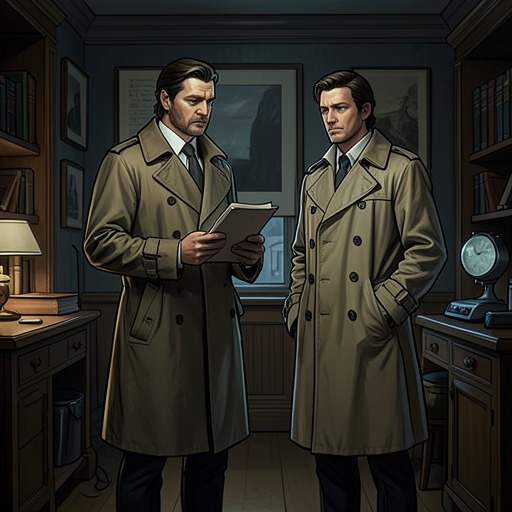
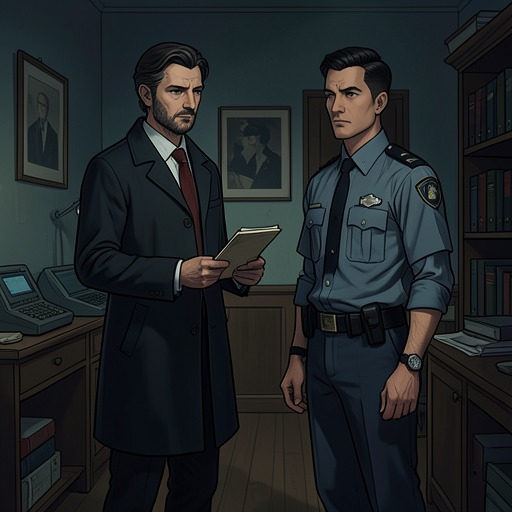
The Black-Eyed BlondeSergeant Joe Green is a Central Homicide detective and an important, if wary, source of help to Philip Marlowe. His role in the investigation of Nico Peterson’s disappearance is practical rather than dramatic: he checks records, reports what the police know, and points Marlowe toward the next step. Yet the information he relays also exposes how uncertain the official account of Peterson’s death is. Later, when Marlowe calls for help at Langrishe Lodge, Joe again arrives promptly, but finds himself outside the familiar conditions of his police work.
Identity and Working Relationship
Joe and Philip Marlowe have a history that makes their cooperation guarded. Marlowe recalls that Joe once briefly considered charging him as an accessory to first-degree murder, an episode that created a bond without making them friends. Marlowe describes them instead as wary acquaintances. Joe is a good detective, but Marlowe also sees him as experienced to the point of weariness, with a narrow appetite for inquiries that do not yet present a clear crime.
That reserve shapes Joe’s first response to the Peterson matter. When Marlowe calls late and supplies Nico Peterson’s name, number, and address, Joe does not recognize the name. He suspects the missing man may belong to one of Marlowe’s divorce cases, then reminds Marlowe that he could simply go to Peterson’s address. Marlowe refuses to identify the woman who hired him, explaining that the matter is private and no crime has been established. Joe nevertheless agrees to check the records, though his interest appears limited.
Their exchanges also reveal a familiar informality beneath the professional caution. Marlowe jokes about Joe’s long hours and later asks him to meet for a beer. Joe initially responds suspiciously, but he does meet him. That combination—suspicion, banter, and eventual assistance—defines a relationship neither entirely friendly nor merely official.
The Peterson Records and Their Limits
Joe calls Marlowe the next morning with a consequential result: Nico Peterson is recorded as dead. The records place his death on April 19, in the Pacific Palisades, near a local club, and classify it as a hit-and-run. Joe adds that Peterson was buried at Woodlawn and even has the plot number. His report gives Marlowe a firm institutional account to investigate, but it does not establish that the account is correct.
Marlowe later examines the coroner’s file. It states that an unknown vehicle struck Peterson on Latimer Road between eleven at night and midnight on April 19, and records blunt-force trauma as the cause of death. The file includes a photograph from the scene. Joe has supplied the basic police conclusion; the file gives Marlowe a more exact time and location, without identifying a driver or resolving the central question of identity.
When Marlowe asks whether the body can be exhumed, Joe suggests that it might be possible. Marlowe then tells him the remains were cremated. The proposed check against the body is therefore unavailable. This exchange illustrates the practical limits on verification: the death certificate and police file provide a settled answer, but one of the most direct ways to test that answer is no longer open.
Joe also reports that Peterson’s wallet was in the dead man’s possession and that Floyd Hanson, the manager of the Cahuilla Club, identified him at the scene. Those details initially appear to reinforce the identification. But when Marlowe questions Hanson, the manager distinguishes seeing the body from officially identifying it: he believes Peterson’s sister made the formal identification at the morgue the following day. The chain of knowledge is thus less straightforward than Joe’s summary suggests. Joe passes on the available report; Marlowe’s follow-up separates an identification at the scene from the official act, while leaving the sister’s identification and the recorded death in place.
Cooperation Across Jurisdictions
Joe continues to assist as the investigation develops, but his help has boundaries. After two men attack Marlowe at Nico Peterson’s residence and abduct Lynn Peterson, Marlowe calls Joe from home. Joe is skeptical of the account and asks why the abductors would take her. Marlowe cannot say. Joe recognizes that the case falls outside his jurisdiction and tells Marlowe that he will have to involve the Los Angeles County Sheriff's Office. He recommends contacting Bernie Ohls, while acknowledging that Marlowe and Ohls are not exactly friends.
Marlowe asks Joe to make that call for him, explaining that he is not in good condition to manage the conversation. Joe agrees, but warns that Ohls will expect a coherent account. The exchange shows Joe acting as a bridge between Marlowe and another law-enforcement office rather than claiming authority over the matter. He does not resolve the kidnapping or pretend to know its motive; he directs the report toward the agency with jurisdiction and prepares Marlowe for the scrutiny that will follow.
The case also draws on an earlier episode in Marlowe’s history with Terry Lennox. After Lennox fled to Tijuana following his wife’s murder, Joe was waiting for Marlowe when he returned. Marlowe was taken in as an accessory and held for a couple of nights before being released after news of Lennox’s purported suicide. The account makes clear that the arrest and its consequences shaped Marlowe’s sense of what he owed Lennox. Joe is part of that institutional response, although the evidence does not establish that he personally directed the rough treatment Marlowe received from Joe’s superior.
The Final Response at Langrishe Lodge
At the end of the novel, Marlowe chooses to call Joe rather than Bernie Ohls after the shooting at Langrishe Lodge. He expects Joe to be more approachable: they can drink beer, joke, and talk about baseball. Joe is on duty, as usual, and arrives about twenty minutes after the call, accompanied by two patrol cars. His prompt arrival contrasts with his earlier hesitation over a missing-person inquiry: once a violent emergency is reported, he responds directly.
The scene is unfamiliar terrain for him. Joe surveys the room and appears out of his depth; Marlowe observes that he is accustomed to tenement stairways, forced entries, and confrontations with street-level suspects. The situation at Langrishe Lodge instead resembles, to Joe, a country-club affair that has gone badly wrong. That contrast does not mean he refuses the work. He examines the scene, looks from Terry Lennox to Everett Edwards III, and asks Marlowe for an account of what has happened.
Joe initially addresses Clare Cavendish as Mrs. Langrishe. Marlowe corrects him, giving her married name, and Joe proceeds to have a patrolman take her from the room. The officer gives her a blanket and leads her away. Joe then tells Marlowe that he will need to come downtown and file a statement. Marlowe asks to go home and return the next morning; Joe is uncertain whether to grant the request, leaving the immediate exchange on an ordinary procedural question rather than a dramatic resolution.
Narrative Role
Joe provides a point of contact between Marlowe’s private investigation and official police procedure. His records make the presumed death of Nico Peterson seem established, while the gaps in those records—an unidentified driver, a body Marlowe cannot examine, and differing accounts of who identified it—keep the question open. Joe is neither the source of the mystery’s solution nor an obstacle who blocks the investigation. He supplies information and practical direction, while Marlowe tests what that information can actually prove.
His characterization also develops through contrast. Marlowe sees an experienced officer worn down by years of exposure to crime, but the two retain enough familiarity for humor and mutual favors. Joe’s skepticism can frustrate Marlowe, yet he checks the records, relays what he finds, offers a possible means of verification, and helps connect Marlowe with the sheriff’s office when jurisdiction requires it. At Langrishe Lodge, his uncertainty in an elite domestic setting exposes the social distance between his usual work and the people involved, even as his arrival and insistence on a statement restore the case to ordinary police procedure.