Nico Peterson's staged death
The Black-Eyed BlondeNico Peterson's staged death was a substitution designed to make his disappearance look like a fatal hit-and-run. An unidentified club worker's body, dressed in Nico's clothes, was left on Latimer Road while Nico escaped north with a suitcase. The later account of the scheme unsettles the official record of his death: the body had been reported, examined, and identified, yet the identification had been part of the deception.
The Official Account
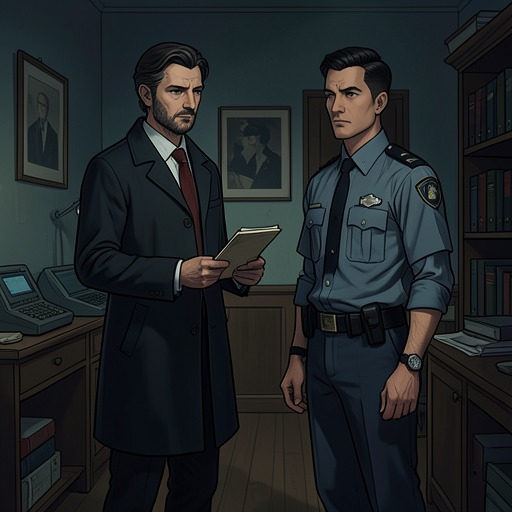
The apparent death was dated April 19. Joe Green told Philip Marlowe that Nico had died that night in a hit-and-run near a club in Pacific Palisades, and said that he was buried at Woodlawn. The report Marlowe later examined placed the collision on Latimer Road, between eleven o'clock and midnight, and recorded blunt-force trauma as the cause of death. It also included a photograph taken at the scene. These details gave the presumed death the authority of a police file and a burial record, even though the victim's identity was false.
The identification chain appeared to reinforce that conclusion. A witness who had been at the scene told Marlowe that he had not officially identified the body; he believed Nico's sister had done so at the morgue the following day. When Marlowe challenged him, he emphasized that he had seen Nico on the road and that Nico's sister had expressed no doubts. Marlowe's contrary information—that someone had recently seen Nico alive—made the confidence of those accounts itself a source of suspicion.
How the Substitution Was Arranged
Nico later told Marlowe that the body had belonged to a roustabout who worked at the Cahuilla Club. He denied killing the man and said he had not asked Floyd Hanson about the body's origin; he had assumed the man had died naturally because he saw no marks. The account therefore establishes the body's substitution and Hanson's participation, but does not establish who caused the roustabout's death.
Hanson helped Nico put the body into Nico's suit behind the clubhouse. They then carried it in a wheelbarrow to the road. Nico had spent the evening acting drunk and making sure people saw him, so that witnesses would connect the apparent victim with the person they had watched at the club. Clare Cavendish was among those present. The staged scene depended not only on clothing but on the manufactured continuity between Nico's public appearance and the body found afterward.
Nico had also arranged the aftermath with his sister, Lynn Peterson. He said that he had fixed it with Lynn to identify the body and arrange for cremation. Those plans were meant to close off further scrutiny and complete the appearance of a confirmed death; the account establishes the arrangement, not whether every planned step was carried out. Once the body had been left by the road, Nico drove away in a car he had parked farther down the road, with the suitcase in its trunk, and headed north.
Exposure and Unresolved Details
The scheme was revealed during Marlowe's questioning of Nico, turning what had been treated as a settled death into a concealed escape. The surviving official details—date, location, medical cause, photograph, and family identification—did not prove that Nico had died. Instead, the confession showed how each could be made to support a false identity when the body, clothing, witnesses, and planned disposition were coordinated.
Important uncertainties remain. Nico said that he did not know who the roustabout was and had not asked Hanson about him. Although Marlowe inferred that Hanson must have killed the man, Nico's account did not confirm that inference. Nor does the confession establish that Lynn knew the body was not her brother; it establishes that Nico had arranged for her to identify it and plan a cremation. The deception is clear, but responsibility for the roustabout's death and the full extent of the other participants' knowledge are not.
Narrative Significance
The staged death makes identity a matter of evidence and procedure rather than appearance alone. A suit, a body placed on a road, a witness's recollection, a sister's identification, and an official file combined to make the false conclusion persuasive. The story first presents those records as confirmation, then reveals that they were elements in Nico's escape plan. The reversal does not erase the evidence; it changes what the evidence can be said to establish. Nico's supposed death is thus both a practical disguise and a test of how readily a documented account can be mistaken for the truth.