Philip Marlowe
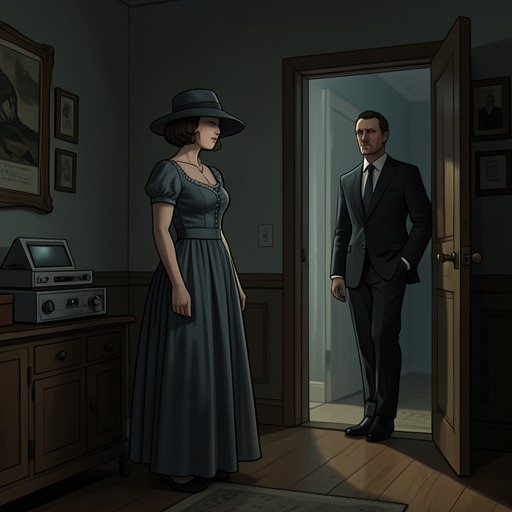
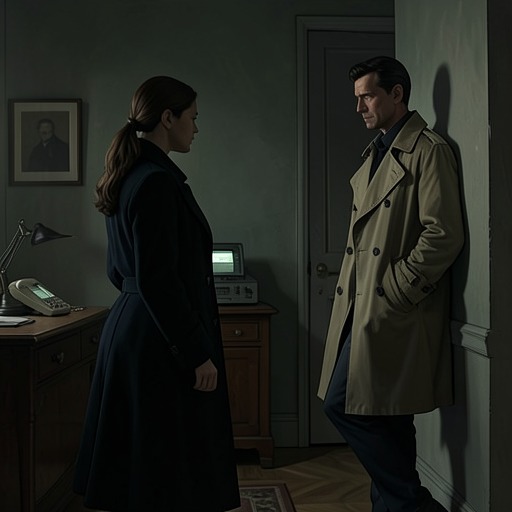
The Black-Eyed BlondePhilip Marlowe is the private detective and first-person narrator of The Black-Eyed Blonde, a new Bay City case that turns on whether Nico Peterson is dead or has disappeared under another explanation. In the early 1950s, Marlowe’s watchful wit, solitary habits, and willingness to question official conclusions make him the story’s guide through a city where evidence can seem conclusive and still fail to settle a person’s identity. The investigation brings out his professional loyalty and his doubts about its cost, but leaves him with unanswered questions and an unpaid bill.
Identity and Introduction
Marlowe enters the novel during a lean stretch of work, on a summer Tuesday afternoon when his office and the street outside seem to have slowed to a standstill. His attention fixes on small details: a woman crossing near Cahuenga and Hollywood, the traffic below his dusty window, and the telephone waiting on his desk. That habit of noticing is paired with a sardonic account of ordinary life, including the work he has recently taken: a week as a bodyguard for a nervous visitor from New York, followed by recovering a rare coin collection stolen by a client’s son. The cases provide income, but neither offers the steady purpose he lacks.
The novel establishes Marlowe through his contrast with the world he observes. He is alert to appearances and social performance, yet does not treat them as proof. A detective’s license can be mistaken for police authority; a client’s wealth can suggest what a person might afford, but not what she is entitled to. His humor gives shape to his solitude without removing it. After work, he sits alone at his desk, smokes, and tries not to think about whether he has mishandled a client’s confidence. The voice is both his instrument and his exposure: its wit can deflect discomfort, but his second thoughts reveal the moral unease beneath it.
The Peterson Investigation
A young, beautifully dressed client hires Marlowe to find her former lover, Nico Peterson. Soon after, Joe Green telephones with news that Peterson was reported killed in a hit-and-run on April 19 near a club in the Palisades. Joe says the dead man is buried at Woodlawn and has a plot number. The certainty of the report initially gives the case the shape of a confirmed death, but Marlowe does not treat that conclusion as the end of the inquiry.
The official file gives the claim a material basis. It places the collision on Latimer Road in Pacific Palisades between eleven at night and midnight, records that the driver was unknown, and identifies blunt-force trauma as the cause of death. The file also includes a photograph taken at the scene. Marlowe studies the record and the image, but documentation does not erase the questions surrounding the body. His account draws attention to the steps by which a death becomes accepted: a police file, a witness at the scene, a wallet, and a family member’s identification. Each item carries weight, yet the process is not as simple as the first report suggests.
Joe Green’s own part in that process proves less definitive than it first sounds. Marlowe learns that Joe was present at the scene and called the police, but Joe says he did not officially identify the body; he believes Peterson’s sister did so the following day at the morgue. Marlowe presses on the question of identity, pointing out that someone has recently seen Peterson alive. The contradiction does not by itself establish what happened, but it changes the inquiry: the detective must test not only whether Peterson died, but whether the dead man was Peterson at all.
Methods, Judgment, and Professional Loyalty
Marlowe’s investigation depends on following uncertain evidence while deciding when to share it. After telling Joe Green that the client says she saw Peterson alive, he wonders whether he has betrayed her trust by involving the police too soon. He recognizes a reason for his choice—when an inquiry stalls, he sometimes has to force movement—but cannot dismiss the possibility that he should have followed the trail further before calling Joe. The episode gives his professional code a practical rather than heroic form: loyalty requires judgment, and judgment can leave him unsure whether he has served his client or exposed her.
That uncertainty persists when Marlowe speaks with the man connected to the body and the report. Instead of presenting the case as solved, he raises the unresolved question of Peterson’s identity. The response invokes the apparent certainty of the sighting at the roadside and the sister’s lack of reported doubt at the morgue. Against these assurances stands Marlowe’s information that Peterson was later seen alive. His method is to make the discrepancy explicit and keep asking, rather than treat confidence, official paperwork, or a family identification as interchangeable with proof.
The work also wears him down. Following an attack and the abduction of a woman from Peterson’s home, Marlowe contacts Joe Green from his house in Laurel Canyon and reports what happened. Later, Bernie Ohls arrives there to confront him about the case. Marlowe is exhausted, but still answers Ohls with dry humor. The exchange puts his physical vulnerability beside his habitual resistance to being managed: even while worn out, he insists on speaking for himself and explaining what he knows.
Relationships and Conflict
Marlowe’s relationship with Clare Cavendish complicates the detective’s role. He remembers the side of the bed where she had lain and thinks about the fragrance he associates with her, while also telling himself that ending their involvement was right. Her wealth, and the wealth of Linda Loring, seem to him to belong to a world he does not know how to join. His thoughts turn from Clare to Linda, who is in Paris and continues to press him about marriage. Marlowe acknowledges that he and Linda had once been intimate, but does not regard that history as a reason to marry. His hesitation reflects not a settled romantic resolution but a recurring retreat from the future others appear to expect of him.
Terry Lennox supplies a different test of Marlowe’s judgments about character. When Terry reappears, Marlowe notices the familiar gesture with his cigarette and hears an apology for the trouble surrounding the Nico Peterson affair. He remembers a man who had been unreliable with drink, money, and women, but whom he had not considered seriously crooked. That old assessment no longer holds. Marlowe’s description of Terry’s charm is double-edged: apparent kindness can follow conduct that has already done damage, and the apology does not restore the trust behind the earlier friendship.
Ordeal, Later Encounters, and Significance
The case draws Marlowe into violence beyond the initial investigation. At the Cahuilla Club, Wilberforce Canning has him restrained and subjected to a water-based interrogation intended to make him disclose what he knows. Marlowe maintains that he has no useful information. The scene makes clear that the demand for certainty can itself become coercive: Canning treats Marlowe’s knowledge as something to extract, although Marlowe says he does not possess the answers Canning wants.
The consequences of the club violence remain unsettled. Later, Bernie Ohls reports that there is no trace of Canning and that Clarence Bartlett cannot speak; the two other men involved remain unidentified. Marlowe asks about the case and continues to be in intermittent contact with the person who hired him to find Peterson, though he has not been paid. The investigation thus leaves both public and private business unresolved: the people connected to the violence are not all accounted for, and the detective’s work has not been compensated.
Marlowe eventually tells Bernie Ohls that he has seen Peterson at Los Angeles Union Station. Peterson had summoned him there and carried a suitcase, choosing the station so that he would not attract attention. When they meet, Marlowe does not accept the request to take the suitcase and deliver it without first demanding an account of the situation. He recognizes that Peterson is frightened and on the run, and insists on hearing what is inside the case and what has happened. The encounter shifts the inquiry from a missing man’s reported death to a direct, tense negotiation with Peterson himself, without making Marlowe’s knowledge complete.
The novel’s ending preserves that incompleteness: the client never pays Marlowe for the work she hired him to do. His persistence has taken him through a disputed death, conflicting identifications, betrayal, and coercion, but it has not produced the clean closure his profession might promise. Marlowe’s narrative is compelling partly because its wit does not convert uncertainty into triumph. He keeps testing appearances and acting on what he can establish, even when the truth remains partial and the practical reward never arrives.