Terry Lennox
The Black-Eyed BlondeTerry Lennox is Philip Marlowe’s friend and one of the story’s most practiced self-inventors: a man who disappears through a staged death, plastic surgery, and successive identities, yet cannot finally escape the debts and loyalties attached to his past. His return makes the mystery of who he is concrete, but not simple. Even after Marlowe learns that Terry’s familiar biography was false, further layers remain uncertain; the last is a renewed connection that ends with Everett Edwards III shooting him.
Identity and Background
For years, Marlowe knew Terry as a tall, thin, elegant man whose hair had once been white and whose right cheek and jaw were marked by scars and frozen skin. Terry attributed those injuries to a mortar blast in the war and subsequent capture by the Germans, who had treated him poorly. But this account, like other parts of his biography, was a story he had told, not a history Marlowe could verify. Terry’s later, altered face made the question of identity more than a matter of names: Marlowe reflects that he had never seen Terry’s real face.
The name Terry Lennox was itself not his original identity. Marlowe eventually discovered that he was not the man from Salt Lake City he had claimed to be, but Paul Marston, a Canadian born in Montreal. At his eventual reappearance, however, Terry gives another name: Cisco Maioranos. He presents it sheepishly, and Marlowe recognizes it as yet another alias. The sequence does not resolve into a single secure identity. Instead, each disclosure unsettles the account that came before it, leaving Marlowe wondering what name Terry might use the next time they met—and whether there would be a next time.
Life, Disappearance, and Reinvention
Terry lived in Encino in a large, imitation English mansion set on a couple of acres. That period belonged to a complicated marriage: he and his wife reunited and married twice, a history Marlowe regards as another form of trouble. After Sylvia Lennox was murdered and Terry appeared likely to take the blame, he fled to Mexico. Marlowe helped him leave, and Terry staged his suicide in Otatoclán. He then underwent extensive, expertly performed plastic surgery and adopted a new appearance and identity.
The disappearance succeeded for a time. Marlowe saw Terry once under the new identity, after which Terry vanished from his life. The false death also became a practical boundary around what others knew: even Bernie Ohls did not know that Terry had survived. Terry had wanted to disappear, and the staged suicide allowed him to do so while Marlowe and others believed he was dead. His evasion was therefore not only a change of face or name; it depended on other people accepting an ending that had been manufactured for them.
Terry’s wartime account also ties reinvention to a story of loyalty. He, Mendy Menendez, and Randy Starr were said to have shared a foxhole in France when a mortar shell landed. In the continuing version, Terry saved the others by carrying the shell outside and throwing it into the air. Marlowe never knew how much of Terry’s adventures to believe. The story gives Terry a heroic past and helps explain the obligations that persist after his disappearance, but the narrative leaves its truth unresolved rather than treating it as settled fact.
Friendship and Obligations
Terry’s friendship with Philip Marlowe survives an absence that Marlowe describes as permanent only in appearance. Marlowe misses him and remembers him as a disaster in human form, but still a rare friend. Their connection has an ordinary ritual as well as a history of exceptional help: Victor’s was their old haunt, and Marlowe returned there to raise a gimlet to Terry’s memory when he believed Terry dead. Later, he shared a drink there with Bernie Ohls, continuing the same remembrance. The bar and the toast make friendship visible as repeated practice, even when the person remembered is absent.
Terry’s obligations to others also survive his attempts to start over. Mendy Menendez and Randy Starr helped him disappear and obtain a new identity after the staged suicide. Terry says that Mendy keeps in touch and that he owes him a great deal. When Marlowe discovers that Terry has made ill-judged investments and is deeply indebted to Mendy, he understands why Terry sent Clare Cavendish to him: the commission to find Nico Peterson had been arranged on Mendy’s behalf. Terry does not answer Marlowe’s accusation directly, but his silence and subsequent explanation about Mendy’s hard terms confirm the debt. The favor associated with the wartime rescue has not freed Terry; it has become part of a continuing financial relationship.
Terry’s personal connections extend beyond Marlowe and his wartime associates. He was Sylvia Lennox’s husband, and her murder was the reason he fled when he seemed destined to take the blame. Through Sylvia, he was Linda Loring’s brother-in-law. Marlowe remembers Linda as a memorable woman and considers whether he might marry her, an unresolved possibility that gives Terry’s family history a continuing place in Marlowe’s life. Clare Cavendish, meanwhile, reacts to Terry’s reappearance with fury at the casual, almost boyish manner in which he and Marlowe resume their conversation. Her response exposes the emotional cost of treating Terry’s return as another clever performance.
Return and Death
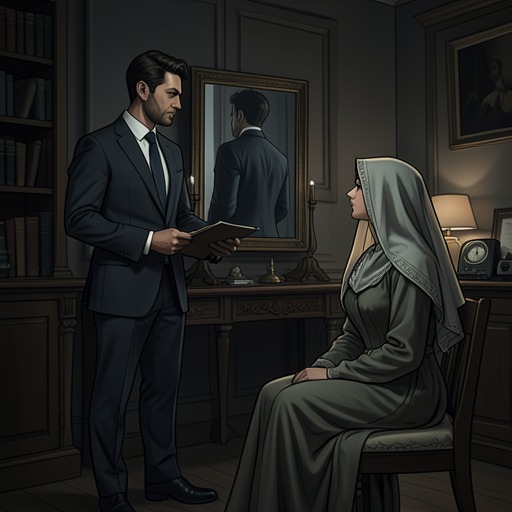
Terry returns to the room after Marlowe calls him out from behind the drapes. He appears in a dark double-breasted suit and blue bow tie, his dark hair and trim mustache complementing an elegance he seems not to notice. His familiar smile is boyish, embarrassed, and rueful. He asks Marlowe for a cigarette, and Marlowe offers him one; for a moment, their old ease seems intact. Yet this meeting cannot restore the friendship to its earlier form. Terry has returned with another alias, current obligations to Mendy, and a history of concealment that has already shaped the lives around him.
The last confrontation turns on a sudden, unsuccessful attempt at violence. As Everett Edwards III threatens Terry, Terry lunges for a glass ashtray lying beside a chair, apparently intending to throw it at him. Everett is quicker and shoots Terry before he can make the attack. Terry dies on the floor. Marlowe takes the gun from Everett, who has gone limp, and Clare comes in, pushes past her brother, and cradles Terry’s head without speaking or weeping. Her action makes clear to Marlowe that she had loved Terry. His death ends the possibility of another disappearance, another explanation, or another name.
Narrative Role
Terry’s shifting identities make him a figure through whom the story tests how much a person can alter and still remain answerable to a past. His face, name, and supposed death can all be changed; his debts, his connections, and the consequences of other people’s attachment to him remain. The uncertainty around his wartime exploits sharpens this pattern: even the story that casts him as a rescuer is known to Marlowe only as a version Terry and his companions have continued to tell.
For Marlowe, Terry is neither simply a fraud nor simply the loyal friend he remembers. Marlowe acknowledges that Terry deceived him and that he nevertheless liked him, valuing his style even while recognizing his failures. The return briefly revives their familiar banter, but Clare’s anger and Terry’s death disclose what that performance cannot repair. His final appearance is at once a homecoming and an ending: the man who once escaped by making his death seem real is killed after returning under yet another name, leaving Marlowe with friendship as a memory rather than a continuing bond.