Wealth, Class, and Insulated Privilege
The Black-Eyed BlondeWealth, Class, and Insulated Privilege is expressed in the novel less as an abstract hierarchy than as a map of who may enter, linger, and feel at ease in particular places. Private streets, guarded gates, manicured grounds, and exclusive leisure spaces make economic advantage visible as control over everyday experience. Philip Marlowe moves through these settings as an observant outsider: his dry attention to their furnishings and procedures exposes both their attraction and the distance separating their inhabitants from the wider city.
Access and Social Boundaries
The Cahuilla Club makes class difference explicit before Marlowe even reaches its grounds. Clare Cavendish describes it as a place of polo fields, swimming pools, and conspicuously polished people, adding that someone in Marlowe’s profession would not be allowed through its electronically controlled gates. Her remark is an implied rebuke as much as a description: she and Nico Peterson first met in this privileged setting, while Marlowe is positioned as the sort of man such a club excludes.
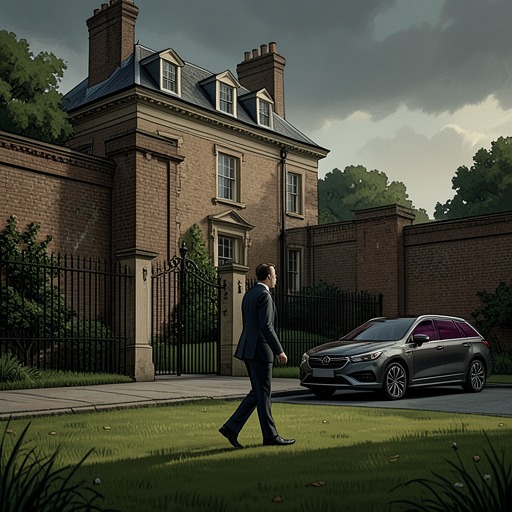
The actual entrance complicates that image without dissolving its boundary. When Marlowe visits, tall gilded gates stand open, but a striped barrier blocks the road. A uniformed gatekeeper asks whether he has an appointment, examines his card, and telephones inside before raising the barrier. The procedure turns access into a matter of permission and recognition, rather than simply an open road. Once admitted, Marlowe follows a drive bordered by high walls and cascades of bougainvillea; gardenias, honeysuckle, jacaranda, and orange trees further distinguish the approach from an ordinary street. The landscape beautifies the boundary while also making it unmistakable.
At the club, privilege includes more than exclusion from unwanted visitors. On a clear morning, flowering paths, fragrant air, a mockingbird, and the quiet hiss of sprinklers form an almost effortless scene of comfort. Marlowe’s observation that Los Angeles offers such moments only to the rich and privileged connects the club’s beauty to unequal access: the city’s pleasures are not distributed evenly, but gathered behind walls and gates.
The House and Its Environs
Clare’s address, 444 Ocean Heights, places her within another protected geography: private streets beside the ocean, where only the cream of society can live. Marlowe registers the address as a sign of extraordinary wealth even before seeing the house. The home, Langrishe Lodge, makes that wealth architectural. Built of pink and white stone, it has towers, turrets, a roof flag, and what Marlowe estimates to be about a thousand windows. Its long drive opens onto an oval gravel forecourt large enough, in his sardonic comparison, for a chariot race. The scale prompts him to imagine that he has chosen the wrong trade if making women smell pleasant can produce such a fortune.
The grounds extend the impression beyond the building itself. From the drive, the garden appears as large as a small public park, but more carefully maintained. Inside, the rooms Marlowe glimpses are lofty, spacious, and impeccably furnished. He wonders where ordinary leisure belongs in a house arranged with such formality—whether there might be a basement den for television, beer, and a ball game—and suspects that the real business of living takes place elsewhere. The contrast is revealing: wealth supplies abundant space, yet the visible rooms seem designed to display refinement rather than accommodate casual use.
The house’s conservatory intensifies this mixture of luxury and estrangement. A great structure of curved glass and steel rises two or three stories from the back of the building, its palms pressing their heavy leaves against the panes. The effect is not simply one of plenty, but of nature cultivated and contained within an elaborate private environment. Marlowe’s attention repeatedly shifts from what the setting offers to the social arrangements that make such settings possible.
Private Leisure and Everyday Protection
A small shelter at the edge of the beach gives privilege a quieter form. Clare and Marlowe sit on a rough plank bench in the shade, with a breeze from the water. The shelter is on a private beach. Marlowe recognizes this not from a sign or a guard but from its condition: a public shelter, he believes, would be too fouled and littered for them to sit in. Cleanliness itself becomes evidence of protected access, maintained by keeping the general public away.
That moment sharpens his understanding of Clare’s social position. He considers her one of the people whom the world shields from its own awfulness. The protection is not presented as a formal guarantee; it is embedded in her surroundings, from the private beach to the quiet, well-kept spaces she can use without encountering their public equivalents. The shelter and the club’s landscaped paths are different in scale, but both make exclusion feel natural by presenting comfort as the ordinary condition of a restricted place.
Luxury as Display
The Ritz-Beverly offers a more theatrical version of class privilege. Its doorman wears a formal coat and bowler hat, while its black-marble lobby is vast enough to invite comparison with a football field. A large table supports a cut-glass vase of calla lilies, whose heavy fragrance makes Marlowe want to sneeze. The Egyptian Room, where Mrs. Langrishe has arranged to meet him, layers bamboo furniture, torch-bearing Nefertiti figures, imitation-papyrus lamps, and a painted Nile landscape with boats, crocodiles, birds, pyramids, and a Sphinx. The abundance is unmistakably expensive, but Marlowe’s dry assessment reduces the elaborate room to what it remains: a bar. The setting’s cultural imagery functions as décor, converting wealth into an atmosphere of curated importance.
At Excelsior Pictures, class display takes a different form. The movie lot resembles a waking dream to Marlowe: cowboys, showgirls, ape-men, and Roman centurions walk to work beneath umbrellas bearing the studio’s bright logo. Their extraordinary costumes coexist with the routine of workers heading to an office or factory. The contrast shows an institution turning spectacle into labor and branding, rather than simply offering private comfort. Against the secluded homes, club grounds, and hotel interiors, the lot presents a public-facing industry whose fantasy is produced through ordinary work.
Narrative Significance
Across these settings, wealth is made legible through thresholds, surfaces, and the conditions of use. A gatekeeper regulates entry at the Cahuilla Club; private roads and a beach narrow who can pass; gardens and interiors make maintenance appear effortless; the hotel turns expensive materials into spectacle. Marlowe’s movement among them supplies the contrast. He notices the pleasure these spaces provide, but also the mechanisms and social assumptions that keep them exclusive.
His descriptions are neither neutral inventories nor simple denunciations. The grandeur of Langrishe Lodge and the club’s flowering paths can impress him even as his jokes puncture their self-importance. That tension keeps privilege concrete: it is a gate that must be raised, a beach shelter that remains clean because it is private, and a residence whose vastness makes ordinary living seem displaced. The theme therefore links social rank to insulation from inconvenience and exposure, while Marlowe’s outsider’s eye makes that insulation visible as a constructed advantage.