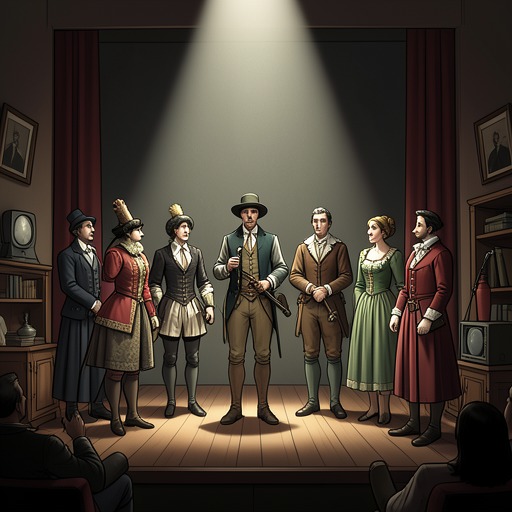
“a Nursery of whining Lovers”
The Blazing World“a Nursery of whining Lovers” is the Duchess’s dismissive name for plays that cultivate sentimental lovers rather than wise, witty, noble, and well-behaved people. The phrase condenses her challenge to theatrical fashion: dramatic art should describe human nature rather than submit to rules that, in her judgment, prize method over the life of their subject.
The Phrase in the Theatre Debate
The expression arises when the Emperor asks the Duchess for advice about establishing a theatre in the Blazing-World. She admits that she does not know how to construct theatres or painted scenes, and says her understanding of them comes from an immaterial observation of a theatre in the chief city of E. The Emperor and Empress nevertheless believe she can advise them about plays, since she has written them herself.
The Duchess explains that critics of her time considered her plays unfit for performance because they did not follow the Rules of Art. She maintains that their descriptions of human life are as good as those written by her critics. The Emperor presses the issue by asking whether the purpose of plays is to portray people’s humours, actions, and fortunes. When the Duchess agrees, he points out that human life itself does not proceed according to artificial rules. Her reply identifies the conflict: the fashionable standards of her “Blinking-World of Wit” lead its critics to reject descriptions that are not shaped by their prescribed method.
A Satire on Theatrical Fashion
Asked whether methodically composed plays are good, the Duchess grants that they are judged good according to the age or national mode, but not according to her own judgment. Her phrase “a Nursery of whining Lovers” gives that judgment its sharpest form: such plays, she says, nurture lovers’ complaints rather than serve as an academy or school for wise, witty, noble, and well-behaved people. The image makes the theatre’s influence formative. What is staged is not merely entertainment; it can cultivate habits and models of conduct in its audience.
The Emperor makes the alternative explicit. He wants a theatre that may make wise men and prefers natural descriptions to artificial ones. The Duchess answers that her plays might therefore be acted in the Blazing-World, though they cannot be acted in the “Blinking-World of Wit,” and offers to arrange the Emperor’s theatre on a later visit. The exchange turns her critical phrase into a practical proposal: a different audience and patron might permit the kind of drama that established taste excludes.
Dramatic Form and the Duchess’s Project
The debate distinguishes subject from convention. Both the Emperor and Duchess recognize that plays describe human behaviour and fortune; their disagreement concerns whether rules of art should govern those descriptions. The Duchess’s criticism is not that theatre should lack purpose, but that formal correctness, as defined by current fashion, may frustrate its capacity to represent people and foster sound judgment. Her theatrical ideal joins natural description to ethical and intellectual education.
The Empress adds that she likes a foolish farce alongside a wise play. The Duchess responds that the Blazing-World has especially suitable performers for such comedy, naming the Lice-men, Bird-men, Spider-men, Fox-men, Ape-men, and Satyrs. The Emperor and Empress then ask her to stay, organize their theatre, and make plays and farces for them. She declines for the moment because she longs to return to her dear Lord and Husband, but promises to come back after a short time. The phrase thus belongs to a larger imaginative contrast: the Blazing-World offers the Duchess a prospective stage for work dismissed by the theatrical conventions of her own world.