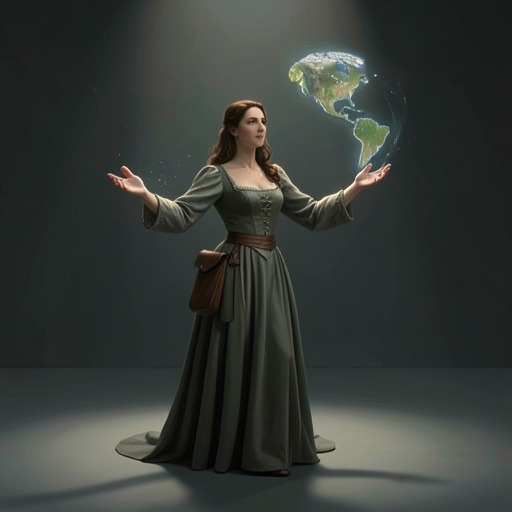
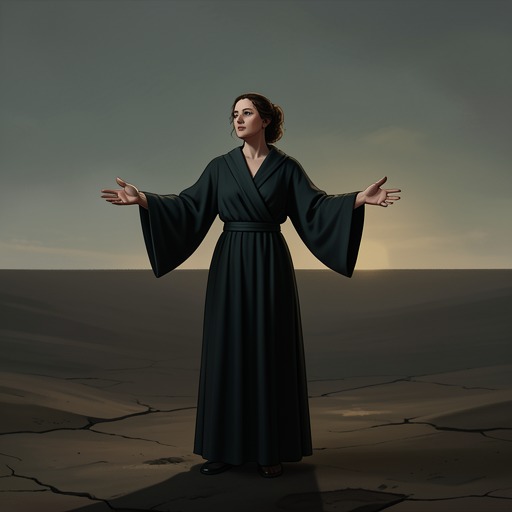
“create Worlds of their own”
The Blazing WorldThe expression “create Worlds of their own” closes the work by making imaginative world-making both a form of self-government and a check on imperial ambition. The Duchess invites readers who do not wish to become subjects to govern themselves in worlds of their own, but she also insists that freedom does not license them to seize the worlds already created by others.
From Material Ambition to Inner Worlds
The invitation recalls the Immaterial Spirits’ argument that a person can create a world within the mind and shape its inhabitants, motions, and government. Such inward creation, they contend, offers pleasures available without the trouble of ruling a vast material dominion, which even a sovereign can know only in part. The Duchess accepts their counsel and abandons her ambition to become Empress of a terrestrial world; the phrase’s final promise of self-rule thus grows from a plot-wide contrast between external power and imaginative creation.
The work also makes world-making difficult rather than effortless. The Duchess tries to construct worlds according to the doctrines of Thales and Pythagoras, then Plato, but abandons each attempt when its demands—daemons, troublesome numbers, or Ideas that resist being set in motion—overwhelm her. Against that comic sequence of failed models, the final invitation offers a more personal freedom: one may imagine a world and govern it according to one’s own choice, without claiming that creation is easy or that every imagined world must follow the same design.
A Conditional Freedom
At the close, the Duchess distinguishes mental sovereignty from control of the material world. Readers who wish to join her world may imagine themselves its subjects; those who cannot endure subjection may make worlds of their own and govern themselves as they please. The alternative is not presented as a transfer of territory or an overthrow of the existing order. It is a form of self-rule located in “Minds, Fancies or Imaginations,” where creation can answer the desire for autonomy without conquest.
That freedom comes with an explicit boundary. The Duchess warns would-be world-makers not to become unjust usurpers who rob her of hers. She claims the philosophical world for herself, while the Blazing-World already has an Empress: her dear Platonick Friend. The Duchess says she would not disturb that friend’s government or depose her from the imperial throne for another’s sake; if another friend were to be honored, she would rather create another world. In this ending, independent creation and respect for another creator’s rule are joined as complementary principles.
The Work’s Final Political Distinction
The phrase also clarifies the difference between the two worlds the Duchess presents. The Blazing-World is a public polity governed by one Empress, and the Duchess elsewhere advises restoring its earlier unity under one sovereign, religion, law, and language to prevent faction. Her closing invitation does not erase that political ideal: it offers imagined worlds as a personal alternative for those unwilling to be subjects, while preserving the Empress’s authority over the world already entrusted to her.
The distinction is pointed because the Blazing-World’s peace exists alongside coercive power. The Empress destroys invading fleets and compels other nations to pay tribute to the King of Esfi; at home, disputes among learned societies are allowed only on condition that they do not disturb the state. Against these exercises of public sovereignty, the Duchess’s invitation imagines a less coercive kind of rule: a person may govern an inward world without fighting to possess someone else’s. The ending therefore celebrates creative independence while refusing to make it a pretext for usurpation.