A World within yourself
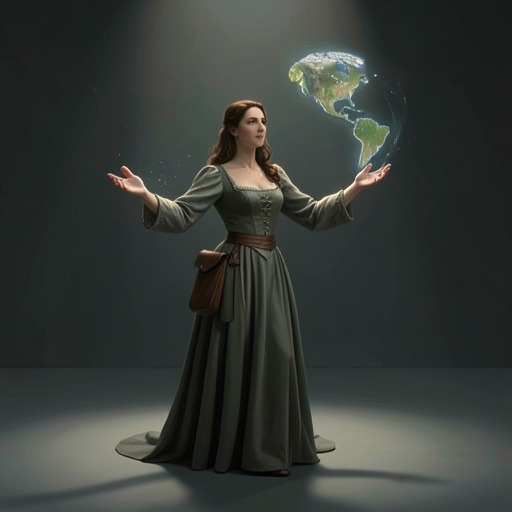
The Blazing WorldA World within yourself is the idea that a person can create and inhabit an imagined world within the mind, rather than seek sovereignty by conquering a material one. The Immaterial Spirits present inward world-making as an alternative to the burdens and limits of external power; the Duchess of Newcastle tests that possibility, abandons philosophical templates that fail her, and finally makes a world according to her own invention. The Empress follows her example, turning a private act of imagination into a striking counterpart to the government of the Blazing-World.
Meaning and Philosophical Basis
The Spirits urge the Duchess to reconsider her ambition to become Empress of a terrestrial world. Even its sovereign, they explain, cannot enjoy every part of the realm at once: governing means general responsibility, while subjects experience the pleasures of particular places. Glory, pleasure, and delight also depend on other people’s opinions and cannot guarantee peace of mind or bodily ease. In contrast, an inward world can be made and altered at will, and enjoyed without opposition. The argument does not simply praise fantasy; it contrasts the reach of an imagined domain with the practical limits and cares of material rule.
This proposal rests on the book’s account of matter, life, and motion. The Empress describes Nature as one infinite self-moving body, divided into restless parts that perpetually change through composition and division. In the Spirits’ explanation of natural existence, inanimate, sensitive, and rational matter are intermingled throughout Nature: sensitive matter is life, rational matter is soul, and inanimate matter is body. Natural lives, forms, and matter cannot be separated into independent worlds. Against that material account, the inward world is introduced as an immaterial creation that a human creature can make within the compass of the head. The passage thus holds together two different claims: Nature’s living activity belongs to self-moving matter, while the mind’s power to fashion an inward world gives imagination its own kind of creative sovereignty.
The Duchess’s Experiments
The Duchess first tries to create by following established philosophies, but each system brings a different obstacle. In a world modeled on Thales, troublesome demons prevent her from doing as she pleases. A Pythagorean design founders on the difficulty of arranging its parts through numbers, a task for which she lacks arithmetic skill. The Platonic world is harder still: its Ideas depend on motion from her mind, and animating them feels like controlling many puppets at once. Unable to bear the strain, she dissolves it.
An Epicurean world fares no better. Its infinite Atoms raise a mist that blinds her perception; without a Vacuum to receive them or a reliable order, their confusion produces monstrous forms and nearly dissolves her mind into chaos. She next considers Aristotle, but recalls the principle that nothing can be made from nothing and doubts that an immaterial mind can create by that system. Modern models also prove physically and mentally taxing. Des Cartes’s swiftly turning Æthereal Globules make her thoughts reel, while Hobbes’s pressing parts and equal reactions squeeze her thoughts until they can move neither forward nor backward and cause severe pain in her head. She dissolves that world too.
The sequence makes the eventual act of invention more than a celebration of choosing one doctrine over another. The Duchess has tried ancient and modern schemes, and each constrains her in a particular way: by demons, numbers, unmanageable Ideas, confused Atoms, a conflict between immaterial mind and material creation, dizzying motion, or crushing pressure. Only after finding that these patterns do not serve her does she stop borrowing philosophical designs and turn to a world of her own invention.
Making and Sharing an Original World
The Duchess’s world is composed of self-moving matter, chiefly its rational and subtler, purer degree. While sensitive matter moves and sustains bodily perception, rational matter moves at the same time toward the creation of the imagined world; the degrees are mixed, yet their parts can move in different directions simultaneously. The result appears curious, varied, well ordered, and wisely governed. Its pleasure is also difficult to put into words: the account emphasizes both the world’s form and the Duchess’s delight in making it.
The Empress, who has also been making and dissolving worlds in her own mind without settling on one, asks to see the Duchess’s creation. The Duchess brings the world with her and invites the Empress’s Soul to observe its frame, order, and government. So powerful is the Empress’s response that her Soul wishes to live in it. The Duchess instead encourages her to make a world in her own mind, offering the rational motions of her own mind as assistance through sensitive expressions and instruction. The scene presents world-making as an individual art that can be shown, discussed, and learned from, rather than a possession that must be entered or seized.
The Empress accepts the counsel and completes an imaginary world of her own. She provides it with creatures suited to it, good laws, and arts and sciences. It is governed without secret or deceptive policy and has no ambition, factional malice, civil dissent, religious division, internal quarrels, or foreign wars; its people live in peaceful society, united tranquillity, and religious conformity. Its ordered state contrasts with the disorder the Duchess later describes in her own world, where competing sovereigns, religions, opinions, laws, and ambitions produce conflict. Inward creation therefore supplies not only a private refuge but an opportunity to imagine an entire social order.
Imaginative Freedom and Its Limits
The Empress’s world is described as so well ordered that it cannot be improved, and the Duchess’s original world as too various and curious to be adequately expressed. Yet neither creation is presented as proof that imagining a world eliminates the difficulties of the material one. The Empress still wants to visit the Duchess’s native world to observe its governments, laws, and customs, despite the Duchess’s warning that it is divided by factions, divisions, and wars. The desire to look outward remains even after inward creation has offered a peaceful alternative.
The idea also resonates with the book’s own description of its form. The Duchess presents The Blazing-World as an appendix to her Observations upon Experimental Philosophy, with sympathy and coherence between the works, yet separates it for readers who may not enjoy philosophical arguments. She distinguishes a first part that is romancical, a second that is philosophical, and a third that is fantasy. Her imagined world thus occupies a deliberate meeting place between philosophical reflection and fiction: the mind’s capacity to make worlds becomes both a subject of argument and an occasion for imaginative freedom. The expression’s decisive promise is not that inward worlds replace material life, but that creation allows a person to fashion a domain whose design need not be borrowed from existing authority.