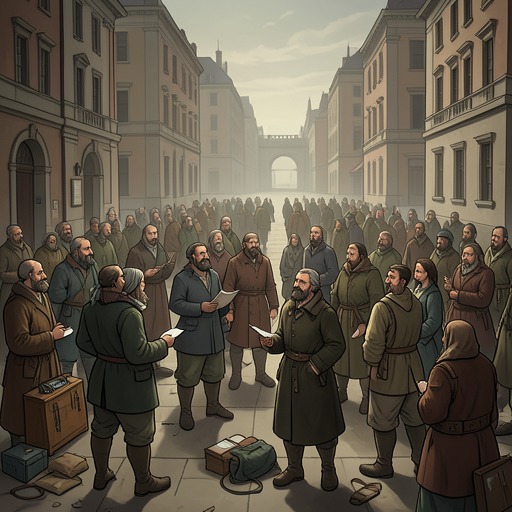
Bear-men
The Blazing WorldBear-men are the Blazing-World’s experimental philosophers, a learned people whose instruments promise to make nature visible but whose observations often produce rival explanations instead of certainty. Their encounters with the Empress frame a recurring tension between empirical ingenuity and the limits of what instruments can establish: they investigate celestial bodies and minute creatures, defend the pleasures of disputation, and serve the state as observers in both scientific inquiry and imperial campaigns.
Identity and Imperial Role
Among the Blazing-World’s many kinds of inhabitants, Bear-men are assigned the study of experimental philosophy. The Empress encourages the different peoples to pursue arts and sciences suited to their natures, and establishes schools and societies for that work; the Bear-men become one of these organized learned groups. Their scientific vocation is not separate from political service: they report to the sovereign, answer her questions, and later accompany her military operations.
The Empress first summons the Bird-men to describe the Sun and Moon, then turns to the Bear-men as her experimental philosophers when she wants celestial phenomena observed through telescopes. That division of labor does not make their work simply subordinate or passive. They argue for their interpretations, explain the sources of disagreement, and defend the value of their instruments, even when their conclusions frustrate the Empress.
Telescopes and Disputed Observation
The Bear-men’s telescopic observations generate a cascade of competing accounts. Some report that the Sun stands still while the Earth moves around it; others maintain that both bodies move, or that the Earth remains still while the Sun moves. Observers also disagree over the number and size of the stars. They divide over the Moon’s surface: some interpret its spots as hills and valleys on another world, while others identify the spots as land and the smoother regions as sea.
At the Empress’s direction, the Bear-men take their telescopes to the pole adjoining the world from which she came. They return with a report of three Blazing-Stars appearing there in quick succession, two bright and one dim. Even this observation will not hold a single account together. Some say there was one star seen at three different times and places; others insist that the appearances must belong to three stars. The latter argue that one star could not shift between widely separated positions, including two opposite locations and a third to the side, without visible motion, and that a single object should not vary so sharply in brightness.
The Empress concludes that the telescopes are false informers and orders them broken, reasoning that they have not corrected differences in sense and judgment. The Bear-men answer that the disagreement arises not from the glasses but from the observers: their optical senses do not move alike, and their reasoning is not invariably regular. The dispute makes their instruments’ epistemic problem explicit. A telescope may extend vision, but it does not by itself settle how appearances should be interpreted or whether observers share reliable standards of judgment.
The Bear-men also reveal that scientific inquiry has an institutional and pleasurable dimension. They petition the Empress to spare the telescopes, saying that artificial deceptions give them more delight than natural truths: instruments supply subjects for argument and occasions to contradict one another. Without falsehood to dispute, they contend, there would be no reason to argue over who is wiser. The Empress relents, but confines their quarrels to their schools and forbids them to produce factions or disturbances in government. Their defense thus secures continued inquiry while placing a political boundary around its contentiousness.
Microscopes and the Limits of Magnification
To make amends for the controversy, the Bear-men show the Empress other optical instruments, including microscopes. They explain that these can enlarge small bodies until a louse appears as large as an elephant and a mite as large as a whale. Looking at a gray drone-fly, they describe two large head-bunches covered with polished, pearl-like hemispheres arranged in triangular order. There are two sizes of hemispheres, oriented in different directions, and the Bear-men count 14,000 altogether. Because each appears to contain a transparent cornea and a fluid resembling the eye’s humors, they infer that every hemisphere is a complete eye. The Empress allows that the structures may be glassy pearls rather than eyes and questions whether the microscope has informed them correctly; the Bear-men insist that their microscopes rectify the senses and that the world would otherwise remain blind.
Their interpretation of charcoal likewise moves from visible detail to a contested causal claim. Through a microscope they discern a dense multitude of pores and count 2,700 in a line an inch long. They conclude that the pores cause charcoal’s blackness because they reflect no light. The Empress objects that this explanation conflicts with their account of color as produced by reflected light: if black is also a color, she reasons, it cannot simply be the absence of reflection. The episode separates a countable observation from the theory drawn from it. Seeing minute pores does not, by itself, resolve what blackness is.
When the Bear-men inspect a nettle, they report small bladders beneath its points, filled with a poisonous liquid that the points convey into the skin like syringe-pipes. Asked why nettles do not harm people in the same way when eaten, they say that explaining such effects belongs to physicians, not experimental philosophers; their own task is to inspect and describe natural forms as represented by their glasses. The boundary they draw between observation and explanation is both a limit on their claims and a reminder that an instrument’s image does not automatically provide a complete account of a natural process.
Microscopic views of fleas and lice are so disturbing to the Empress that they nearly make her swoon. She pities the poor, who must sustain lice with their own blood despite having little for themselves, and asks whether the instruments can prevent bites or show how to avoid them. The Bear-men dismiss such practical remedies as mechanical arts below the noble study of microscopic observation. Their refusal exposes a tension between knowledge pursued for its own sake and knowledge directed toward relief from harm.
The instruments also fail at the scale of very large objects. The Bear-men cannot fit a whale’s full circumference within the magnifying power of their best large microscope, though the narrator leaves uncertain whether the fault lies with the glass or with the whale’s position relative to reflected light. At the Empress’s request, they produce glasses of the opposite kind, which contract appearances: a whale can look no bigger than a sprat or even a vinegar-eel, an elephant no bigger than a flea, a camel no bigger than a louse, and an ostrich no bigger than a mite. Yet no instrument they devise can reveal a vacuum in all its dimensions, immaterial substances, non-beings, or mixed beings situated between something and nothing. The Bear-men are troubled by this limit, still hoping that extended study might overcome it; the episode leaves some realities beyond optical access, however ingeniously scale is manipulated.
Inquiry Beyond the Instruments
The Bear-men’s assigned place in the learned community puts them alongside other investigators, but the Empress’s natural philosophy challenges the idea that experimental dissection can disclose nature’s ultimate principles. When the Ape-men debate what bodies are made of, she declares that nature is one infinite self-moving body, divided into innumerable parts that continually change through composition and division. On this account, fire, the four elements, water, and proposed chemical ingredients are particular effects of nature, not primary principles from which all nature can be reconstructed. She tells the investigators to stop wasting their efforts on fruitless searches for primitive ingredients and to pursue experiments useful to the public.
In another inquiry, the herbalists say that the causes of most drugs’ effects are unknown to them, although they attribute those effects to the plants’ and drugs’ inherent figurative motions. They further maintain that herbs and drugs possess sense and reason, and that their operations may be more reliable than human opinions. These claims extend the novel’s challenge to human-centered ideas of knowledge: observation and reason are not the exclusive possession of human-like rational discourse, and the investigators’ ability to describe effects does not guarantee access to their causes.
Service to the Empress and Narrative Significance
The Bear-men’s work extends from inquiry to imperial logistics. During the Empress’s expedition toward her native country, they travel among the forces in ships with the Worm-men, while Bird-men and Fish-men serve in the air and underwater. The expedition’s vessels pass beneath the water between the two worlds, drawn by Fish-men with golden chains, and rise again after crossing the Icy Sea. As the fleet approaches the threatened kingdom, the Bear-men use their telescopes to discover the enemy ships that have besieged it. Their instruments, contentious in the schools, now supply military intelligence.
They are also used to identify targets in a campaign of coercion. When nations refuse tribute to the King of Esfi, the Empress orders the Bear-men to inspect through their telescopes which towns and cities will not submit. After receiving their report, she directs the Bird-men and Bear-men where to begin the threatened burnings. Their role is not to carry out the destruction described in the campaign, but to make resistance legible to the Empress’s forces and help translate surveillance into selective punishment.
Across these episodes, the Bear-men embody a double-edged faith in instruments. Telescopes reveal distant celestial appearances and enemy fleets, while also multiplying disputes about what observers see; microscopes disclose structures too small for unaided sight, yet invite inferences that the Empress contests. Their defense of argument preserves scientific activity, but their military and administrative service shows that observation can also support centralized rule. The Bear-men are therefore neither simply triumphant discoverers nor mere comic foils: their ingenuity expands the field of perception, while the novel repeatedly distinguishes seeing more from knowing with certainty.