Blazing-World Expeditionary Fleet
The Blazing WorldThe Blazing-World Expeditionary Fleet carries the Empress from her adopted realm into her native country, transforming a difficult passage between worlds into a campaign of aid, naval destruction, and political submission. Its distinctive ships, underwater route, and cooperation among different peoples make the fleet a demonstration of ingenuity; its later use to compel tribute reveals how readily that ingenuity becomes imperial power.
Formation and Design
The expedition begins with a practical obstacle: the passage between the Blazing-World and the Empress’s native world is so narrow that no vessel larger than a packet boat can pass through, and it is sometimes frozen shut. At the Duchess’s suggestion, the Empress summons her shipwrights and architects, who are Giants, and asks them to devise vessels that can travel underwater. Although they have never heard of such a design, they undertake the work and succeed. The construction turns the Duchess’s proposed solution into the fleet’s defining capability: access to a route that ordinary ships cannot use.
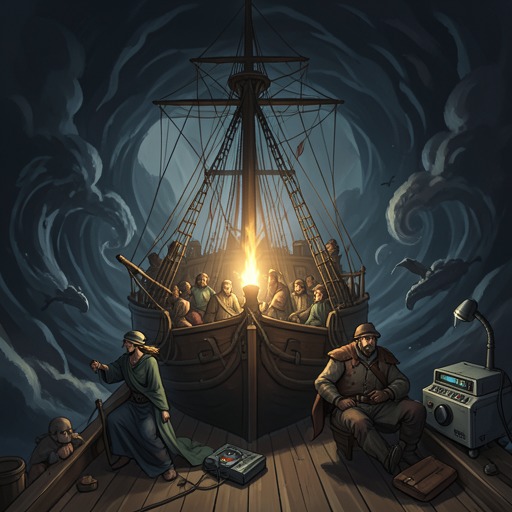
The fleet is not designed as a conventional gun-bearing navy. The Duchess warns that its ships cannot carry cannons and would be vulnerable to capture if they met enemy vessels directly. Their value instead lies in concealment, mobility, and the coordinated labor of their crews. Though made of gold and resistant to being shot through, the ships could still be battered, boarded, and taken. The Duchess therefore proposes that the Empress use Fish-men in place of artillery, while Worm-men gather Fire-stone from the burning mountains. Since the stone burns while wet, it can set the wooden ships of the other world alight; cut into torch-like shapes, it can also provide illumination.
Peoples and Methods
The expedition draws on several groups of the Empress’s subjects, assigning each a distinct role. Fish-men tow the vessels through the underwater passage with golden chains and ropes, and serve beneath the surface. Bird-men travel through the air, while Bear-men and Worm-men accompany the Empress aboard ships. Worm-men supply the Fire-stone needed for the campaign. The fleet’s effectiveness thus depends less on a single weapon than on an arrangement of different capacities across sea, air, and shipboard movement.
The Empress’s preparations also show that the fleet is a large undertaking, not a small raiding party. Bird-men need places to rest, and the Empress will not require them to exhaust themselves through prolonged flight; she therefore takes many ships both to transport the different kinds of subjects and to carry provisions. Other subjects petition to join, and she cannot refuse them all. The force that departs is consequently both a military instrument and a broad demonstration of allegiance to the sovereign.
Crossing and First Intervention
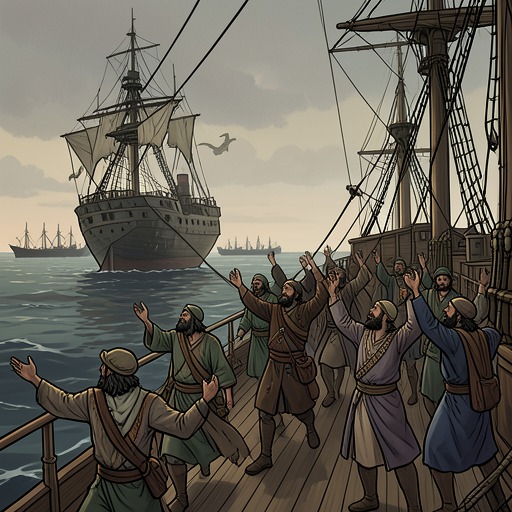
During the crossing, Fish-men draw the ships underwater through the short passage between worlds. The Giants’ construction keeps water out and supplies air for the land-dwelling passengers, so they experience no inconvenience aboard. After the fleet passes the Icy Sea, the golden ships surface and continue toward the Empress’s native country. Bear-men, using Telescopes, discover that a large, well-equipped enemy fleet has blockaded the country.
Before approaching the enemy, the Empress sends Fish-men and Bird-men to gather intelligence about the opposing ships’ number, position, and formation. At night, Bird-men carry Fire-stone with its tips wetted, while Fish-men hold additional burning stones above the water. Thousands of these lights make both sea and air appear ablaze. Those who see them interpret the spectacle as the Last Day and fall to prayer. At dawn the lights are extinguished, revealing ships that seem to move without sails, guns, arms, or other instruments of war. The Empress has had the golden hulls painted black or another dark color, concealing their material and ensuring that even the enemy’s best Telescopes cannot identify the gold.
The fleet’s arrival is therefore staged as a combination of intelligence, night display, and deliberate ambiguity. Once she knows the colors of her native country, the Empress sends a letter to its general and commanders, identifying herself as a powerful princess who has come to help against their enemies and asking them to state when they want her assistance. The intervention begins with an offer of aid, but the fleet’s extraordinary appearance and power have already placed the recipients in a position of uncertainty.
From Assistance to Tribute
The expedition’s political consequences extend beyond the initial relief of the Empress’s country. The fleet is later used against foreign maritime powers that trade by sea. When neighboring nations refuse the Empress’s demand that they pay tribute to the sovereign of her native country, she orders Fish-men to destroy their ships. The loss of naval power disrupts their affairs, and negotiations end with their submission. Because these nations depend on maritime commerce, their defeat at sea makes the King of the Empress’s native country master of the seas and, consequently, of that world.
That settlement does not end resistance. The neighboring nations later unite against the King, prompting the Empress to send Fish-men to destroy the remaining naval forces. Most are compelled to submit again, but nations able to live without foreign sea trade, or whose commerce is entirely land-based, refuse tribute. The Empress threatens to burn their towns and cities if they will not yield voluntarily. She orders Bird-men and Worm-men to begin with smaller towns, reserving the destruction of larger cities for continued resistance; Worm-men can travel beneath the earth after being set down in the territory. Bear-men use Telescopes to identify the towns and cities, and Bird-men are ordered to fly at night so they will not be noticed.
The fleet’s trajectory exposes a tension between its declared purpose and its eventual role. The Empress initially presents herself as coming to assist her native country, but the same force that reaches it also helps establish a wider order of naval supremacy and tribute. Destroying ships, controlling trade routes, and threatening towns convert military capacity into political subjection. The expedition’s ingenuity is not separate from its imperial consequences: the methods that make passage and defense possible also enable the Empress to extend the authority of her native sovereign.