Blazing-World golden ships
The Blazing WorldThe Blazing-World golden ships are both a remarkable technology and the material foundation of the Empress’s power beyond her own world. Built of gold yet light enough to travel, they can be joined into a closely fitted formation and, after the Giants devise a new construction, pass beneath the sea. They first carry the young lady toward the Emperor’s seat at Paradise; later, adapted for an expedition across worlds, they transport the Empress and her varied subjects into a war that ends in tribute and submission.
Construction and Maritime Use
The Emperor’s ships are made of gold, while merchants’ and skippers’ ships are made of leather. The gold vessels are not much heavier than wooden ships because they are neatly made and do not require the thickness of ordinary wooden construction. Their joints are soldered securely, leaving no fear of leaks or splits. Unlike the vessels familiar to the narrator, they need no pitch, tar, pumps, or guns: the account says that the people of the Blazing-World have no enemies but wind and waves. The lighter leather ships are less secure and are pitched to keep out water.
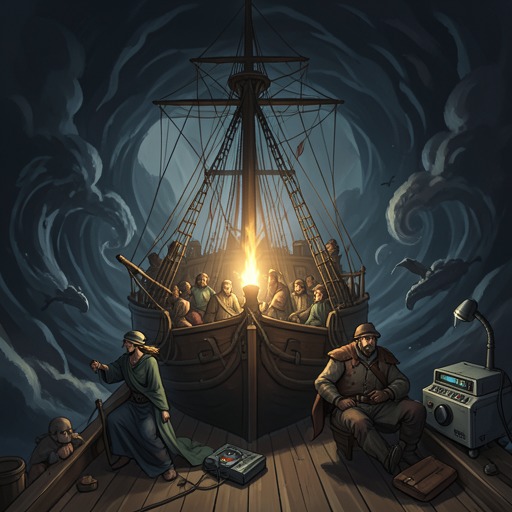
The ships’ design also supports collective travel. They can be fastened together as closely as a honeycomb, without wasted space, so that wind and waves cannot pull the united formation apart. When conditions at sea threaten a separated fleet, the vessels can therefore serve as a single, stabilized body. Their construction answers not only the demands of travel but a central feature of the Blazing-World’s maritime order: the ships can proceed through calm or storm, while the people aboard rely on practiced observation and specialized devices rather than familiar navigational instruments.
The Lady’s Passage to Paradise
The golden ships belong to a wider network of boats and vessels that conveys the young lady through the Blazing-World. After the Bear-men find her in the boat that carried her from the Icy Sea, they take her to their city and then onward, with the Fox-men and Bird-men, through successive islands and across rivers. The sequence moves from local hospitality to increasingly elaborate transport; when the party reaches a kingdom whose inhabitants prepare them for the open sea, the journey requires ships to reach the island where the Emperor resides.
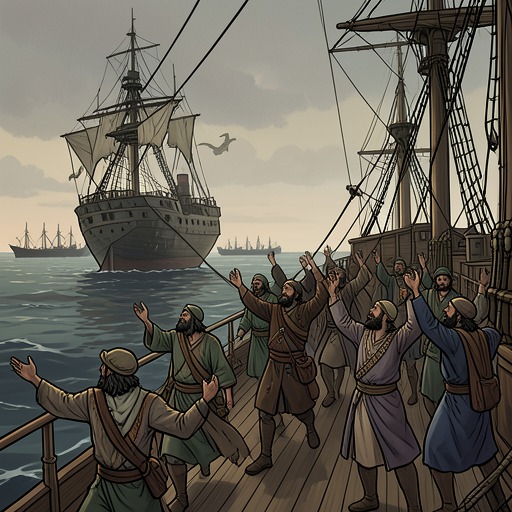
The narrative’s arrival at Paradise makes the vessels part of the world’s political geography. The young lady’s company approaches through the sea passage to the Emperor’s domain, and boats emerge from a cleft in the high rocks to meet them. The ships and boats meet with courteous greetings, in a realm described as having one language and one Emperor. The golden vessels thus carry travelers toward the imperial center through an entry that is both physically narrow and politically controlled: the account presents the passage among the rocks as the only way in, winding like a labyrinth and protecting the domain from invasion.
Refit for an Underwater Expedition
The ships’ later purpose grows from a practical obstacle. The Duchess of Newcastle and the Empress wish to travel from the Blazing-World to the Duchess’s native world, but the Fish-men report that the single passage between the worlds is so small that no vessel larger than a packet-boat can pass, and that it sometimes freezes shut. The Duchess therefore asks the Giants, who are the world’s architects and shipwrights, to attempt a vessel capable of swimming underwater. They had not heard of such an invention, but undertake to discover how to make one.
When the Giants succeed, the golden ships can do what their ordinary sea-going design could not: carry the Empress’s expedition through the short passage beneath the water. The Duchess advises that the Empress travel bodily, while the Duchess herself can accompany her only as a soul and offer counsel from within the Empress’s body. The ships are not built for cannons and would be vulnerable if an enemy boarded them, so the Duchess assigns the ships’ protection and offensive work to the accompanying subjects. Fish-men are to draw and guide the vessels with chains and ropes; Bird-men, Bear-men, and Worm-men have distinct duties in the expedition. The ships’ value lies not in conventional armament but in their ability to transport this coordinated force.
The crossing gives their underwater capacity a specific, carefully described operation. Fish-men draw the ships beneath the water with golden chains, so sails and other arts of ordinary navigation are unnecessary in the passage between the worlds. The Giants have made the vessels sufficiently watertight and supplied them with air for the land animals aboard, who experience no inconvenience. Once the fleet has passed the Icy Sea, the golden ships rise above the water and continue toward the kingdom that is the Empress’s native country. The undersea vessel is therefore not simply a marvel: it is a transport system designed around the needs of a mixed company of land, air, and water-dwelling subjects.
Appearance, Spectacle, and Campaign
Near the Empress’s native country, the Bear-men use their telescopes to discover enemy ships gathered around the kingdom. Before the expedition comes into view, the Empress sends Fish-men and Bird-men ahead for intelligence. At night, she orders them to display thousands of Fire-stones, cut like torches or candles and wetted at their tips. The lights fill the air and sea with the appearance of flame; those who see them believe the Last Day has arrived and fall to pray.
At daybreak the lights are extinguished, revealing ships that appear to have neither sails nor guns nor other instruments of war, and seem to move without assistance. The Empress has had the golden ships painted black or another dark colour, concealing their natural gold even from the best telescopes. The change in appearance intensifies the enemy’s uncertainty: after the night’s apparent fire, they cannot tell what the ships are or which side they represent, and are too frightened to act. The fleet’s effectiveness in this encounter depends on concealment and the coordinated spectacle around it, not on the guns the ships do not carry.
The ships also make possible the Empress’s claim that she has come as an ally. She sends a letter to the enemy commanders identifying herself as a powerful princess who intends to assist her native country, and asks them to state when they want her help. The Empress subsequently addresses her countrymen as a native of their kingdom who has crossed from another world to defend them, declaring that she would rather relinquish her tranquillity, riches, and pleasure than see them destroyed. This declaration presents the fleet as the means of rescue. Yet the ships’ capacity to reach the theatre of war also enables the wider expansion that follows: the Empress uses her force at sea to compel neighbouring nations to pay tribute to the ruler of her native country, and later orders naval power destroyed when they resist. The vessels that first signify aid thus become part of an order of coercion and imperial subjection.
Political and Narrative Significance
The Blazing-World golden ships embody a striking contrast between technical ingenuity and political consequence. Their design is presented as unusually secure and efficient: they are light despite their gold construction, soldered against leaks, joinable in a close formation, and adaptable to underwater travel. But these advantages are not politically neutral. They permit the Empress to cross a boundary that ordinary vessels cannot pass, arrive before a besieged country with an unfamiliar force, and project power over states whose commerce depends on maritime trade.
Their transformation from imperial transport to instrument of foreign intervention also complicates the novel’s vision of order. The Blazing-World is introduced as peaceful under a single Emperor and protected by its difficult entrance; the golden ships make that controlled world’s military reach possible beyond its own borders. The expedition begins with the language of loyalty and assistance, but its outcome is a demand for tribute and the destruction of resisting fleets. In this progression, the ships connect the novel’s celebrated ingenuity to the costs of an empire that turns security and technical mastery outward into domination.