Cabbala
The Blazing WorldCabbala is presented as an ambitious interpretive art that promises access to hidden meanings in Scripture, nature, and number, but the book repeatedly questions whether such claims can be verified. The Empress’s desire to make a Jewish Cabbala brings the problem into focus: the Immaterial Spirits offer extensive distinctions but acknowledge the limits of created knowledge, and the Duchess advises that the project has no practical or spiritual advantage. The episode ultimately redirects Cabbala from a purported key to divine mysteries toward an imaginative, explicitly poetic practice.
The Spirits’ Account of Cabbala
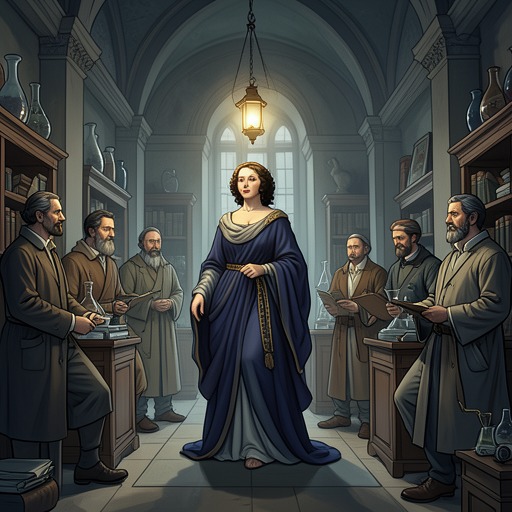
The Empress’s inquiry follows the Spirits’ report on the efforts of Dr. Dee and Edward Kelly. They describe the two men as having made a twofold Cabbala, relating to the Old and New Testament, while allowing that others might devise two, three, or even many more. Cabbala, in their account, has no settled method: some regard it as traditional, others scriptural, literal, or metaphorical. The Spirits’ own answer is that it may be partly all of these, an admission that the practice cannot be reduced to one agreed interpretive procedure.
They also distinguish the intellectual and religious demands of the undertaking. Cabbala requires wit and strong faith, they say, but not natural reason; its practitioners often claim divine inspiration, although the Spirits decline to judge whether those claims are true. They deny that there is a divine reason alongside natural reason, instead separating natural reasoning from divine faith. The resulting contrast is not simply between knowledge and ignorance: the Spirits contend that people confuse the two kinds of understanding, producing writers who mix philosophical reasoning with religious claims.
The Spirits further deny that Cabbala is a universal pursuit. They say that natural philosophers are not Cabbalists; the practice belongs instead to mystical or divine philosophers who seek to go beyond sense and reason. Yet this distinction does not establish the Cabbalist’s access to divine truth. Asked whether God contains ideas or forms, the Spirits answer that God is perfect and beyond the conception of any creature. They likewise reject the claim that Cabbala’s mysteries reside in numbers, treating numbers as marks of reckoning rather than secret revelations.
Numbers, Faith, and the Limits of Interpretation
The Empress tests numerical symbolism through familiar Cabbalistic claims. The Spirits dismiss the idea that Four is a prime or all-encompassing number, and reject the assertion that Ten virtually contains every number in Four. Such supposed mysteries, they say, are fancies rather than features of nature. When the Empress asks whether Six symbolizes marriage because it joins male and female, the Spirits answer that Two would be the more fitting emblem, since marriage joins two. Their reply does not validate a numerical system; it narrows the proposed symbolism to a plain analogy.
Seven, too, fails as an emblem of God. The Spirits argue that no number can represent a God whose nature is unknown, and that number is imperfect whereas God is perfection. They describe subtraction as a kind of death to numbers, but do not turn that image into a sacred code. Numbers multiply, they say, as the world does, toward infinity; neither the parts of the universe nor creation itself can be captured by a finite count. In this account, arithmetic can describe multiplication, but it cannot make hidden theology securely legible.
The dialogue also sets a limit on religious interpretation. The Spirits say God will not damn the ignorant while saving only those who claim knowledge of divine secrets through Cabbalas. They distinguish theological Cabbala, which is mystical and belongs to faith, from natural Cabbala, which belongs to reason, but their surrounding answers make clear that neither category licenses certainty about God. The Empress’s questions repeatedly press toward a system that would render mystery intelligible; the responses instead mark what mortal or created understanding cannot establish.
The Empress’s Project and the Spirits’ Disappearance
After a long series of questions, the Empress says that she wants to make a Cabbala, specifying that she means the Jewish Cabbala. The Spirits disappear as soon as she declares her intention. The sudden departure startles her so greatly that she falls into a trance. When she recovers, she wonders why they vanished and becomes convinced that they may have erred in their answers and been condemned to the darkest vehicles. Her distress arises not merely from losing her informants, but from fearing that her own request has caused their punishment.
The episode makes supernatural testimony uncertain without simply dismissing it. Earlier, the Spirits have admitted that they can forget the past when it has not been recorded, and that their foreknowledge depends on comparing past and present events. They also deny possessing universal knowledge. Their disappearance therefore leaves the Empress with no authoritative explanation of what happened; she can only form a conjecture, which she treats as a cause for remorse. Her desire to obtain secret knowledge has brought her into contact with informants who themselves insist that their knowledge is partial.
The Empress sends the Fly-men and Worm-men to search for the Spirits. The Worm-men descend into the Earth and learn that the Spirits remained for a time at its centre before travelling onward to the Antipodes. This search does not answer the Empress’s larger questions about Cabbala or explain the Spirits’ departure. Instead, it carries the episode from speculative interpretation into a concrete pursuit, while leaving the cause of the disappearance unresolved.
The Duchess’s Counsel
The Empress later chooses the Duchess’s soul as her Scribe, valuing her writing as plain and rational even though her handwriting resembles characters rather than well-formed letters. When the Empress names the Jewish Cabbala as the work she wants written, the Duchess advises her to seek the soul of a famous Jewish teacher, perhaps Moses or a leading rabbi of the Tribe of Levi. Without such instruction, the Empress is likely to mistake the matter and make serious errors. The Empress objects that she can be taught by Spirits, but the Duchess counters that Spirits, like mortals, are ignorant in many cases and possess neither general nor absolute knowledge.
The Duchess recommends abandoning the project. It would benefit neither the Empress nor her people, she argues, unless the Empress belonged to the Jewish religion. Even then, a literal reading of Scripture would be more instructive and easier to believe than a mystical interpretation. Moses, in the Duchess’s reasoning, would have explained the matter himself if such an interpretation were necessary to the salvation of later generations. She advises accepting Scripture’s general literal sense rather than allowing each reader to interpret it according to private fancy, and adds that God will not damn people for lacking mystical knowledge.
The Empress proposes alternatives, but the Duchess subjects each to the same practical test. A philosophical Cabbala adds confusion to what sense and reason can already teach about nature; numbers are infinite, and adding nonsense to infinity would bewilder human understanding. A moral Cabbala is unnecessary because morality comes down to fearing God and loving one’s neighbour. A political Cabbala is likewise redundant because government rests on reward and punishment. These exchanges distinguish useful guidance from an elaborate interpretive system that merely multiplies explanations.
The Duchess’s final alternative preserves the name while changing the kind of authority it claims. If the Empress insists on making a Cabbala, the Duchess advises a poetical or romancical one, using metaphors, allegories, and similes that may be interpreted freely. The Empress accepts the counsel. Cabbala thus ends not as a recovered body of secret doctrine but as a form of imaginative world-making, whose figurative openness is acknowledged rather than disguised as certain access to divine knowledge.
Narrative Significance
The Cabbala discussions belong to the book’s wider examination of disputed knowledge. The Empress asks learned observers and spirits for explanations, yet their answers divide among competing interpretations or admit limits. The Spirits’ account of Cabbala is especially revealing because it makes interpretive uncertainty its subject: the tradition may be literal, metaphorical, scriptural, or traditional, while its claims to divine inspiration remain beyond their judgment. Numbers provide no dependable shortcut from visible signs to divine truth.
The Duchess’s intervention gives the episode its decisive turn. She does not merely offer one more interpretation; she distinguishes the practical work of faith, morality, and government from the speculative ambition to decode hidden systems. Her proposed poetic Cabbala retains invention while abandoning the pretense that every allegory yields a single authoritative secret. In the contrast between the Empress’s wish to know and the Duchess’s caution about what can be known, the book makes creative interpretation possible without confusing it with proof.