Experimental Philosophy
The Blazing WorldExperimental Philosophy in The Blazing-World is both an organized pursuit of knowledge and a running test of its limits. The Empress commissions investigations across the natural world, but the resulting observations rarely settle what they appear to show: instruments multiply interpretations, and specialists disagree about causes and principles. Her responses distinguish useful inquiry from the mere accumulation of disputes, while the episodes leave a productive tension between her confidence in natural sense and reason and the experimentalists’ faith in their instruments.
Court-Sponsored Inquiry
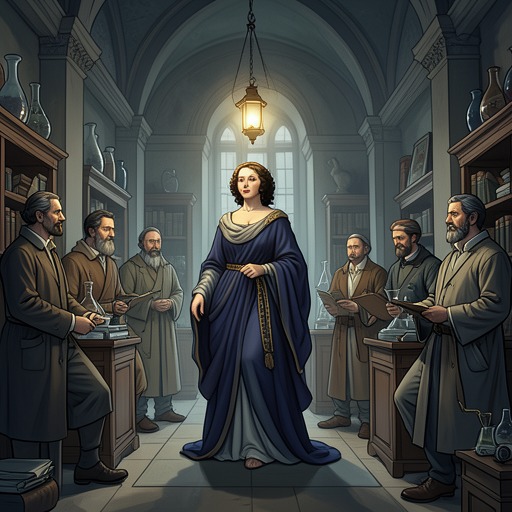
The Empress gives inquiry an institutional setting by founding societies of virtuosi and assigning different kinds of work to them. When she judges that these groups have made progress, she convenes the Bird-men to report on the Sun and Moon. Their account presents the Sun as a vast, solid, yellowish stone of extraordinary brightness and the Moon as a whitish body possessing light of its own. They describe the Moon’s centre as eccentric in relation to the world, and interpret the spots on both bodies as flaws or stains in their stony surfaces. Yet even this report opens onto disagreement: the Bird-men divide over whether the Sun is intrinsically hot or whether its heat results from its light, and their competing explanations invoke the nature of fire, fuel, and immaterial effects.
The Empress’s investigations extend from the heavens to weather. When considering thunder and lightning, she hears one explanation that attributes them to an encounter of cold and heat, with an exhalation kindled in clouds producing lightning and their ruptures producing thunder. Another account describes a sudden, enormous blaze in the air that need not involve a cloud. Because the latter observers cannot explain what they mean by a blaze, the Empress prefers the first explanation. Her choice is practical as well as epistemic: tired of prolonged disputes, she seeks a way to make celestial phenomena more exactly known, and orders the Bear-men to observe them through Telescopes.
Instruments and Disagreement
Rather than resolve disputes, the Telescopes intensify them. Observers disagree about whether the Sun stands still while the Earth moves, whether both move, or whether the Earth stands still and the Sun moves. They count different numbers of stars, claim to discover new ones, dispute the stars’ sizes, and offer rival readings of the Moon’s surface: one group sees hills and valleys, another sees land and sea. A report of three Blazing-Stars appearing in succession at the end of the Pole adjoining the world from which the Empress came becomes another contested observation. Some observers take the appearances for three separate stars; others argue that they are one star seen at three times and in different places. Their arguments appeal to differences in brightness, position, and the apparent difficulty of a star moving invisibly across such distances.
The Empress concludes that the glasses are false informers, deluding rather than instructing the senses, and orders them broken. The Bear-men object that the disagreement lies not in their instruments but in the unequal motions of observers’ optical organs and the irregularity of their reasoning. The Empress answers that a true instrument should correct irregular sense and reason, and maintains that Nature has made those faculties more regular than Art has made the glasses. The Bear-men then defend the instruments for a strikingly different reason: they enjoy artificial delusions more than natural truths. Without disputed findings, they say, they would lose both subjects for argument and the opportunity to appear wiser by contradicting others. The Empress ultimately allows them to keep the Telescopes, on condition that their quarrels remain inside their schools and do not produce factions or disturb government. Instruments survive, but their public authority is restricted.
The Bear-men’s Microscopes reveal a parallel tension between magnification and warranted inference. They describe a gray drone-fly’s head as largely composed of two clusters of polished, pearl-like hemispheres, which they identify as eyes on the grounds that each seems to contain a transparent cornea and eye-like fluid. The Empress allows that they may be glassy pearls rather than eyes and questions whether the instruments report truthfully. The observers insist that Microscopes correct and inform the senses, and claim that the world would otherwise remain blind. Their confidence is not simply the opposite of the Empress’s scepticism: both sides argue about how an instrument’s appearance licenses a conclusion.
Looking through the Microscopes, the Bear-men find what they call 2,700 pores in a one-inch line of charcoal and infer that the pores’ failure to reflect light explains its blackness. The Empress points out a contradiction: if all colours arise from reflected light and black is itself a colour, black cannot simply be defined as an absence of reflection. The investigators then report poison-bearing bladders beneath the points of a nettle, which they say inject liquid into the skin. Asked why eating nettles does not cause comparable inward harm, they decline to explain, saying that their task is to inspect and report natural forms, not to provide physicians’ reasons. Observation, inference, and explanatory competence remain distinct.
The Scope and Uses of Experiment
Microscopic inspection also has human consequences that the investigators’ definition of their task excludes. The Empress is nearly overcome by the magnified appearance of a flea and a louse, then pities poor beggars who must feed lice from their own flesh and blood. She asks whether the instruments can prevent the creatures from biting, or show how to avoid them. The Bear-men dismiss such remedies as mechanical arts beneath microscopical observation. Their answer exposes a gap between describing a natural object and addressing the suffering it causes.
A different instrument problem arises when the Empress asks whether the Bear-men can magnify large bodies. Their best and largest Microscope cannot contain the Whale’s full circumference; the narrator leaves uncertain whether the failure belongs to the glass or to the Whale’s position relative to reflected light. At the Empress’s command, the investigators then make glasses that contract rather than enlarge an object. Through them, a Whale can appear no larger than a Sprat or even a Vinegar-Eele; an Elephant may shrink to the apparent size of a flea, a Camel to a louse, and an Ostrich to a mite. Yet neither enlargement nor reduction gives the observers access to everything: they cannot devise glasses that reveal a Vacuum in all its dimensions, immaterial substances, non-beings, or mixed beings between something and nothing. Their difficulty marks a limit not just of a particular instrument but of the experimental ambition to make every object available to sight.
The Empress also challenges inquiry that treats dissection as knowledge without a public benefit. When she commands the Anatomists to dissect monsters, they refuse, arguing that their dissections of dead animals are meant to identify defects and diseases so that similar conditions can be cured in the living. Dissecting monsters, they contend, cannot prevent Nature from producing others and would serve only idle curiosity. The Empress replies that such work would benefit Experimental Philosophers; the Anatomists answer that even for those investigators it would be useless labour. The exchange sets two standards against one another: inquiry as systematic inspection and inquiry justified by its contribution to human preservation.
Natural Philosophy and Its Limits
In her address to the Ape-men, the Empress rejects the search for a small set of primary ingredients by which natural bodies can be explained. She argues that Nature is one infinite self-moving body, divided into infinite parts whose restless motions perpetually compose and divide them. On this account, natural effects arise from self-moving matter, not from a final list of ingredients extracted by experiment. The rival chemical principles—the four elements, water, or salt, sulphur, and mercury—are, she says, particular effects and creatures of Nature rather than its primitive foundations.
Her criticism turns specifically on the use of fire as a universal analytical instrument. Fire has different effects on different bodies and cannot alter the interior figure of gold; it is therefore unsound, she argues, to suppose that fire can disclose Nature’s first principles. She orders the Ape-men to stop wasting their time on such fruitless attempts and to conduct experiments that may benefit the public. Her rebuke does not oppose inquiry as such: it redirects it, making practical value and a coherent account of Nature tests of a worthwhile experiment.
The Herbalists offer a more limited account of their own expertise. They say they can identify the effects and virtues of most herbs and drugs but do not know the particular causes. Their explanation appeals to the varied, inherent, figurative motions of natural bodies. They also claim that plants and drugs possess sense and reason, and that their operations may be wiser and more certain than human words, actions, and opinions. Combinations with other drugs can give them artificial effects, they add, but cannot change their proper natures. The episode distinguishes knowledge of what a substance does from knowledge of why it does it, without treating human discursive reasoning as the sole measure of natural intelligence.
Experimental Philosophy is therefore neither simply vindicated nor dismissed. The societies produce detailed observations and unexpected questions, yet their devices fail to settle rival interpretations, and their specialists sometimes separate inspection from explanation or practical care. The Empress’s decisions preserve this friction: she keeps the Telescopes under political restraint, questions microscopic conclusions, and urges experiments toward public benefit. Inquiry remains valuable in the narrative, but its claims must be measured against the assumptions built into observation, the limits of its instruments, and the purposes it serves.