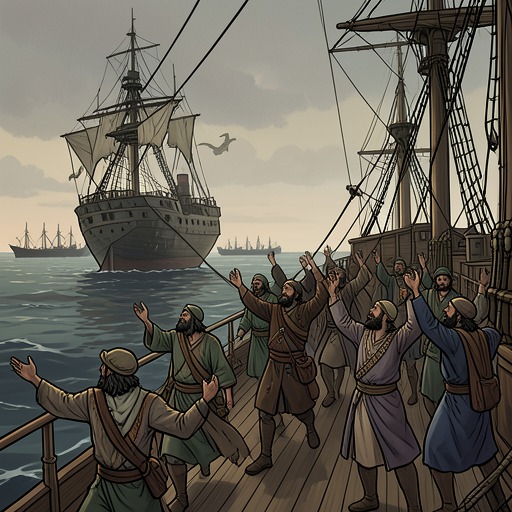
Fire-Stone Campaign Against the Resistant Nations
The Blazing WorldThe Fire-Stone Campaign Against the Resistant Nations is the landward phase of the Empress’s intervention in her native world: she uses fire-stones, concealed placements, and coordinated action by the Bird-men and Worm-men to make resistant nations submit to the King of Esfi. What begins as a defense of a country under attack becomes a program of universal subjection, in which the Empress’s stated aim of peace is secured by the threat and spectacle of destruction.
Causes and Stakes
The campaign follows the destruction of the enemy fleets. The Empress had promised the King of Esfi that she would make him the most powerful ruler in the world; after his maritime opponents were defeated, she demanded tribute from trading nations. Some submitted when their ships were destroyed, but others resisted because they could live without overseas commerce or traded by land. Their refusal presented an obstacle to the Empress’s project of making the King master of the whole world.
The Empress first sent a warning: unless the remaining nations submitted, she would burn their towns and cities. She preferred, she said, to inflict no more damage than necessary, and initially ordered that smaller towns be targeted before larger cities. This graduated threat made the campaign both punitive and demonstrative: its purpose was to force compliance by showing what continued resistance would cost.
Fire-Stones and the Attack
The weapon’s unusual property had already been established in the Blazing-World: a fire-stone grows intensely hot when wetted, flames until it dries, and then ceases burning. The Empress’s use of the stones therefore turned water—the familiar means of extinguishing fire—into the trigger for destruction. The campaign depends not only on the stones’ power but on anticipating rain, dampness in the ground, and the annual tide that reached the final holdout.
The Empress assigned the work to the Bird-men and Worm-men, whose different abilities made the operation possible. Worm-men could travel beneath the earth as readily as people moved above it; Bird-men could approach from the air. Before sending them out, the Empress had the Bear-men inspect the resisting towns and cities through their Telescopes. She then designated targets, warned the princes and rulers that smaller towns would provide a first proof of her power, and ordered the Bird-men to fly at night to avoid detection.
At each selected town, the Worm-men placed fire-stones under house foundations while the Bird-men set others on the rooftops. Rain and moisture in the earth would activate the stones. The Bird-men learned a few words of the local language and announced that the next rain would set the towns ablaze. The inhabitants were astonished to hear men speaking in the air, but laughed at the prediction, reasoning that water quenches fire. Their confidence rested on ordinary experience; the Empress’s weapon made that experience a trap.
When rain came, the houses suddenly caught fire. More water made the flames burn more fiercely rather than putting them out. The spectacle terrified neighboring cities, nations, and kingdoms, and they submitted to the King of Esfi to avoid the same fate. The Empress’s use of limited initial destruction thus achieved a much wider capitulation: the burnings served as a warning to places not yet attacked as well as an assault on those selected.
The Tide-Washed Holdout
One nation still rejected submission. It seldom received rain and relied instead on dew, so its inhabitants believed a large fire would quickly consume that limited moisture. The Empress identified a different vulnerability: each year, a tide flowed over the country for several weeks, and although the houses stood high, their supporting posts were fixed into the ground.
She ordered the Bird-men and Worm-men to place fire-stones at the bottoms of those supports. When the tide arrived, the houses caught fire. The burning made the water so rarefied that the tide became vapor and then air; the destruction of the houses was accompanied by general barrenness across the country that year. Faced with the loss of both homes and agricultural fertility, the last holdout submitted. The campaign adapted its method to the country’s environment, turning its annual tide from a defense against fire into the means by which the fire reached its buildings.
Outcome and Political Meaning
The narrator presents the result as the transformation of the Empress’s native country into the absolute monarchy of the whole world. The campaign completes what naval force and tribute demands had begun: the King of Esfi’s authority is no longer limited by the nations that refused to yield, and all are brought under the order the Empress has set out to establish.
The campaign’s political logic contrasts with the Empress’s account of sound government elsewhere. In the Blazing-World, political unity is defended as an answer to faction and civil conflict; the Duchess likewise advises that one sovereign, one religion, one law, and one language can hold a world together. Here, however, unity is not achieved through agreement. Fire-stones placed beneath foundations and above roofs, a rain that reverses the expected action of water, and a tide that leaves a country barren make submission the consequence of overwhelming force. The Empress describes her intervention in her native world as assistance, but its outcome is not merely rescue: it is a world-spanning regime of conquest and tribute, imposed on those who refused the King of Esfi’s rule.