Fire-stone
The Blazing WorldFire-stone is a stone discovered beneath a flaming mountain in the Blazing-World. When wet, it grows intensely hot and burns with flame until it dries. Its properties give it an unusual double role: it helps the Empress make religious teaching visible without resorting to force, and later becomes a practical instrument in the campaign to aid her native country. In both uses, its effects depend on material properties, but their consequences are shaped by how the Empress and the Duchess of Newcastle put it to work.
Discovery and Properties
The Empress learns of the burning mountain through a report from the Bird-men. She sends the Worm-men to investigate, and they descend to the mountain’s bottom to find out what causes its eruption. Their discovery is a stone that becomes excessively hot and bursts into flame when wetted, continuing to burn until it dries. The Empress asks them to bring her some of it, with the specific instruction that they keep the discovery secret.
The stone’s action is not simply a matter of ordinary fuel being set alight: wetting it produces the flame, and drying ends the burning. That dependence on water makes its behavior available for deliberate control. The Empress can use it to produce a sustained display in an enclosed space, while the Duchess later recognizes its potential against wooden ships. In each case, the stone’s material response is the basis for an effect that neither woman could achieve through intention alone.
The Empress’s Chapels
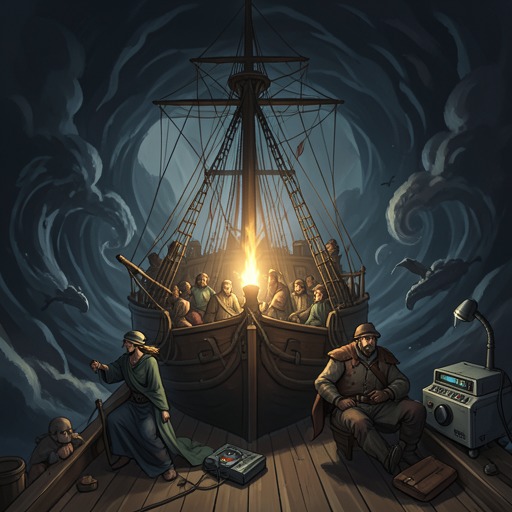
The Empress places Fire-stone in one of two chapels she has built, setting it against a lining of diamonds. Because fire has no power over diamonds, the lining provides a surface on which the stone can burn without consuming the chapel’s decoration. Artificial pipes carry water into the room; when the Empress turns a tap, water springs over the interior and keeps the Fire-stone wet, making the chapel appear to be aflame for as long as the water continues to act on it.
The chapel stands on pillars in the center of a round cloister that is dark as night. Its only illumination comes from the Fire-stone, and the chapel is open to view from within the cloister. It is one of a pair of chapels that move continuously in opposite directions around their own centers. The companion chapel is lined with Star-stone, whose light is bright and comforting but gives off no heat. Together, the two spaces make a deliberately legible contrast: the Fire-stone chapel serves as an emblem of Hell, while the Star-stone chapel signifies Heaven.
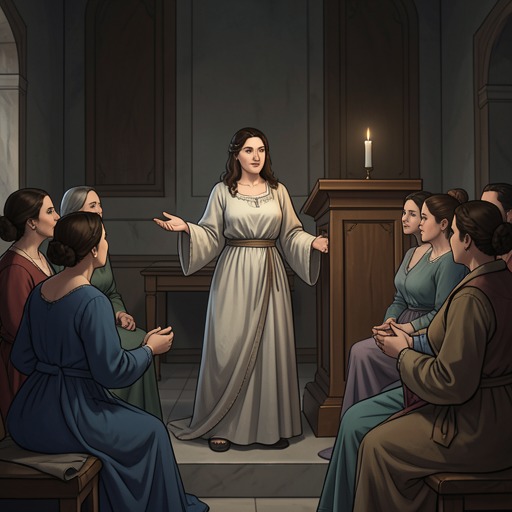
In the Fire-stone chapel, the Empress preaches sermons of terror and warns the wicked of everlasting punishment after death. She can endure the flame’s heat: the narrative explains that the water’s self-motion, combined with the stone’s natural motions, produces a flame weaker than one fed by other fuel. In the neighboring chapel she offers comfort to those who repent. The stone’s theatrical force thus supports an argument about belief, but the Empress’s method is not to compel it by violence. She uses the opposing effects of the chapels to persuade her subjects, reasoning that love sustains duty more reliably than fear.
From Religious Display to Naval Strategy
When the Empress later prepares to help her native country, the Duchess of Newcastle proposes a military use for Fire-stone. The expedition’s golden ships are not equipped for cannon warfare, and their strength and mobility would not by themselves prevent an enemy from boarding them. The Duchess instead recommends using the stone against the wooden ships of the opposing fleet: Worm-men should collect a large quantity from the burning mountains, and the stone should be used to set the enemy vessels alight. If the fleet’s ships are destroyed and its navigation obstructed, the Empress can gain control over a country whose regions depend on navigation.
The Duchess also identifies a second use for the stone: as a source of light or torches in the Empress’s native world, where nights are dark and the stars provide little illumination. The Empress approves the plan and sends Worm-men to gather a considerable supply. She organizes the expedition with Fish-men accompanying the ships underwater, Bird-men serving in the air, and Bear-men and Worm-men travelling aboard the vessels. The stone therefore belongs to a broader arrangement of materials, creatures, and specialized tasks rather than acting as a weapon in isolation.
The Fleet’s Display
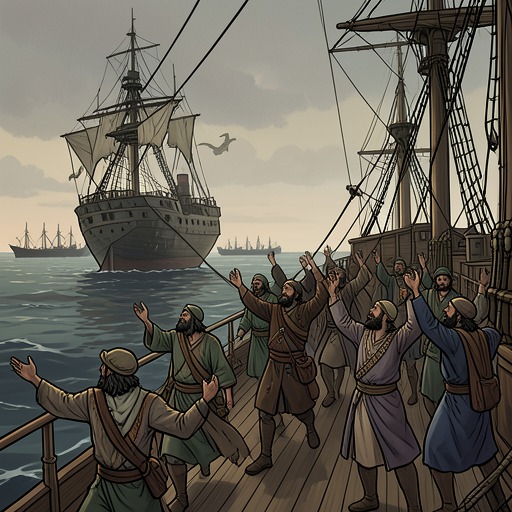
Before the Empress reaches the enemy, she sends Fish-men and Bird-men to gather intelligence about the fleet’s number and position. At night, she orders the Bird-men to carry Fire-stones whose tips have been wetted, while the Fish-men carry stones out of the water. Cut into the form of torches or candles, the many thousands of burning pieces make the air and sea appear to be on fire. The people on or near the water mistake the spectacle for the coming of the Last Day and fall to pray.
At daybreak, the Empress orders the lights extinguished. The enemy then sees ships without sails, guns, or other instruments of war, apparently moving without assistance. Their hulls are golden, but the Empress has had them painted black or another dark color, concealing the gold even from the best Telescopes. The night’s fiery display and the morning’s inexplicable ships leave the enemy unable to decide what they are seeing or which side the vessels belong to; the confusion is sufficient to prevent the fleet from moving. Fire-stone’s role here is both material and strategic: its wet flame creates the night spectacle, while the contrast between that spectacle and the unarmed-looking ships compounds the enemy’s uncertainty.
Significance
Fire-stone links a natural phenomenon to two different kinds of authority. In the chapels, the Empress uses a controlled, visible transformation to give theological ideas a public form and to encourage religious adherence through persuasion rather than force. In the expedition, the Duchess turns the same property into a plan for disabling wooden ships and intimidating their crews. The stone does not have one fixed meaning: the Empress makes it an emblem of punishment, while the Duchess makes it an instrument of strategic advantage.
Across both episodes, the stone’s effects emerge from interactions among material conditions and deliberate arrangements. Water sustains its flame; pipes, chapel linings, darkness, and moving architecture shape its religious display; wet tips, aerial and underwater carriers, and the timing of night and day shape its military use. Fire-stone is therefore more than a passive symbol or a convenient tool. Its distinctive behavior makes possible effects that alter how people understand a scene and how they act within it, while human ingenuity directs that material force toward political or religious ends.