Fox-men
The Blazing WorldFox-men are an upright, fox-shaped people of the Blazing-World whose first appearance helps turn the Lady’s perilous arrival into a passage through a network of hospitable communities. Later, the Empress makes them her politicians, placing them within a system that assigns different peoples specialized public roles. The narrative also returns to them as performers in comic entertainment, so that the same species can signify practical political service and theatrical variety.
First Encounters and Passage
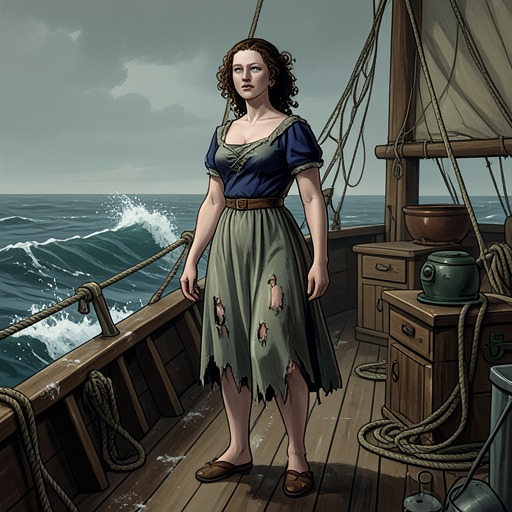
The Lady first encounters Fox-men after the Bear-men remove her from the boat and take her to their underground city. Because her constitution does not suit the cold climate or the Bear-men’s diet, they resolve to carry her to a warmer island. There, upright Fox-men receive their Bear-men neighbours with civility and courtliness, and admire the Lady. After the groups confer, they agree to present her to the Emperor of the Blazing-World. Fox-men thus enter the story not as captors but as participants in an orderly chain of reception and escort that moves the Lady toward the imperial court.
The journey proceeds through a succession of communities and waterways. Bear-men and Fox-men attend the Lady as she is carried across a clear river in boats resembling fox-traps. On the next island, Geese-men join the escort; further travel brings them among Satyrs, and onward to a green-complexioned people who provide what is needed for the voyage across open sea. The Fox-men’s place in this sequence is significant: their welcome and cooperation help make the Lady’s transfer between peoples possible, while the repeated courteous exchanges present movement through the world as a social as well as a geographical passage.
Political Office and the Empress’s Order
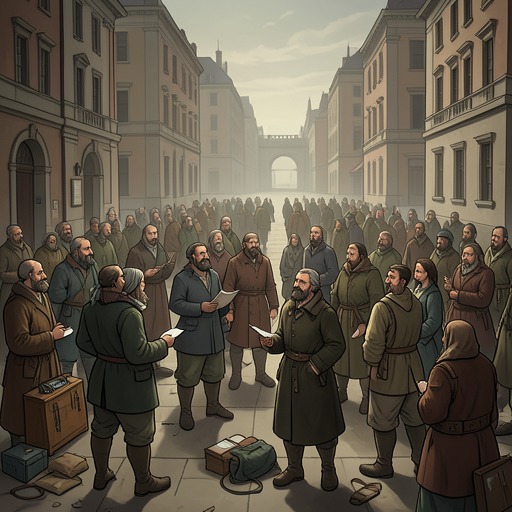
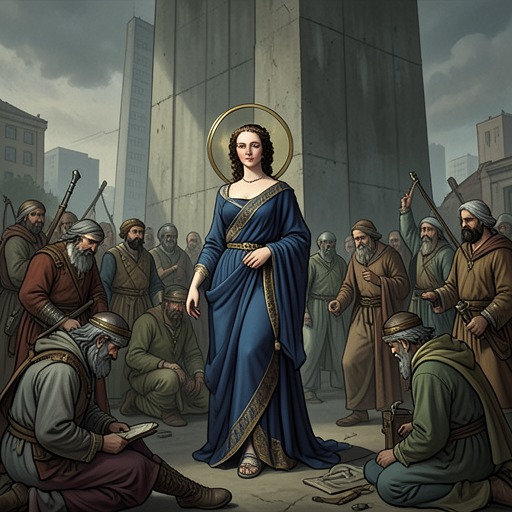
After the Lady reaches the imperial world and becomes Empress, she encourages the different kinds of people to pursue arts and sciences suited to their species, establishing schools and learned societies. Within this classification, Fox-men become her politicians. Their assigned profession places them alongside other specialists: Bear-men serve as experimental philosophers, Bird-men as astronomers, and Ape-men as chymists. The arrangement treats the population’s bodily and species differences as a basis for differentiated public labour, while the Empress’s patronage organizes those differences into institutions.
This political role belongs to a polity that prizes unity. Its rulers explain that few laws help prevent divisions and factional conflict, and defend monarchy as a single head for a political body, corresponding to their worship of one God and obedience to one Emperor. Fox-men are named as political specialists within that unified framework, but the text does not describe particular policies or decisions they make. Their significance lies in their place in the Empress’s professional order, not in a separately narrated career or individual political action.
The work also makes clear that this ordered society has exclusions. The Empress learns that women are barred from public religious congregations and public employment; the priests and governors are made eunuchs to prevent marriage, while women are said to influence public affairs indirectly through husbands and parents. These arrangements belong to the world in which the Fox-men hold their assigned political office. Their presence as a species-specific profession therefore sits within a broader structure that distributes authority selectively, even while the society presents itself as harmonious and unified.
Learning, Disagreement, and the Limits of Order
The Empress’s learned societies do not remain free of conflict. Bear-men experimental philosophers and other groups engage in disputes, and the Empress fears their divisions may turn into rebellion. Her response, guided by the Duchess’s advice, is to restore the earlier form of government: one sovereign, one religion, one law, and one language, and to dissolve the societies whose contests threaten political quiet. Fox-men are among the groups named in the account of this factional tension and the proposed dissolution. The passage does not detail a particular Fox-men dispute; instead, it places them within a larger conflict between organized learning and the ruler’s demand for civic stability.
That tension complicates the ideal of peaceful unity. The world’s common language and single sovereignty are associated with freedom from domestic insurrection, but the Empress’s effort to secure order limits institutional debate. The Fox-men’s political specialization belongs to a system that values useful knowledge and expertise, while the later recommendation to disband contentious societies shows the danger that such organized expertise may be seen to pose. Their role is consequently both an emblem of differentiated civic service and part of a society in which the boundaries of permissible disagreement are set by sovereign authority.
Comedy and Courtly Recreation
Fox-men reappear outside their political function in the discussion of theatre. The Duchess’s soul argues that the Blazing-World’s varied peoples are especially well suited to farce, naming Fox-men alongside Lice-men, Bird-men, Spider-men, Ape-men, and Satyrs. The Emperor and Empress invite her to stay and organize a theatre, but she asks leave to return to her own world and promises to visit again. The text does not show a performance being staged; it presents the Fox-men as potential material for theatrical comedy, part of a broader imaginative use of the world’s many forms.
They also appear in the Empress’s public recreation. Races are arranged among different kinds of people: Fox-men race against Ape-men, and Satyrs sometimes try to outrun them. The scene places Fox-men among the participants in courtly spectacle rather than in an account of government. Together with their proposed comic use, these contests make them recur as part of the world’s visible variety: a political people in the Empress’s administrative scheme, but also a species whose distinctiveness can animate play and entertainment.
Narrative Significance
Fox-men have no individually named member or separately developed personal arc in the supplied episodes. Their characterization is collective and functional: they are courteous hosts during the Lady’s journey, politicians in the Empress’s classification of useful professions, a group implicated in broader factional tensions, and participants in racing and prospective farce. The shifts in emphasis reveal how the Blazing-World’s social imagination converts difference into both labour and spectacle.
Their initial hospitality gives the journey a practical social structure: the Lady can move onward because communities receive and accompany her. In the imperial setting, that interdependence becomes more formal, as the Empress assigns kinds of people to specific disciplines and services. The later appearances in factional debate and leisure keep the Fox-men from belonging to a single narrative purpose, though the evidence offers no private perspective from which to judge how they experience these roles. They remain a collective presence through which the book depicts an ordered, diverse society—and the political and theatrical uses that society makes of its diversity.