Imaginative world-making
The Blazing WorldImaginative world-making in The Blazing World turns authorship into a form of sovereignty. A human mind can fashion an inhabited world from its rational parts, while the book itself offers its author a kind of dominion that earthly conquest cannot: creation without the same disturbances and deaths, and the freedom to imagine political orders otherwise. The idea links the Duchess of Newcastle’s private making to the Empress of the Blazing-World’s public government, but it does not erase the difference between them or the coercion shadowing the imagined ideal.
The Mind as a World-Maker
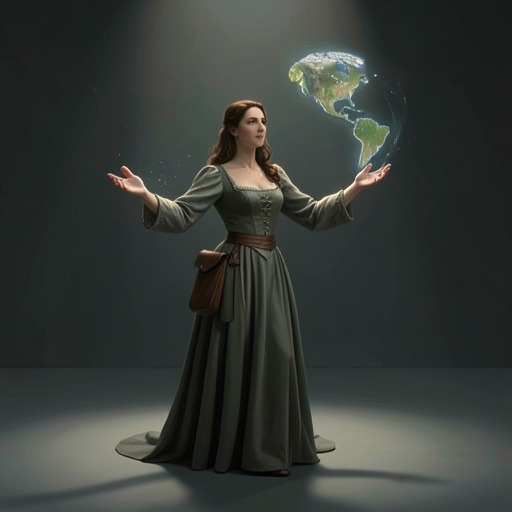
The book presents imaginative creation as more than a retreat into fancy. In the epilogue, the author identifies the Blazing World and the philosophical world discussed earlier as compositions of the pure, rational parts of matter, which are also the parts of her mind. Their making, she says, was swifter and easier than the conquests of Alexander and Caesar. Where those famous monarchs brought widespread destruction, her worlds required far fewer deaths: she recalls only the men in a small boat, who died from extreme cold after, as she explains, justice punished them for abducting a young and beautiful lady.
This comparison makes the author’s creative achievement both imaginative and ethical. She claims greater pleasure and glory in forming worlds than Alexander or Caesar found in conquering the terrestrial one, and measures authorship against political and military fame. Yet her imagined power is not limited to a single model of society. She could make another world full of factions, divisions, and wars, and people it with figures as courageous as Hector and Achilles, as wise as Nestor, as eloquent as Ulysses, or as beautiful as Helen. The capacity to create conflict is present; choosing peace is part of the author’s design.
From Ambition to an Inner World
The Duchess’s conversation with the Immaterial Spirits gives this idea a personal and philosophical form. When they ask why she would seek to become Empress of a material world, they contrast the burdens of sovereignty with the pleasures of making an immaterial one within the mind. A monarch, they point out, bears the general trouble of ruling, while subjects enjoy the world’s pleasures in particular places; no single person can enjoy an entire kingdom at once without travelling through it and enduring the difficulties of the journey. Even the Empress, who possesses a world, does not know all the countries and dominions she governs.
The Spirits also challenge the value of public glory: it lives in other people’s opinions and can neither bring tranquility to the mind nor ease to the body. By contrast, a mind-made world can be enjoyed in whole and in parts, altered at will, and made without external control or opposition. The Duchess accepts their counsel, renounces her ambition to rule an outward world, and resolves to make one of her own. The episode recasts world-making as an alternative to the burdens of political power, not simply as a smaller version of it.
The book’s authorial framing makes that alternative concrete. In the dedication, the Duchess says that Fortune and the Fates have given her no world, so she has made one herself. Her wish to be “Margaret the First” redirects the language of monarchy toward authorship: without the power or occasion to become a great conqueror, she can still become mistress of a world through invention. Her ambition remains emphatic, but it takes a form that does not require possession of an earthly throne.
Private Creation and Public Rule
The Duchess’s inward freedom sits beside a political ideal embodied by the Empress. When the Duchess advises her friend on the unrest in the Blazing-World, she recommends a return to one sovereign, one religion, one law, and one language, so that the world can be united like a single family. In her account, competing authorities and opinions in her own world produce discord, while uniformity promises peace. The Empress’s rule thus gives imaginative world-making a public counterpart: the mind creates a world, and the sovereign orders one.
But the ideal is not free of contradiction. The Empress’s society excludes women from public religious assemblies and offices: women pray at home, while priests and governors are made eunuchs to prevent marriage and the influence of families on church and state. The Empress herself responds by establishing a congregation of women, preaching to them, and converting them to her religion. Female authority and spiritual capacity are therefore asserted through her actions even as the existing institutions deny women public religious participation.
The same tension appears in the management of knowledge. The Empress initially orders the Bear-men’s telescopes broken, judging their reports misleading, but relents when they plead that artificial delusions give them pleasure and provide subjects for dispute. She permits their instruments only on condition that arguments remain within their schools and do not disturb government. Later, when factional disputes threaten the state, the Duchess advises dissolving the learned societies altogether. The pursuit of knowledge and the pleasures of intellectual disagreement remain possible, but political order determines the limits within which they may continue.
Peace, Conquest, and the Author’s Choice
The epilogue’s celebration of a peaceful world must also be read against the Empress’s exercise of force abroad. When maritime nations refuse to pay tribute to the sovereign of the Empress’s native country, she orders their ships destroyed; when some nations resist again, she threatens to burn their towns and sends Bird-men and Worm-men to attack them. The Duchess’s ideal of unified government therefore coexists with the destruction of ships and settlements in the name of submission. Peace describes the order the author prefers within her imagined world, not an absence of coercion in the wider political story.
The closing declaration makes the author’s preference explicit. She esteems peace before war, wit before policy, and honesty before beauty, and chooses the figure of Honest Margaret Newcastle over the heroic and beautiful figures she could otherwise create. The choice does not imply an inability to imagine martial courage or political grandeur; the epilogue has just shown that she can. Rather, it identifies what she wishes her world to honor and what kind of figure she values within it.
Finally, the author distinguishes her creative sovereignty from the Empress’s. Readers who like the world may imagine themselves as its subjects in their minds, fancies, or imaginations; those who dislike subjection may create worlds of their own. Yet they must not unjustly usurp hers. The philosophical world belongs to the author, while the Blazing World already has an Empress, her dear Platonic friend, whose government she refuses to disturb or overthrow. If another friend needs a world, the author will make another. World-making thus ends as both a claim to authorship and a limit placed on that claim: imaginative sovereignty can multiply worlds without requiring the author to depose another woman from hers.