Imperial conquest and tribute
The Blazing WorldImperial conquest and tribute names the transformation at the heart of the Empress’s expedition: what begins as assistance to her native country becomes a campaign to make the King of Esfi absolute master of the world. The Empress presents her force as protection and her demands as the means to peace, but the settlement is secured by burning fleets and towns, destroying commerce, and compelling submission. The distance between that benevolent claim and the coercion that fulfills it gives the episode its political tension.
From Aid to Sovereignty
The Empress first declares that she has crossed from the Blazing-World to save her native kingdom from enemies who intend to make war on it, weaken its naval power, and destroy it. She says she seeks no bargain or private advantage: she is willing to leave behind her own tranquility, riches, and pleasure, and asks only for gratitude and recognition of her loyalty. Her offer goes beyond immediate defense, however. She promises to make the kingdom the most powerful nation in the world and to destroy its enemies before the following night.
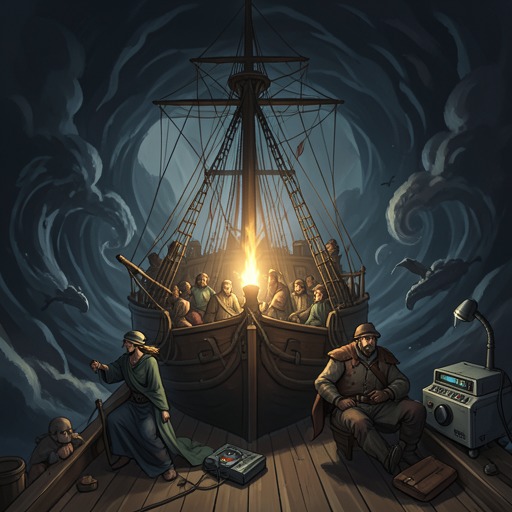
Her intervention is staged to make power visible before it is exercised. At night, Bird-men and Fish-men carry Fire-stones whose wet tips blaze like torches, making the air and sea seem to burn. The enemy fleet believes the Last Day has come and falls to prayer. At daylight, the Empress’s ships appear without sails, guns, or other weapons; painted black, their golden hulls cannot be recognized even through the best Telescopes. The spectacle leaves the opposing fleet too frightened and bewildered to act.
The Empress then sends a letter to the enemy commanders, identifying herself as a powerful princess who has come to assist the country whose colors she recognizes. She asks them to declare when they want her help. Their council cannot promptly agree on an answer, and the delay angers her enough that she considers returning to the Blazing-World without aiding her countrymen. The Duchess counsels patience, explaining that councils are slow because their members hold different opinions and compete to appear wise. This pause exposes a contrast between the political worlds: the Empress’s swift, centralized command meets the slower deliberations of a divided government.
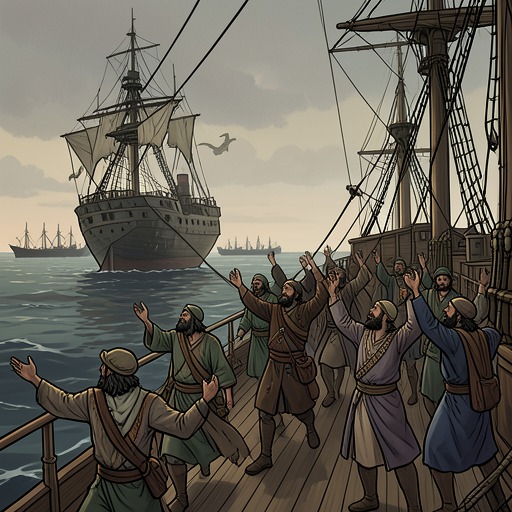
When the Empress appears before her countrymen, she announces that her aid will make them powerful and assures them she will destroy their enemies. The people respond with thanks, but her appearance and powers produce competing explanations: some call her an angel, others a sorceress, a goddess, or a devil in the shape of a beautiful woman. The episode therefore makes political authority a matter of both force and spectacle. Her countrymen’s uncertainty about what she is does not prevent them from accepting her intervention.
Naval Victory and the Tribute Demand
On the morning of battle, the Empress appears above the water in jeweled imperial robes, holding a carbuncle shield and a diamond spear. She orders the Fish-men to carry Fire-stones in diamond cases and uncover and wet them only when close beneath or beside enemy ships. The stones ignite the vessels; when the flames reach the gunpowder, the ships explode. The hostile navies are destroyed in a short time. The Empress refuses to return to the Blazing-World after this victory, resolving first to force the rest of the world to submit to her native nation.
The naval destruction is followed not by a peace negotiated between equal powers but by a demand that the maritime nations pay tribute to the King of Esfi. The King tells the Empress that surviving enemies still obstruct the trade and commerce of his dominions. She answers that she will burn or sink any ships that refuse tribute, then invites the neighboring seafaring nations to pay. They reject the demand with scorn; she orders the Fish-men to destroy foreign trading ships. Faced with the damage to their affairs and designs, the nations ask to negotiate, but the only terms she will accept are submission and payment to the King. Their dependence on maritime commerce makes the threat effective: once they yield, the King becomes master of the seas and consequently of the world, because the nations cannot readily live without sea trade as well as land trade.
Submission does not end resistance. After a short time, the tributary nations judge themselves so constrained that they can scarcely move beyond their own dominions without an expensive charge. They join forces against the King, and the Empress again sends the Fish-men to destroy the remainder of their naval power. Most submit once more, but some states refuse: a few can live without foreign trade, while others trade only by land. Their refusal reveals the limit of the maritime blockade. To complete the conquest, the Empress must turn from control of the sea to direct attacks on territory.
Fire-Stones and Compulsory Submission
The Empress threatens to burn the towns and cities of the states that will not pay tribute. She initially orders a measured campaign: Bird-men and Worm-men are to begin with smaller towns, because she is reluctant to cause more destruction than necessary, and to proceed against larger cities only if resistance continues. The Worm-men explain that they can travel beneath the earth as easily and quickly as people walk on its surface, allowing them to reach the target settlements. Before the operation, the Empress orders the Bear-men to identify the defiant towns through their Telescopes, then directs the Bird-men and Worm-men where to strike.
The attack turns rain into an instrument of terror. Traveling by night so they will not be seen, the Bird-men and Worm-men plant Fire-stones at the foundations and rooftops of houses. The Bird-men learn a few words of the local language and warn the inhabitants that the next rain will set their towns alight. The people laugh at this prediction because they expect water to quench fire. When rain falls, however, the houses burst into flames, and the more water is poured on them, the more intensely they burn. The warning, the apparently impossible mechanism, and the flames themselves make a public demonstration of the Empress’s power; neighboring cities and kingdoms submit for fear the same destruction will reach them.
One country still resists because it seldom receives rain, relying instead on dew that would quickly be spent in a great fire. The Empress adapts the method to its conditions. Since the country is inundated each year by a tide lasting several weeks, and its houses stand on supports fixed into the ground, she orders Fire-stones placed at the supports. When the tide arrives, the houses catch fire; the water is rarified into vapor and then air, and the country suffers both the destruction of its houses and a general barrenness that year. It too submits. The campaign’s success depends not on one weapon used mechanically, but on applying the stones to each territory’s particular vulnerabilities.
Empire, Pageantry, and the Claim of Peace
The Empress’s victory makes her native country the absolute monarchy of the world, and the King of Esfi its head monarch. She later tells assembled princes that their sovereign was unjustly attacked over hereditary rights and prerogatives of the Narrow Seas. Heaven, she claims, has rewarded him with absolute power; those who resist will gain loss rather than victory. She urges the princes to pay tribute so that they may live peacefully and happily and receive Heaven’s blessings. The language of justice, providence, and peace presents submission as both politically unavoidable and morally proper.
The audience that frames this declaration is another carefully managed display of imperial authority. The princes assemble their ships in a broad circle at sea, and the Empress appears in jeweled robes. At the darkest hour, Fire-stones make the air and water glow; the frightened spectators believe they may be destroyed. She extinguishes the lights and shows herself alone in garments of light, then is carried into the air by Bird-men. Fish-men sing from the sea, answered by the Bird-men above, so that air and water seem to converse in song. At daybreak she meets privately with the King of Esfi, assures him that she will assist whenever required, and says that she lacks no intelligence. She then addresses the princes and presents tribute as the peaceful alternative to futile resistance.
After the speech, the princes’ ships draw back. The Empress’s fleet enters their circle without visible help from sails or tide; when she boards her own ship, the fleet immediately sinks beneath the sea and stays submerged until it reaches the Blazing-World. The departure extends the same political theatre that accompanied her arrival: the force behind the new order is made visible in spectacle, then withdrawn from sight. The princes are left in amazement, but the terms of their submission have been stated plainly.
The Cost of the New Order
The narrative describes the outcome as both salvation and conquest. The Empress has saved her native country from destruction, yet she has also compelled the world’s rulers to submit to its monarch and made the kingdom an absolute power. Her protection is not an empty pretext—she does destroy the fleets threatening her countrymen—but the protection expands into a system in which foreign ships, commerce, and finally towns are exposed to destruction unless rulers accept the King’s supremacy and tribute.
This outward campaign stands in contrast to the Empress’s explanation of good government within the Blazing-World. There, she and the Duchess discuss the dangers of faction among learned societies and the value of restoring one sovereign, one religion, one law, and one language. The Empress has already accepted the condition that scholarly disputes remain within their schools rather than disturb government. Imperial unity is thus associated with the ending of division, but the means used abroad are more severe than the containment of debate: fleets are burned, towns are set alight, and a resistant country is made barren. The episode sets the promised peace of political unity beside the violence required to impose it.
The Empress’s own account of her conduct also contains a revealing limit. She tells the King of Esfi that she wants no riches for herself, and later explains that she refuses to enrich her family because abundance makes people covetous and drives them to destroy one another for wealth. Yet she undertakes a vast material campaign to secure the King’s power and tribute from other nations. The story does not equate her personal restraint with restraint in government: she can distrust private riches while using overwhelming force to establish a world-wide political hierarchy. Imperial conquest and tribute is therefore not simply the restoration of safety, but the conversion of military rescue into durable supremacy, justified in the language of loyalty, hereditary right, divine favor, and peace.