Imposition of Tribute on the Maritime Nations
The Blazing WorldThe Imposition of Tribute on the Maritime Nations is the decisive turn in the Empress’s expedition to aid her native country: what begins as assistance against an invasion becomes a bid to make the King of Esfi master of the wider world. By destroying hostile fleets and making access to maritime trade conditional on tribute, the Empress converts military rescue into an enduring hierarchy of subjection.
From Aid to Maritime Supremacy
The Empress first offers help in the language of loyalty to her birthplace. She writes to its commanders that she is a powerful princess who has come to assist them, and later tells her countrymen she has left the tranquillity, riches, and pleasures of her own world rather than see them ruined. Her stated aim is to make them the most powerful nation, and she promises to destroy their enemies. Once the enemy fleets have been burned, however, the assistance expands beyond immediate defense: the King of Esfi tells her that hostile naval forces still obstruct the trade of his dominions, and she offers to burn or sink ships that will not pay him tribute.
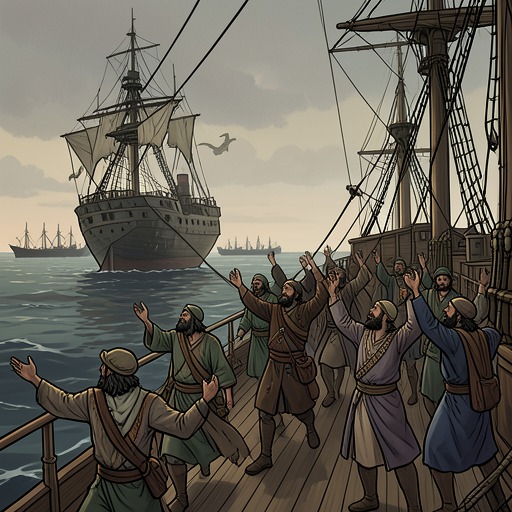
The Empress accordingly sends word to neighboring nations that trade by sea to demand payment to the King of Esfi. They reject the demand with scorn. She answers not with further negotiation but by ordering her Fish-men to destroy foreign ships engaged in maritime trade. The sequence makes the change in the expedition’s purpose visible: the fleet that had come to rescue the Empress’s country now polices the sea on behalf of its sovereign.
Enforcement and Resistance
The destruction of shipping unsettles the neighboring kingdoms and disrupts their affairs. They eventually seek terms, but the Empress allows no alternative to submission and tribute; she threatens to ruin their trade by burning their ships. The negotiations are prolonged, yet the nations gain no better conditions. Their submission makes the King of Esfi master of the seas and, in the Empress’s account, effectively master of the world, since the nations cannot readily live without commerce by sea as well as by land.
That submission does not end resistance. The neighboring nations later unite their forces again against the King of Esfi. The Empress sends her Fish-men to destroy what remains of their naval power, and they are soon compelled to submit once more. The account marks exceptions: some nations can live without foreign trade, while others conduct their commerce entirely by land. These states refuse to become tributaries, showing the limits of maritime pressure and prompting the Empress to threaten a different kind of coercion.
From Sea Blockade to Threatened Conquest
Against the states that remain outside the tribute system, the Empress threatens to set their towns and cities on fire and reduce them by force to what they would not willingly accept. She orders the Bird-men and Worm-men to begin with smaller towns, since she is reluctant to cause more destruction than necessary, and to destroy larger cities if resistance continues. The Worm-men can travel beneath the earth as easily as people move across its surface; the Empress deploys this ability to place Fire-stones under house foundations, while the Bird-men are assigned to approach at night. The policy extends coercion from ships and commerce to settlements on land.
The campaign thus links a claimed defense of the Empress’s native country to tribute, renewed naval destruction, and the threatened burning of towns. Its stated beneficiary is the King of Esfi, whose authority the Empress presents as rightful and whose supremacy she tells the princes of other nations they cannot prevent. Yet the means that establish that supremacy are not voluntary agreement: refusal brings the destruction of trade, ships, and potentially cities. The episode’s central political reversal is that an offer of protection ends by requiring other peoples to finance and acknowledge the protector’s chosen sovereign.