King of Esfi
The Blazing WorldThe King of Esfi is the sovereign of the Empress’s native country and the beneficiary of her intervention in a war that threatens his dominions. He appears chiefly through reports and through the Empress’s public declarations: the narrative gives little access to his private character, but makes his political transformation unmistakable. With the Empress’s military aid, a ruler whose country is under attack becomes the head monarch of the world, supported by a system of tribute imposed through force.
Identity and Political Position
The King rules several kingdoms in the country where the Empress was born. When she arrives from the Blazing-World, she identifies herself as a native of his realm and presents her intervention as loyalty to her homeland. The King is not initially described as commanding the wider world: the immediate crisis is that hostile powers threaten his country and its naval strength, while their ships obstruct the trade and commerce of his dominions.
His position is therefore both hereditary and precarious. The Empress calls the other nations’ attack an assault on his hereditary rights and prerogatives over the Narrow Seas, but the military imbalance is plain enough that he needs outside assistance. The contrast between his exposed realm and the power she brings from another world sets the terms for everything that follows: aid will preserve his rule, but it will also magnify it far beyond its former reach.
Rescue and the Empress’s Offer
Before meeting the King, the Empress sends an envoy to the native country’s naval commanders. Her letter announces that she is a powerful princess who has come to assist them, and asks them to say when they want her help. Their council cannot quickly agree on a response because its members hold competing opinions. The Empress grows angry at the delay and considers leaving without helping; the Duchess of Newcastle persuades her to be patient with a council whose many voices make decision slow.
When the Empress finally addresses the countrymen, she explains that she has crossed from another world to defend her birthplace. She presents the offer as free of bargaining or self-interest: she would rather surrender her own tranquillity, riches, and pleasure than see her native country ruined. She promises to destroy its enemies at sea and to assist against enemies on land, and asks only for grateful acknowledgment of her love and loyalty. The speech frames intervention as rescue and patriotic service, while its promise to make the country the most powerful nation already points beyond the immediate defense of the realm.
The naval commanders report the deliverance and conquest to their sovereign, along with the Empress’s design to make him the most powerful monarch in the world. The King then sends his thanks for her aid and asks for further service: although the enemy has been partly destroyed at sea, its remaining strength still hinders the trade of his dominions. His request turns the campaign from the defense of a threatened country toward control of maritime commerce.
From Naval Victory to Tribute
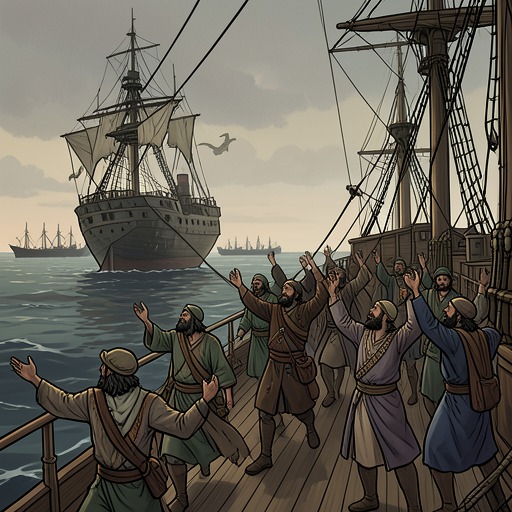
The Empress answers that she will burn or sink any ships that refuse to pay the King tribute. She sends this demand to neighboring nations engaged in sea trade, but they reject it with scorn. She then orders the Fish-men to destroy foreign trading ships. The devastation disrupts the neighboring powers’ affairs, and they ask to negotiate; the Empress offers no alternative to submission and tribute. After a long treaty, they yield, and the King becomes master of the seas and, through the importance of maritime trade, effectively master of the world.
That settlement does not end resistance. The neighboring nations soon conclude that they have been made so dependent on costly tribute that they can scarcely move beyond their own dominions, and they unite their forces against the King. The Empress again sends the Fish-men to destroy the remaining naval power, compelling the coalition to submit once more. Some inland or self-sufficient nations, however, can live without foreign commerce and refuse to become tributaries. The limits of sea power thus prompt a further escalation: the Empress threatens to burn their towns and cities if they will not submit willingly.
Conquest by Fire and the King’s New Status
To subdue the resisting nations, the Empress sends Bird-men and Worm-men against their settlements. She orders that smaller towns be targeted first, because she is reluctant to cause more destruction than necessary, while warning the rulers that continued resistance will turn limited losses into total ruin. The Bear-men use telescopes to identify the towns and cities that refuse submission; the Bird-men travel by night, and the Worm-men move underground. They place Fire-stones beneath house foundations and on rooftops. The Bird-men warn the inhabitants that rain will set their towns alight, a prediction the people dismiss because they expect water to extinguish fire.
When rain comes, the Fire-stones ignite the houses, and the water intensifies rather than quenches the flames. The terror spreads through neighboring cities and kingdoms, which submit to the King. One country, where rain is rare, still defies the demand. The Empress exploits its annual incoming tide: Bird-men and Worm-men set Fire-stones beneath the supports on which its raised houses stand. When the tide arrives, the houses burn; the water becomes vapor, and the country suffers a general barrenness that year. It too is forced to submit. The campaign ends with the Empress having saved her native country and made it the absolute monarchy of the world, with the King at its head.
Sovereignty, Spectacle, and the Cost of Peace
The Empress’s final address to the assembled princes names the King as the head monarch of the world. She describes him as unjustly attacked and his rights over the Narrow Seas as injured; in her account, Heaven has answered those injuries by granting him absolute power. She advises the princes to pay tribute so they may live peacefully and happily, but warns that resistance will bring loss without victory. The speech converts military success into a public claim of rightful sovereignty, joining divine favor, inherited rights, and the threat of further defeat.
The King’s enlarged authority rests on a striking reversal. What begins as aid to a native country ends with neighboring states compelled to finance its monarch and resistant towns burned into submission. The Empress speaks of peace as the desired condition, yet the order she establishes depends on naval destruction, coercive tribute, and exemplary violence. The King gains security and an unprecedented dominion, while the narrative makes the means of that gain impossible to separate from its consequences: a world united under his sovereignty is also a world whose independent refusal has been systematically overcome.