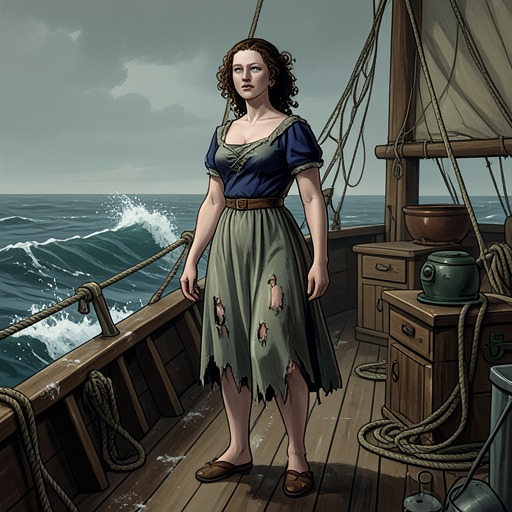
Lady’s Abduction and Passage into the Blazing-World
The Blazing WorldThe Lady’s Abduction and Passage into the Blazing-World begins with an act of theft and becomes a journey across worlds. A merchant abducts a young lady from a foreign shore, but a storm carries their boat through the Icy Sea and into the Blazing-World. The men aboard perish, while the lady survives and is conveyed from one people to another until she reaches Paradise, the Emperor’s seat. Her passage moves from captivity and mortal peril to the first possibility of safety, while introducing a world ordered by strange bodies, customs, and political unity.
Abduction and the Storm
The merchant is travelling in a foreign country when he falls in love with the young lady. Because he is a stranger and inferior to her in both birth and wealth, he has little hope of winning her; as his desire intensifies, he decides to take her away. Her father’s house stands near the sea, and she often gathers shells on the shore with only two or three servants, giving the merchant an opportunity to act. He arrives in a small, lightly built vessel with a few sailors and provisions for a potentially delayed voyage, then carries her off.
The apparent success of the abduction immediately reverses. A storm rises, and the crew cannot determine where to steer. Driven by the wind, the boat races toward the North Pole and enters the Icy Sea, where ice and the violent motion of the weather threaten its passage. The narrator frames the storm as a consequence of Heaven’s disapproval of the merchant’s theft, making the journey’s first turn both physical and moral: the scheme that seemed to promise the merchant happiness instead exposes everyone aboard to danger.
The boat passes beyond the pole of its own world and reaches the adjoining pole of another. The account explains this passage through a cosmology in which the worlds meet at their poles, preventing a traveller from circling the globe from pole to pole; arrival there forces a return or an entry into another world. Each world has its own Sun, moving within its own circuit. This explanation gives the lady’s displacement a specific geography: she has not merely been carried to an unknown country, but across the boundary between separate worlds.
Survival and First Contact
The cold kills the sailors, while the young lady alone remains alive. Their bodies, preserved from decay by the freezing conditions, begin to thaw as the boat moves onward. Unable to throw them overboard, she leaves the small cabin for the deck. Between two expanses of ice, she finally sees land beneath snow. Strange creatures, shaped like bears but walking upright, come across the ice, seize the vessel with their paws, and enter to inspect it. After speaking among themselves in a language she cannot understand, they carry her out and sink the boat with the dead men.
The lady’s arrival on land is marked by fear, but the Bear-men’s conduct counters her expectation of cruelty. Unable to walk securely on the slippery ice, she is carried in their arms to a city of underground caves. The inhabitants, males and females, young and old, gather to look at her in astonishment. In a spacious cave, the Bear-men leave her with their females, who receive her respectfully and provide their customary food. When they recognize that neither the climate nor the diet suits her constitution, they arrange to take her to a warmer island. Their response turns first contact into a sequence of practical acts of care, even as the lady remains dependent on people whose language and customs are unfamiliar to her.
Passage Through the Islands
The Bear-men bring the lady to an island inhabited by upright Fox-men. The Fox-men welcome their visitors and admire the young lady; after conferring with the Bear-men, they agree to present her to the Emperor. Their escort carries her across the island to a clear river, where she travels in one of many boats shaped like fox-traps, attended by Bear-men and Fox-men.
Across the river, Geese-men, also called Bird-men, join the procession. They have goose-like heads, beaks, and feathers, but walk upright; their wings are as long as their bodies, and their tails trail behind them. After the Bear-men and Fox-men explain their purpose, some Bird-men accompany the party across their island and to another river. From there, the lady continues in larger boats resembling birds’ nests. The successive encounters are organized around hospitality and escort: each community receives the travelling party, joins it, and helps carry the lady onward.
The next island is mild and wooded, and its inhabitants are Satyrs. They receive the Bear-men, Fox-men, and Bird-men courteously; after discussion, some of their leaders accompany the lady to another river, where commodious barges are ready. Beyond it lies a spacious kingdom whose people have grass-green complexions. They provide for the party’s further voyage, but this time a river crossing is not enough: the travellers must sail across open sea to the island where the Emperor resides.
The Sea Route and Arrival at Paradise
The people who prepare the sea voyage are described as skilled navigators despite having no knowledge of the lodestone, needle, or pendulous watches. Their experience and observations allow them to judge the sea’s depth and locate sandbanks, rocks, and other hazards. They also use a powerful engine that draws in air and shoots it out as wind. At sea, the device is placed behind a ship in calm weather and in front during a storm; its artificial wind can batter waves aside and help force a passage through them. When waves and wind threaten a separated fleet, the ships can be fastened together in close formation, like a honeycomb, so that the storm cannot pull them apart.
The contrast between the Emperor’s gold ships and the merchants’ leather ships gives the voyage a further material distinction. The gold vessels are carefully joined and need none of the pitch, tar, pumps, or guns that make wooden ships heavy; the lighter leather ships are pitched against water but are less secure. These details present passage through the storm as a collective achievement of craft and coordination, rather than a simple journey through scenery. Meanwhile, the lady’s own response changes: at first tormented by fear and uncertainty about whether the adventure will end in safety or destruction, she takes courage from the civility and diligence of her attendants. She tries to learn their language and, once she can partly understand them through words and signs, comes to regard herself as safe and happy in their company. The episode explicitly contrasts the disquiet of novelty with the tranquillity that acquaintance can bring.
After passing several rich islands and kingdoms, the party approaches Paradise, the Emperor’s seat. At first, the lady sees only high rocks apparently touching the sky, seemingly joined into one unbroken mass. As the ships draw nearer, she makes out a cleft in the rocks and boats emerging from it. The boats look like ants in a line and, when joined, fit closely together like the cells of a honeycomb. Their crews have varied complexions, unlike those of her own world, but exchange courteous greetings with the arriving ships.
The passage ends with the lady transferred from her ship into one of the boats and carried through the only entrance into the Emperor’s part of the world. Its rivers divide the land into islands described as pleasant, healthy, rich, and fruitful; the winding, labyrinthine approach through the rocks also protects it from foreign invasion. The arrival establishes the setting’s political order as well as its geography: the inhabitants share one language and submit to one Emperor, and the account associates that unity with continuing peace, free from foreign wars and internal insurrections. The lady’s journey has thus brought her from an abduction that strips her of control to the threshold of a society presented as secure, orderly, and hospitable.