Microscopes
The Blazing WorldMicroscopes enter The Blazing-World as instruments that promise to make the imperceptible visible, but their demonstrations repeatedly unsettle the boundary between seeing and knowing. The Bear-men use them to magnify minute bodies and even construct glasses that contract large objects; yet the Empress challenges the conclusions drawn from these displays, and the instruments cannot reach a vacuum or immaterial substances. Their importance lies not simply in what they show, but in the disputes over what a showing can prove.
Introduction and Use
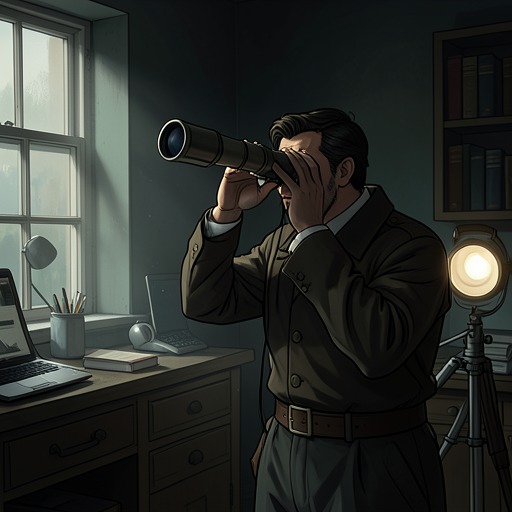
After the Empress’s dissatisfaction with the Bear-men’s Telescopes, they offer other optical instruments that, they say, will give her greater satisfaction. Among them are Microscopes, through which small bodies can be enlarged: a louse may appear as large as an elephant, and a mite as large as a whale. The scale-change makes familiar creatures and materials available for inspection, while also transforming their appearance so dramatically that observation itself becomes an event requiring interpretation.
The Bear-men first show the Empress a gray drone-fly. They report that much of its face and head consists of two large clusters covered with small, smooth, polished hemispheres arranged in a triangular order. The hemispheres are of two sizes and orientations, and together number 14,000. From their observation of a transparent cornea and internal liquid in each, the Bear-men infer that every hemisphere is a perfect eye. The Empress allows that the structures may be glassy pearls without being eyes, and suggests that the Microscopes may not be informing them accurately. The same image thus supports different claims: the instrument displays the tiny structures, but does not by itself settle what they are.
Findings and Interpretive Disputes
The Bear-men next examine charcoal and find, in a line an inch long, no fewer than 2,700 pores. They infer that the abundance of pores causes its blackness, on the theory that light is not reflected from them. The Empress points out a contradiction in that explanation: if all colours arise through reflection and black is itself a colour, black cannot simply be explained as the absence of reflection. The close inspection yields a count, but the count does not resolve the reasoning built upon it.
A nettle provides another example of the distinction between an observed appearance and a proposed explanation. Through the Microscopes, the Bear-men report small sacs beneath the plant’s points, containing poisonous liquid; they describe the points as serving like syringe-pipes to convey it into the skin. The Empress asks why eating nettles does not cause comparable harm inwardly. The observers decline to answer, saying that explaining effects belongs more properly to physicians: their own work is to inspect and report the forms of natural parts as represented by their glasses. Their boundary between observation and causal explanation is therefore explicit, even as their descriptions invite questions beyond it.
The instruments’ ability to enlarge also changes the Empress’s own response to what is seen. The Bear-men show her a flea and a louse, whose magnified forms almost make her faint. She pities people troubled by lice, especially poor beggars who must sustain them despite having little for themselves, and asks whether the Microscopes can prevent the creatures from biting or show how to avoid them. The Bear-men answer that such practical arts are mechanical and beneath the study of microscopical observation. The episode draws a line between producing knowledge about a creature and using that knowledge to relieve the people affected by it.
Magnification, Contraction, and Limits
When the Empress asks whether the instruments can enlarge great bodies as well as small ones, the Bear-men attempt to view a whale through one of their largest Microscopes. The whale’s circumference exceeds the glass’s magnifying capacity. The narrator leaves uncertain whether the difficulty lies in the instrument or in the whale’s position in relation to reflected light, making the failure itself resistant to a single explanation.
At the Empress’s command, the Bear-men then produce glasses of the opposite kind, which contract objects beneath their natural proportion. Through the best of these, a whale appears no larger than a sprat, or, through some glasses, a vinegar-eel. Ordinary examples make an elephant seem no bigger than a flea, a camel no bigger than a louse, and an ostrich no bigger than a mite. The instruments can therefore reverse scale as well as enlarge it, but their success in altering appearances does not amount to unrestricted access to nature.
The stated limit is decisive: despite their skill and ingenuity, the Bear-men cannot devise glasses through which they can inspect a vacuum with all its dimensions, immaterial substances, non-beings, or mixed beings described as intermediate between something and nothing. They remain troubled by the failure and hope that prolonged study might eventually overcome it. The Microscopes make some hidden structures available to sight while leaving other proposed objects beyond their reach.
Instruments, Authority, and the Natural World
The contrast with the Telescopes clarifies the Empress’s ambivalence about instrument-mediated knowledge. Telescopes multiply incompatible reports about celestial bodies: observers disagree about the motion of the Sun and Earth, the number and size of stars, and the nature of the Moon’s markings. After a disputed observation of three Blazing-Stars near the Pole, the Empress calls the glasses false informers and orders them broken, but the Bear-men argue that differences in judgment arise from the observers’ senses and reasoning rather than from the instruments. They plead to keep the Telescopes because they enjoy artificial delusions more than natural truths and value the arguments those instruments sustain. The Empress ultimately permits their use on condition that disputes remain within their schools and do not disturb the State or Government.
Microscopes receive a more confident defense from their users. When the Empress questions whether the fly’s hemispheres are truly eyes, the Bear-men maintain that the instruments never deceive but rectify and inform the senses, and assert that the world would otherwise remain blind. Yet their own demonstrations complicate that claim: magnified appearances support disputed inferences, their account of charcoal invites the Empress’s logical objection, and their inspection of the whale encounters a practical limit. Elsewhere, when Worm-men ask to borrow the Bear-men’s Microscopes for observations underground, the Bear-men explain that the glasses represent exterior objects through reflections and positions of light and will be of little service without light. The Worm-men add that underground creatures have forms of perception suited to their own conditions, for which surface creatures’ optical instruments may not be advantageous.
The Empress’s broader natural philosophy places these instruments within a world of matter whose motions are not reducible to what a glass can display. In addressing the Ape-men’s competing accounts of the principles of natural bodies, she declares Nature to be one infinite self-moving body, divided into parts that continually change through composition and separation; self-moving matter, rather than a set of primary ingredients, is the universal principle. Against that background, the Microscopes’ achievement is real but bounded: they expose minute visible forms, while neither appearance nor magnification alone establishes the ultimate nature of what is seen. Their episodes make experimental inquiry a contest among instrument, sense, reason, and inference, rather than a simple passage from seeing to truth.