North Pole
The Blazing WorldThe North Pole is a boundary between worlds and the turning point in the young lady’s journey from an abduction at sea into the Blazing-World. Its joined poles make passage around a world impossible in that direction: a vessel reaching either pole must turn back or enter another world. In the story, that geography determines the lady’s route, while the cold at the conjunction of two poles proves fatal to the merchant’s crew but not to her.
A boundary between worlds
The narrator explains that the poles of neighboring worlds join, preventing a traveler from circling the globe from pole to pole as one might travel from east to west. The North Pole is therefore not simply the far end of a familiar route. Reaching it leaves only two possibilities: return or cross into another world. Each world has its own Sun, moving in a separate circle that does not obstruct the others; the narrator adds that skilled astronomers can observe two or three Suns at once with good telescopes.
This account also addresses what people at the poles might see. The separate Suns do not necessarily produce simultaneous visible lights, or six months without sunlight, because the nearer Sun’s brightness obscures the more distant one from ordinary sight. The passage presents the polar boundary as a consequence of the book’s larger cosmography, not as an unexplained break in the young lady’s voyage.
The storm and the crossing
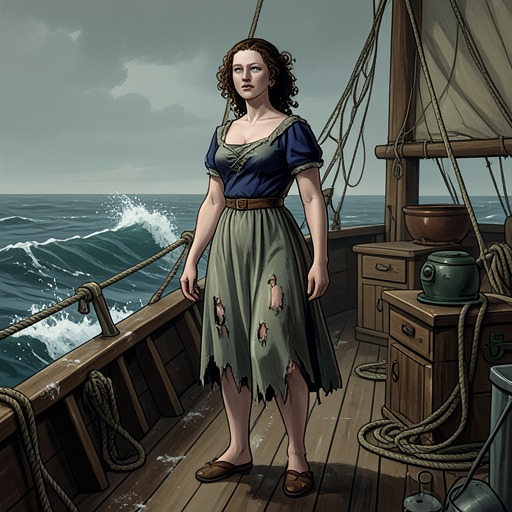
The young lady reaches the North Pole after the merchant abducts her from the shore in a small, lightly built vessel. A violent storm drives the boat swiftly toward the pole and into the Icy Sea, where huge pieces of ice surround it. Because the boat is small and light, it can wind between the ice; the men aboard, however, are unprepared for such a cold voyage.
At the joined poles, the cold has a double force. The crew freezes to death, while the young lady alone remains alive, protected in the story by her youth, beauty, and the gods. The difference between her survival and the crew’s deaths establishes the crossing as a perilous ordeal rather than a safe passage. When the boat continues into the neighboring world, the men’s bodies thaw and begin to corrupt, forcing her to leave the cabin and remain on deck.
From the ice to inhabited islands
As the boat moves between two expanses of ice, the young lady sees land covered in snow. Upright, bear-like inhabitants come across the ice, inspect the boat, and carry her out of it; they then sink the vessel along with the dead men. Though she fears that her life is in danger, the Bear-men treat her with kindness, lift her across the slippery ice, and take her to their underground city. Its inhabitants gather to look at her, and the females receive her with respect and provide their customary food. Because the climate and diet do not suit her, her hosts arrange to take her to a warmer island.
The crossing becomes a chain of encounters that carries her toward the imperial center. Fox-men receive the Bear-men courteously and agree to present the lady to their Emperor. They travel across a river to an island inhabited by upright Geese-men, then cross another river to a mild, wooded island of Satyrs. From there, they pass through a kingdom whose green-complexioned inhabitants provide for the next stage of the voyage. Rivers give way to open sea, and the travelers prepare ships to reach the island where the Emperor resides.
Passage, order, and narrative significance
The journey beyond the North Pole contrasts perilous natural conditions with the civility of the people the lady meets. At first, fear and uncertainty define her experience; as she learns enough of the inhabitants’ language to understand them partly through words and signs, she comes to regard herself as safe and happy among them. The narration makes familiarity, rather than the strange appearance of the people, the condition that settles her fear.
The route also reveals a world linked by practical passage and political submission. The islanders understand one another, attend the lady across successive territories, and guide her toward Paradise, the imperial seat. The account thus gives the North Pole a double narrative function: it is the physical threshold that makes the young lady’s arrival in another world possible, and the starting point of a passage through its varied peoples toward a realm organized around a single Emperor. The later description assigns distinct professions to peoples including the Bear-men, Bird-men, and other inhabitants; the pole-crossing episode begins the sequence of encounters through which that world is introduced.