Scholarly disputes must not disturb the state
The Blazing WorldScholarly disputes must not disturb the state is a rule that permits inquiry while restricting its political consequences. In the Blazing-World, instruments and specialized disciplines multiply observations and arguments without guaranteeing agreement. The Empress ultimately contains disputes within schools rather than allowing them to become factions in government; later, the Duchess advises her to dissolve the learned societies altogether when their persistent quarrels threaten public peace.
The Rule and Its Institutional Setting
The rule operates within a society organized by specialized professions. The Empress encourages the different kinds of inhabitants to pursue work suited to their natures and establishes schools and societies for the study of arts and sciences. Bear-men serve as Experimental Philosophers, Bird-men as Astronomers, Fly-men, Worm-men, and Fish-men as Natural Philosophers, and Ape-men as Chymists. This system gives inquiry official support, but it also places professional disagreement inside a state whose rulers fear faction and war.
The Empress’s political advisers explain why the Blazing-World has few laws: many laws, they say, create divisions that breed factions and may end in open war. Their defense of a single governor for the political body sets the stakes for managing learned disagreement. Inquiry is not simply a private pursuit; once its quarrels escape their designated setting, they can unsettle a polity committed to unified government.
Instruments Multiply Disagreement
The conflict becomes visible when the Empress orders the Bear-men to use Telescopes to investigate celestial phenomena. Their observations do not yield a common account. Some say the Sun is stationary and the Earth moves around it; others argue that both move, or that the Earth stands still while the Sun moves. They disagree over the number and size of stars and over whether the Moon’s spots are land or sea. At the Pole adjoining the world from which the Empress came, they report three Blazing-Stars appearing in succession, but cannot agree whether these were three stars or one appearing in different places and with different brightness.
The Empress takes these contradictions as evidence that the Telescopes mislead the senses. She orders the Bear-men to break them and to trust their natural eyes and reason instead. The Bear-men resist, arguing that the disagreement stems from differences in observers’ senses and judgments, not from the instruments themselves. They also openly confess their attachment to dispute: artificial delusions give them subjects for argument and the pleasure of contradicting one another. They ask to keep the Telescopes because the instruments and the debates around them are central to their intellectual occupation.
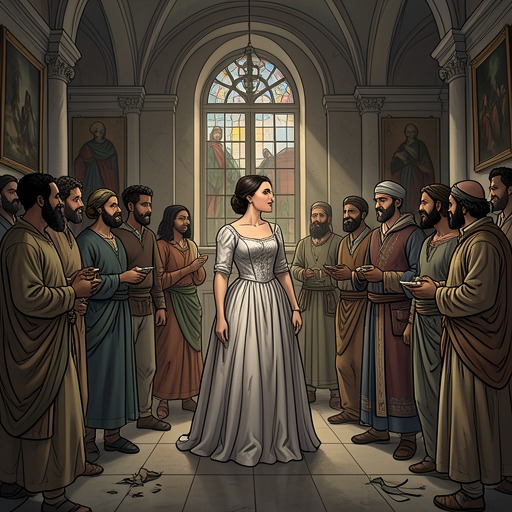
The Empress relents, but makes permission conditional: disputes and quarrels must remain inside the schools and must not cause factions or disturbances in the state or government. This is the rule’s clearest formulation. It neither resolves the astronomical disagreements nor establishes which observers are right. Instead, sovereign authority draws a boundary around their consequences, preserving the instruments and the scholars’ arguments while denying those arguments the right to disrupt political order.
Microscopes and the Limits of Evidence
The same tension recurs in the Bear-men’s microscopic investigations. They claim that a drone-fly’s head contains 14,000 polished, pearl-like hemispheres arranged in two degrees and that each is an eye, because they perceive a transparent cornea and an eye-like fluid. The Empress suggests that the structures might be glassy pearls rather than eyes and questions whether the Microscopes report them accurately. The Bear-men defend the instruments as corrective, insisting that without them the world would remain blind. The disagreement concerns not only what has been seen, but what an instrument’s appearance licenses observers to conclude.
Their other demonstrations expose the same gap between observation and interpretation. Viewing charcoal through a Microscope, the Bear-men count 2,700 pores in an inch and infer that the pores’ lack of reflected light causes the coal’s blackness; the Empress points out that this explanation conflicts with their account of black as a color. They identify poison-filled bladders beneath the points of a nettle and explain how the points carry the liquid into the skin, but when asked why eating nettles does not produce the same harm, they defer to physicians. The Empress is nearly overcome by magnified views of a flea and a louse, yet the investigators say that finding ways to prevent bites is mechanical work beneath their discipline. A Whale also exceeds the magnifying capacity of their strongest Microscope, while a different kind of glass makes it appear no larger than a sprat. Instruments can expand or contract an appearance without settling every question about the object.
These episodes complicate any simple claim that the Empress’s preference for natural perception settles disputes. She distrusts the Telescopes and challenges the Bear-men’s microscopic inferences, but the scholars also expose how much an observation depends on the observer, the instrument, and the reasoning that connects appearance to explanation. The rule manages such uncertainty politically; it does not supply a final method that eliminates it.
From Contained Debate to Political Threat
The Empress’s rule has a broader institutional context. The societies’ divisions are not limited to astronomy. The Spider-men present mathematical figures so thin and abstract that the Empress can scarcely understand them, while the Lice-men’s attempts to measure everything to a hairsbreadth and weigh it to an atom produce inconsistent results, especially for air. She dissolves the Lice-men’s society after declaring that their profession lacks truth and justice. Such episodes show that sovereign authority can both limit argument and intervene directly in the organization of disciplines.
Later, as the Duchess’s soul prepares to leave the Blazing-World, the Empress seeks her advice about growing conflict among the Worm-men, Bear-men, Fly-men, Ape-men, Satyrs, Spider-men, and others. She fears that their continual contentions may turn into open rebellion and ruin the government. The Duchess recommends restoring the earlier arrangement of one sovereign, one religion, one law, and one language, and advises dissolving the learned societies. Learning, she argues, commonly brings controversy: scholars compete to know more, defend their own reasoning, and preserve opinions rather than risk the disgrace of abandoning them. Their school factions may eventually become wars that destroy a state.
The Duchess’s advice carries the rule beyond containment toward institutional suppression. Where the Empress had preserved the Telescopes on condition that disputes remain within the schools, the Duchess is willing to sacrifice the societies’ intelligence for a quiet and orderly government. Together, these decisions reveal the tension at the heart of the rule: the Blazing-World values useful knowledge and cultivated expertise, yet treats the organized disagreements that accompany them as a possible source of political fracture. Its peace depends not on agreement among investigators, but on the sovereign’s power to decide where disagreement may occur and how far it may go.