Self-moving matter
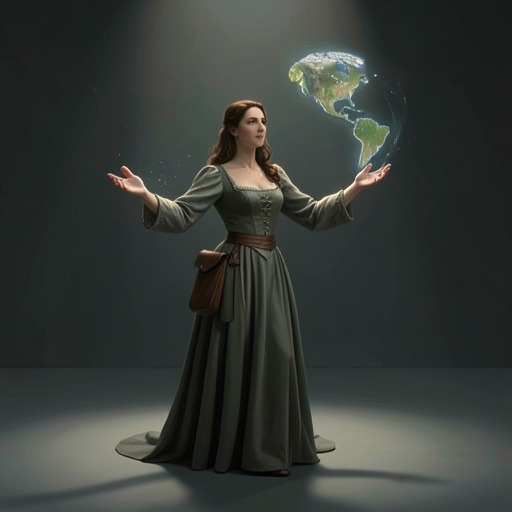
The Blazing WorldSelf-moving matter is the principle that Nature is one infinite body, alive and in motion through its own material activity. In the Empress’s account, natural bodies are not assembled from a handful of motionless first ingredients: Nature divides into innumerable parts, whose compositions and divisions continually transform them. The principle makes matter the source of natural effects rather than passive stuff awaiting an external mover, and it recurs in the book’s debates about instruments, spirits, souls, and the limits of knowledge.
The Empress’s Natural Philosophy
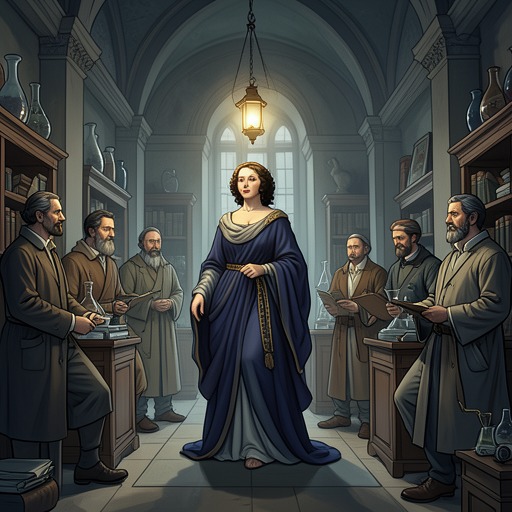
The Empress states the doctrine in response to the Ape-men’s disputes over the principles of natural bodies. Some defend the four elements; others argue from what fire leaves behind that bodies consist of more than four ingredients. Another party names salt, sulphur, and mercury as the true principles, while a further claim reduces vegetables, minerals, and animals to water distinguished into different forms by seeds. Exhausted by these competing explanations, the Empress orders silence and counters that the apparent variety of ingredients consists instead in the ceaseless transformations of one self-moving Nature.
Her objection is not simply that the Ape-men have chosen the wrong recipe. Fire, she argues, is itself a particular natural effect, and its power varies from body to body: gold, for example, has not been made to change its interior figure by fire. Since fire cannot act on every body alike, it cannot serve as a universal test that discloses Nature’s first principles. She tells the Ape-men to stop wasting effort on such fruitless attempts and to turn their experiments toward work beneficial to the public. The doctrine thus joins a claim about what Nature is to a judgment about which kinds of inquiry deserve their labor.
Matter, Motion, and Life
The later conversations with the Immaterial Spirits sharpen the doctrine by questioning whether motion can originate outside matter. The Spirits say that they themselves have no motion except through their corporeal vehicles: pure spirits are immovable, and natural material bodies give them motion rather than receiving it from them. Their vehicles are self-moving bodies and must therefore be living. When the Empress presses the consequence, the Spirits agree that the living body moves the spirit, not the spirit the body.
The discussion of souls supplies a fuller account of living matter. The Spirits describe Nature as one infinite, self-moving, living, and self-knowing body, composed of inanimate, sensitive, and rational matter so thoroughly intermixed that not even an atom lacks all three degrees. In this formulation, the inanimate degree is body, the sensitive is life, and the rational is soul. Natural life and thought are therefore not additions to otherwise inert matter: they belong to the organization of Nature itself. The Empress is satisfied with this answer, which carries the principle beyond physical motion into perception and reason.
The distinction between material Nature and immaterial spirits nevertheless remains significant. The Spirits claim that an immaterial soul has no parts or place and cannot share a body with another immaterial soul, while numerous material souls can inhabit one composed body because every material part has its own natural soul. Their account preserves immaterial spirits as a category but denies them independent movement; their vehicles, by contrast, are material and self-moving. The dialogue makes the boundary unstable without simply erasing it.
Instruments and the Limits of Inquiry
The episodes about optical instruments dramatize a related problem: how far can observation disclose the nature of things? Through telescopes, the Bear-men produce incompatible accounts of the Sun’s and Earth’s motion, the number and size of stars, and the character of the Moon’s surface. Their report of three bright and dim Blazing-Stars at the Pole also divides them: some take the appearances for one star seen at different times and places, others for three separate stars. The Empress calls the telescopes false informers and orders them broken, arguing that natural sense and reason are more regular than the artificial glasses.
The Bear-men answer that the instruments are not at fault; disagreement arises because observers’ sensitive motions and rational judgments differ. They plead to keep the telescopes, confessing that they value artificial delusions more than natural truths because disputes give their work pleasure and distinction. The Empress relents on the condition that their quarrels remain within their schools and cause no disturbance in state or government. The episode does not settle whether unaided or instrument-assisted observation is superior; it shows how the same appearances can support opposed judgments, and how inquiry can produce social divisions as well as knowledge.
Microscopes extend the dispute from distant heavens to minute bodies. The Bear-men claim that their glasses correct and inform the senses: they describe a drone-fly’s head as bearing 14,000 polished, pearl-like hemispheres, which they interpret as individual eyes, and count 2,700 pores along an inch of charcoal, using those pores to explain its blackness as a lack of reflected light. The Empress questions both inferences, noting that the proposed explanation of blackness conflicts with their claim that every colour is produced by reflection. When they describe poison-bearing bladders beneath nettle points, they decline to explain why nettles do not similarly injure people who eat them, saying that such causal questions belong to physicians rather than experimental philosophers.
The instruments also reveal their own limits. A microscope cannot encompass the whale’s full shape; a contracting glass can make a whale appear no bigger than a sprat, an elephant no bigger than a flea, and a camel no bigger than a louse. Yet the Bear-men cannot devise glasses that show a vacuum in all its dimensions or disclose immaterial substances and beings between something and nothing. Their ingenuity can alter the scale at which bodies appear, but it cannot make every kind of existence available to sight. The episode echoes the doctrine’s resistance to reducing Nature to a list of experimentally isolated ingredients: observation has real reach, but neither an instrument nor an observer commands the whole of what exists.
Cosmological Consequences
The Spirits’ account of matter further resists the idea that Nature began as a single undifferentiated fluid. Matter, they say, was always various: some parts were rare, others dense, fluid, or solid. They also deny that a world of natural lives and forms can exist without matter, or that matter can exist as a natural world without lives and forms. Matter and life are inseparable in Nature, even though the Spirits distinguish natural, material life from their own incorporeal condition.
This framework also places a limit on claims about creation. Asked whether the universe was made in six days or by six divine decrees, the Spirits say that the world was made by God’s all-powerful decree and command, but no creature can know whether the commands numbered six, fewer, or more. Self-moving matter explains natural effects within the world; it does not claim to reveal the unknowable terms of divine creation. Its reach is therefore substantial but bounded: it offers a unified account of natural change while refusing to turn mystery into a false certainty.
World-Making and Significance
The doctrine’s emphasis on material motion stands in contrast with the Spirits’ description of an immaterial world created within the human mind. They tell the Duchess that a person can create an immaterial world of inhabitants and government within the head, changing its forms and motions as fancy dictates. They set this inward creation against the burdens of conquering and governing a material world, which no single ruler can fully enjoy or know. The passage distinguishes imaginative world-making from the natural world described by self-moving matter, even as both accounts grant creative power a world-forming reach.
Across these exchanges, self-moving matter is both a physical principle and a challenge to divisions between inert body and active mind. It explains why fire cannot disclose universal ingredients, why material bodies can move spirits, and why life, perception, and reason belong throughout Nature. At the same time, the unresolved limits of instruments and the Spirits’ qualified claims about immaterial existence prevent the principle from becoming a total explanation of everything. The result is a world in which matter is active and richly organized, while the means of knowing it remain partial and contested.