Societies of the Virtuosi
The Blazing WorldThe Societies of the Virtuosi are institutions founded by the Empress of the Blazing-World to direct the varied abilities of its many peoples into useful arts and sciences. Their organization turns species into professional communities: a social design that cultivates invention, yet eventually troubles the sovereign who created it, as intellectual disputes threaten to spill beyond the schools and into government.
Foundation and Structure
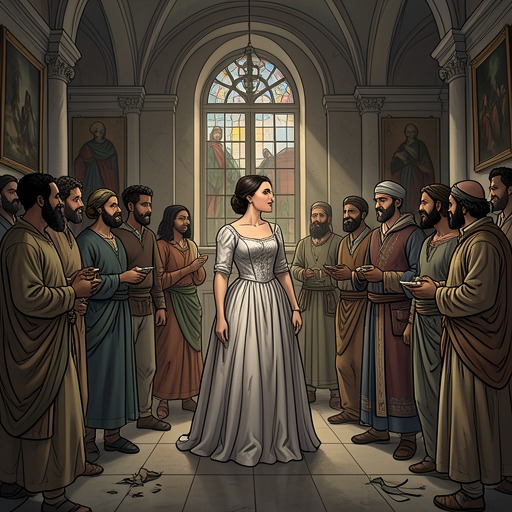
The Empress encourages her subjects to pursue the professions she considers suited to their natures, judging their ingenuity in practical invention at least equal to that of people in her own world. She establishes schools and several societies to give that work an institutional home. The Bear-men become experimental philosophers, the Bird-men astronomers, and the Fly-men, Worm-men, and Fish-men natural philosophers. The Ape-men serve as chymists; the Satyrs as Galenick physicians; the Fox-men as politicians; the Spider-men and Lice-men as mathematicians; the Jackdaw-men, Magpie-men, and Parrot-men as orators and logicians; and the Giants as architects.
This arrangement makes expertise both occupational and political: the Empress assigns jurisdictions, encourages specialized inquiry, and receives reports from the resulting communities. Yet it does not erase differences of method or judgment. In the societies’ work, the same observations and instruments can produce competing accounts, while members sometimes dispute which discipline is entitled to answer a question.
Inquiry, Instruments, and Disagreement
The Bird-men report on the Sun and Moon, while the Empress later orders the Bear-men to observe celestial bodies through Telescopes in hopes of obtaining more exact knowledge. Instead, the instruments multiply disagreement. Observers advance competing accounts of whether the Sun or Earth moves, how many stars are visible, and what the Moon’s spots represent. Even the sighting of three Blazing-Stars near the Pole joined to the Empress’s former world fails to yield agreement: some observers interpret the appearances as one star seen at different times and places, others as three distinct stars.
The Empress calls the Telescopes false informers and orders them broken, arguing that natural sense and reason are more reliable than artificial glass. The Bear-men defend their instruments and say they value artificial delusions more than natural truths: disputes give them subjects for argument, the pleasure of contradicting one another, and a way to distinguish one thinker from another. The Empress ultimately allows them to keep the Telescopes on the condition that their quarrels remain within their schools and create no factions or disturbance in the state. Her compromise preserves inquiry while placing a boundary around its political consequences.
The Bear-men also present Microscopes, which magnify small objects, including a louse to the apparent size of an elephant and a mite to that of a whale. Their observations provoke further disputes over the difference between what an instrument shows and what an observer may infer. Looking at a charcoal, they count 2,700 pores along an inch and argue that the pores explain its blackness because they reflect no light; the Empress points out that this account conflicts with their claim that all colors arise through reflected light. They also describe poison-bearing bladders beneath nettle points, while the Empress questions how that account fits with the consequences of eating nettles. The Bear-men reply that explaining such effects belongs to physicians, not experimental philosophers: their task is to inspect and report forms, not to settle every causal question.
The boundary between observation and inference recurs when the Worm-men discuss what their senses can know inside plants and minerals. They say that exterior sensitive perception can apprehend natural forms after they have been produced, while reason may judge their internal motions and production if those motions are regular. When the Empress asks the Bear-men to lend them Microscopes, the Bear-men object that their instruments depend on light and are of little use in the earth’s interior. The Worm-men answer that subterranean creatures have forms of perception suited to their own conditions, and that instruments designed for surface-dwellers would not necessarily serve them. Their exchange makes the societies’ knowledge contingent not only on evidence but also on the observer’s senses and the conditions under which those senses operate.
Professional Jurisdictions and Sovereign Authority
The societies’ specialization can sharpen disagreement over who is qualified to answer a question. When the Worm-men are asked whether art can produce metals, they distinguish between what they can judge and what belongs to the Ape-men, the Empress’s chymists. The Empress challenges their reasoning about the possibility of making Gold while ruling out the artificial production of weaker metals; the Worm-men respond that they lack knowledge of that art. The episode presents professional division as a practical limit on expertise, but also as a point at which the Empress can test whether a claim is consistent.
The Empress’s authority extends beyond directing inquiry to judging its social costs. The Spider-men present mathematical points, lines, and figures that she finds too abstruse to understand; their work is held in esteem partly because some are also magicians and informers of spirits. The Lice-men attempt to measure everything with extreme precision, but their measurements—especially their attempts to weigh air—fail to agree. The Empress condemns the lack of truth and justice in their profession and dissolves their society. Her response shows that the societies are not autonomous institutions: they exist by sovereign favor and can be curtailed when their methods or results disappoint her.
Faction, Reform, and Significance
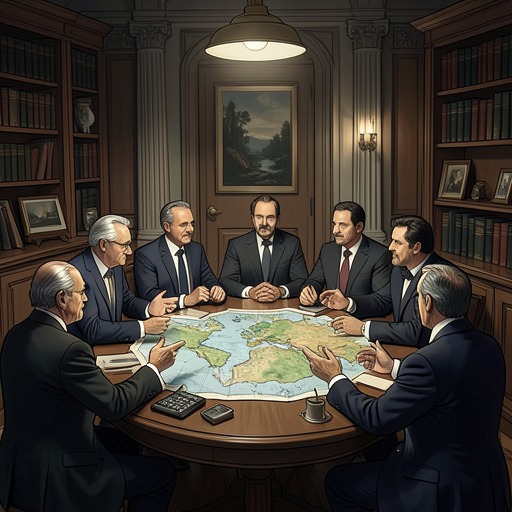
The later crisis of the Societies of the Virtuosi exposes the political danger implicit in their design. The Empress tells the Duchess that after receiving absolute power she changed the government she had inherited, and that the world is now less quiet than before. She fears continual contentions among the Worm-men, Bear-men, Fly-men, Ape-men, Satyrs, Spider-men, and others may become open rebellion and ruin the government. The learned communities have become part of a wider pattern of faction, rather than remaining merely places of study.
The Duchess advises restoring a unified order: one sovereign, one religion, one law, and one language. She recommends dissolving the societies, arguing that learning commonly brings controversy because scholars compete to be wiser, cling to their opinions, or defend them rather than risk disgrace by changing them. School disputes, in her account, can grow into factions and then into wars that destroy a state. The Empress is troubled that reversing her own decrees might disgrace her, but the Duchess frames correction as evidence of wisdom and goodness. The episode does not erase the societies’ earlier value in fostering useful arts and organized inquiry; instead, it places their intellectual productivity in tension with the Empress’s desire for an undivided, peaceful polity. Their history makes the political management of knowledge central to the world’s utopian promise—and to its vulnerabilities.