Telescopes
The Blazing WorldTelescopes are instruments of observation in The Blazing-World, introduced by the Empress as a means to settle disputes about celestial phenomena. Instead, they multiply disagreement: Bear-men report incompatible accounts of the Sun, Earth, Moon, and stars, and their dispute over three appearances of Blazing-Stars persuades the Empress that the glasses mislead rather than correct perception. Yet she does not destroy them. The episode makes the instruments a focal point for the book’s tension between experimental inquiry, competing interpretations, and political control of intellectual controversy.
Introduction and Use
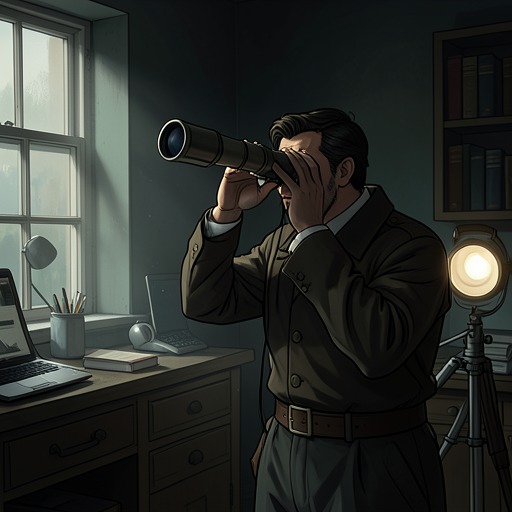
After hearing the Bird-men’s account of the Sun and Moon, the Empress seeks more exact knowledge of celestial phenomena. She orders the Bear-men, her Experimental Philosophers, to observe them through Telescopes. The instruments are thus introduced not as curiosities but as a practical response to disagreement: the Empress expects them to improve observation and help establish what the heavenly bodies are like.
The attempt soon produces an abundance of incompatible claims. Some Bear-men say the Sun stands still while the Earth moves around it; others say both bodies move, while still others hold that the Earth stands still and the Sun moves. Observers also differ over the number and discovery of stars, their size, and the nature of the Moon. Some interpret lunar spots as hills and valleys, while others identify the spots with land and the smooth, glossy areas with sea. The instrument extends what the observers claim to see, but it does not make their readings converge.
Conflicting Astronomical Reports
At the Empress’s command, the Bear-men take their Telescopes to the end of the Pole joined to the world from which she came and search for stars. On their return, they report three Blazing-Stars appearing there one after another in a short time: two bright and one dim. Even this observation fails to settle into a shared account. Some observers maintain that one star appeared three times in different places; others argue that there must have been three separate stars.
The disagreement rests on more than the count. Those who defend the three-star interpretation argue that a single star could not move between distant, even opposite, locations so quickly without visible motion, and that one star would not change its splendor from one appearance to another. The reported sighting therefore becomes an argument about what the observers saw and what could reasonably be inferred from it. The Telescopes have furnished an observation around which rival explanations form, not a result that ends the dispute.
The Empress’s Judgment and the Bear-men’s Defense
Frustrated by the conflicting reports, the Empress calls the Telescopes false informers. She orders the Bear-men to break them and tells the Bird-men to rely on their natural eyes, examining celestial objects through the motions of sense and reason. Her decision treats the instruments’ failure to deliver agreement as evidence against their reliability: if the glasses were true informers, she argues, they would correct irregular sense and judgment rather than leave observers divided.
The Bear-men resist that conclusion. They argue that the fault lies not in the glasses but in the observers: their optical organs do not move alike, and their rational judgments are not invariably regular. They also defend the intellectual and social pleasures the instruments sustain. Artificial delusions, they say, give them subjects for argument and the satisfaction of confuting and contradicting one another; without falsehood and disagreement, no observer could establish superiority over another. Their defense exposes a sharp difference between the Empress’s aim of reaching truth and the philosophers’ investment in the ongoing work of debate.
The Empress finally spares the Telescopes, but imposes a political boundary: their disputes and quarrels must remain within the schools and must not produce factions or disturbances in the state or government. The outcome is neither an endorsement of the Bear-men’s astronomical claims nor a final ban on instrument-based research. The instruments remain in use under a restriction designed to keep intellectual disagreement from becoming political division.
A Contrast with Other Optical Instruments
The Bear-men try to make amends for the Empress’s displeasure by showing her other artificial optical glasses, including Microscopes. They insist that these do not delude but rectify and inform the senses, claiming that without them the world would remain blind. The Empress remains doubtful of what a magnified appearance proves: when the Bear-men interpret the many small hemispheres on a drone-fly’s head as eyes, she allows that they could instead be glassy pearls and questions whether their instruments have informed them correctly.
Their later demonstrations reveal further limits. A Whale is too large for even a powerful Microscope to encompass when magnified, while glasses of a contrary nature can shrink it to the size of a Sprat or even a Vinegar-Eele. The narrative also notes that these instruments cannot disclose a Vacuum in all its dimensions, immaterial substances, non-beings, or beings between something and nothing. This broader sequence does not make the Telescopes and Microscopes identical in function, but it places both within a recurring problem: an instrument can alter what appears before the observer without guaranteeing that the appearance yields settled knowledge.
Knowledge, Inquiry, and Political Order
The Telescopes episode distinguishes the act of observing from the reasoning used to explain an observation. The same reports can be organized into incompatible accounts, and the Empress’s appeal to unaided sense and reason does not itself demonstrate which astronomical account is true. The Bear-men, for their part, acknowledge that observers differ in perception and judgment, yet their defense also values controversy for its own sake. The episode leaves experimental observation entangled with human interpretation rather than presenting the instrument as an impartial route beyond disagreement.
The Empress’s compromise gives this epistemic conflict a political consequence. The Bear-men may keep the Telescopes and continue arguing, but their arguments must remain within the schools. This restriction anticipates her later concern that disputes among learned societies can breed faction and disorder. Telescopes therefore matter both as devices for examining celestial bodies and as instruments around which the book stages a conflict between open-ended intellectual contest and the ruler’s demand for civic unity.