The Duchess’s Creation of an Imaginary World
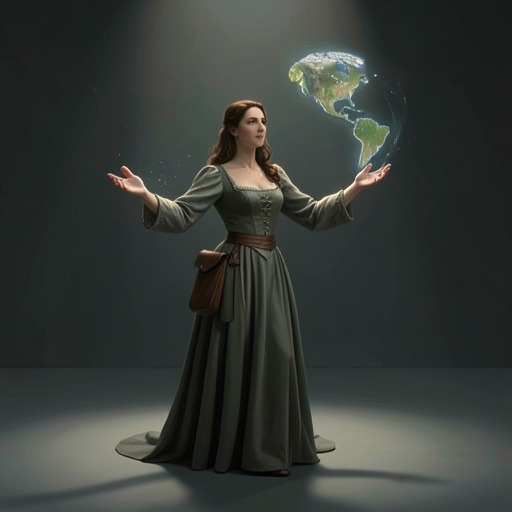
The Blazing WorldThe Duchess’s Creation of an Imaginary World turns frustrated political ambition into an act of philosophical and imaginative creation. Urged to forgo the danger and limited pleasures of conquering a material realm, the Duchess tries successive cosmological systems, finds each constraining or unworkable, and finally invents a world of her own from rational self-moving matter. Its ordered variety gives her a sovereignty that does not depend on conquest, while its example leads the Empress to become an inner-world maker too.
From Political Ambition to Imaginative Sovereignty
The episode begins with the Duchess confessing that her ambition is so great that she will not be at peace until she is an Empress of a world. The Empress responds affectionately, promising advice and consulting the Immaterial Spirits about whether another world might be available for her friend. The Spirits answer that there are innumerable worlds, but none is ungoverned: they are populated, and conquest offers no reliable possession. Conquerors, they warn, are more often feared than loved and commonly meet untimely ends. The Duchess nevertheless declares that she would rather risk death for noble achievement than live in obscure security, because even a short-lived fame lasts longer than a human life.
The Spirits redirect the desire rather than simply denying it. Any human creature, they explain, can create an immaterial world within the head, populate it with immaterial subjects, and give its creatures forms, motions, perceptions, and colors as the maker chooses. Such a world can take different shapes, from a world of ideas or atoms to one of lights, and can be altered at will. The contrast with material sovereignty is pointed: even a monarch who possesses a whole country can enjoy only a part of it, while government brings general burdens and the pleasures of fame depend on other people’s opinions. The Duchess is persuaded to reject the worlds outside herself and make one of her own.
The counsel does not treat world-making as an effortless substitute for rule. The Spirits describe its possibilities, but the Duchess must still discover what she can actually create. In the sequence that follows, philosophical systems become practical tests: each offers a scheme for ordering a world, and each exposes a different difficulty when she attempts to put the scheme into motion. Her eventual success comes not from finding the perfect inherited model, but from ceasing to imitate them.
The Failure of Inherited Models
The Duchess first tries to frame a world according to Thales. She finds herself troubled by Dæmons that will not allow her to act according to her own will and instead compel her to obey their orders. She abandons the attempt. The obstacle is not merely a faulty arrangement of parts: the world’s governing powers frustrate the very freedom that inspired her to create.
She next turns to Pythagoras, but the numbers required to order and compose the world’s parts puzzle her. Lacking skill in arithmetic, she cannot bring the design to completion and gives it up. The failure makes mathematical composition a practical limit on her imaginative work: a cosmology may promise order, yet remain unusable to a maker who cannot manage its numerical structure.
Plato’s system proves harder still. Its numerous Ideas receive no motion except from the Duchess’s mind, from which they flow. She finds imparting motion to each of them more difficult than puppet-players find moving their separate puppets. Unable to bear the labor, she annihilates this world as well. The image of the puppeteer sharpens the problem: a system dependent on the mind’s repeated direction leaves the creator struggling to animate every element individually.
Epicurus’s world fails through a different excess. Its infinite Atoms produce a mist that blinds the perception of her mind, and she cannot make a Vacuum to contain them or provide a place for them to retire. Without that receptacle or a good order and method, the Atoms generate strange and monstrous figures that frighten rather than delight her. Their confusion makes a Chaos in her mind, nearly dissolving it. She has to clear her mind of the dusty, misty particles before she can proceed.
Aristotle’s principle also stops her. Remembering that her mind is considered immaterial, and that according to Aristotle nothing can be made out of nothing, she sees no way to produce a world from it and desists. The episode thus makes her own status as a maker part of the philosophical problem: the principle she has chosen appears incompatible with the material she has available.
Modern systems are no easier to inhabit. Following Des Cartes, she makes Æthereal Globules and sets them moving through a strong, lively imagination. Their extraordinary speed makes her mind dizzy, nearly bringing on a swoon; her thoughts seem to stagger as if drunk. She dissolves that world. With Hobbs, by contrast, the problem is not dizziness but pressure: the parts press and drive one another like wolves worrying sheep or dogs hunting hares. When she introduces a reaction equal to those pressures, her mind feels squeezed so tightly that her thoughts cannot move forward or backward. Although she dissolves the world, the pain in her head takes considerable effort to settle. These failures are not interchangeable: one cosmology overwhelms her with spinning motion, another with constricting interaction.
A World of Her Own
After the failures of the ancient and modern patterns, the Duchess resolves to follow none of them. She makes a world of her own invention, composed of sensitive and rational self-moving matter, but in its making she uses only the rational degree, described as the subtlest and purest. The distinction allows the account to describe two activities at once: sensitive matter moves and acts toward bodily perception and consistency, while rational matter, even at the same time, moves toward the creation of the imaginary world. Though the degrees are mixed, their parts can move in different directions simultaneously.
The result reverses the confusion of the earlier attempts. Her world appears curious and full of variety, yet is also well ordered and wisely governed; its richness cannot be expressed in words, nor can the delight the Duchess takes in making it. The pleasure belongs specifically to creation: unlike the systems she had tried to reproduce, this world answers to her own invention and is not undone by the obstacles that defeated the borrowed designs. Its order is not achieved by conquering inhabitants or compelling troublesome principles into submission, but by composing a world through the motions of her own mind.
The Empress Follows Her Example
Meanwhile, the Empress has also been making and dissolving several worlds within her mind, unable to settle in any. She sends for the Duchess, who brings her beloved world and invites the Empress’s soul to observe its frame, order, and government. The Empress is so ravished by what she perceives that her soul wishes to live in the Duchess’s world. The Duchess advises her instead to make a world in her own mind, offering the rational motions of her mind as instruction, conveyed through sensitive expressions.
The Empress takes the advice. She finishes an imaginary world, frames creatures suited and useful to it, strengthens it with good laws, and adorns it with arts and sciences. The episode therefore makes the Duchess’s invention more than a private refuge: it becomes an example another sovereign can follow. Yet the Empress’s interior creation is distinct from her political dominion. Her existing realm, the Blazing-World, is already so well ordered that she sees no improvement to make in it; its government has no secret and deceiving policy, ambitious factions, malicious detractions, civil dissentions, religious divisions, foreign wars, or home-bred quarrels. Having made an inward world as well, she turns her attention to visiting the Duchess’s Native World and observing its governments, laws, and customs.
Political and Gendered Tensions
The episode places inward sovereignty beside the burdens and risks of public rule. The Spirits argue that material rulers cannot enjoy a whole realm at once and must bear the cares of governing it; the private maker, by contrast, may alter an imagined world at will. But the contrast does not simply erase political power: the Duchess’s creation is explicitly well governed, and the Empress’s response joins imaginative making to laws, useful creatures, arts, and sciences. Inward creation offers a new form of authority, not a rejection of order itself.
The female friendship at the center of the event gives this transfer of authority particular weight. The Empress assists the Duchess’s ambition, listens as she describes its limits, and then learns from the Duchess’s successful act of creation. In a wider polity where women are excluded from public religious assemblies and public employment, the two women nevertheless exercise intellectual and sovereign agency in conversation, instruction, and world-making. The narrative’s female authority is therefore substantial, but it does not by itself abolish the exclusions elsewhere in the society.
The episode also complicates the promise of the imaginary world by setting its peaceful, unified ideal against the Empress’s later account of faction and war in the Duchess’s Native World. The Empress’s well-ordered realm offers a contrast to the divisions that make her journey troubling, while the Duchess’s creation establishes imaginative invention as an alternative source of pleasure and command. At the same time, the wider narrative’s praise of political unity and its resort to force against resistant nations keeps the relationship between ideal order and coercive rule unsettled. The event’s decisive achievement is narrower and more personal: the Duchess discovers that she need not acquire a world through conquest in order to become its maker and sovereign.