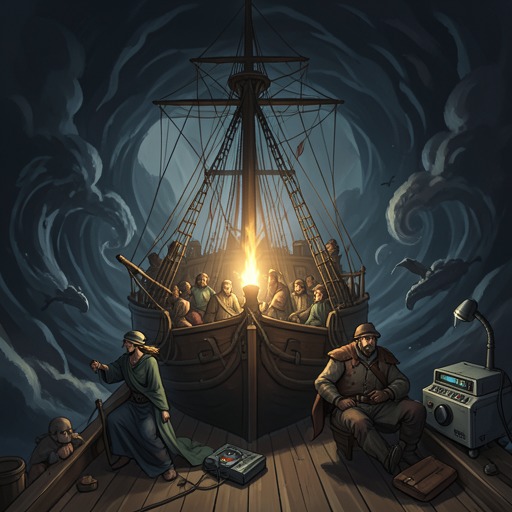
The Duchess’s Native World
The Blazing WorldThe Duchess’s Native World is the earthly realm from which the Duchess came, visited by her soul and the Empress’s soul after the Empress’s curiosity turns from governing the Blazing-World to observing foreign states. Their journey makes the world both a spectacle of political and religious variety and a critique of the ambition, warfare, and hunger for wealth that persist across that variety. Its wide survey ends in intimate evidence of damage: the Duke of Newcastle’s losses in civil war and the reduced estate at Welbeck.
A World Reached by Spiritual Travel
After hearing from the Immaterial Spirits that human beings can create inhabited worlds within their minds, the Duchess argues that an imagined world offers more freedom than the risks and burdens of conquering a material one. The Empress follows her advice and completes an imaginary world, but remains eager to see the Duchess’s home and observe the governments, laws, and customs of different nations. The Duchess warns that her native world is disturbed by factions, divisions, and wars; the Empress nevertheless decides to go.
To conceal the journey from the Emperor and his subjects, the Empress asks the Spirits to supply a substitute for her soul while it is away from her body. They promise a Spirit sufficiently like her own that even the Emperor and his subjects will not recognize the difference. The Duchess explains that, when her soul is absent, her body is governed by its sensitive and rational corporeal motions. The two souls then travel together as lightly as thoughts and, in a moment, survey the world and the actions of its inhabitants. Their voyage is therefore not a conventional passage from place to place: it gives them a sweeping view of nations and institutions before bringing them to a specific household and landscape.
Variety and the Recurrence of Conflict
The Empress is struck by the contrast between the many nations’ different governments, laws, religions, and opinions and what she sees as their shared moral habits. Across the world, she finds ambition, pride, vanity, deceit, envy, malice, injustice, revenge, irreligion, and faction. Political difference does not, in her account, prevent a common appetite for expansion: no state, kingdom, or commonwealth is content with its own share, and each tries to encroach on its neighbours.
The Empress reads this competitive politics as self-defeating. The world’s rulers prize plunder and slaughter, even though victories cost more than they yield; defeat, meanwhile, can mean ruin. She is especially appalled that people value dirt—that is, wealth—above human lives, and vanity above tranquillity. Her own experience of sovereignty sharpens the comparison: even a peaceful, obedient world requires industry, contrivance, and direction, and the magnificence expected of princes is troublesome. The Duchess draws the implication that moderation is the greatest happiness in any world, making the visit a reflection on the costs of rule as well as on the disorders of the Empress’s native society.
Political Authority and Religious Limits
The travellers consider how sovereignty works in different parts of the Duchess’s world. The Empress regards the Grand Signior as the greatest monarch she has observed because his word is law and his power appears absolute. The Duchess qualifies that impression: he cannot alter Mahomet’s laws and religion, so Church and law also govern the Emperor. The Empress replies that his power to appoint and remove officials in both Church and State still gives him command over them in practice. Their exchange distinguishes formal limits on monarchy from the practical authority exercised through appointments.
The world’s religious variety is also examined through the Empress’s encounter with the Immaterial Spirits. She seeks knowledge of the world she left, including her birthplace and her acquaintances, and asks about the Jewish Cabbala and those who had tried to discover it. The Spirits identify Dr. Dee and Edward Kelly as men who came closest, but report that they proved cheats; they also describe Ben. Johnson’s play, The Alchymist, as representing them through its characters. Their recollection is incomplete: they have forgotten whom the Druggist represented. When the Empress asks whether Spirits can forget, they explain that the past remains in memory only if it is recorded, and that their foreknowledge comes from comparing past and present actions rather than from absolute knowledge. The episode makes supernatural testimony useful but fallible, an important qualification to the Empress’s attempt to learn about her former home through spiritual informants.
The Visit to Nottinghamshire and Welbeck
The spiritual journey eventually takes the Empress and Duchess to Nottinghamshire, where the Duke resides. Passing through Sherwood Forest, the Empress admires its dry, level, wooded character and the pleasure of travelling through it in both winter and summer. At Welbeck, the Duke’s home, she is struck by how much woodland surrounds the house in so confined an area. She observes that the ships seem to contain more wood than the land, a contrast the Duchess explains through the destruction of the country’s long civil war.
The conflict has ruined many of the best timber trees and principal palaces. The Duchess says that the Duke has lost half his woods, as well as houses, land, and movable goods; the losses to his personal estate amount to more than half a million pounds. The Empress wishes he had some of the gold from the Blazing-World to repair the damage, but the Duchess answers that good wishes cannot restore what was lost. Her husband bears his misfortunes through patience. The difference between the Empress’s immense resources and the Duchess’s acknowledgment of irreparable loss gives the world’s political disorder a material and domestic measure.
Welbeck itself is described as useful rather than magnificent. The Duchess mentions that the Duke also has Bolsover Castle, about five miles away, but says that it is bare and stripped of its furnishings. The Empress still wants to see it for its structure. When the Duke comes out into the courtyard to see his horses of manage, the Duchess’s joy is so intense that her aerial vehicle becomes radiant, as if illuminated by the sun. The Empress cannot be seen by the Duke, but watches the horsemanship and praises it as a noble exercise suited to heroic persons. Thus the visit joins political history to landscape, architecture, property, and the Duchess’s devotion to her husband.
Significance
The Duchess’s Native World is not presented as a single uniform society but as a broad field of competing political orders, religious beliefs, and local circumstances. Yet the Empress’s survey finds recurring acquisitiveness beneath that variety: states pursue conquest, rulers bear the trouble of government, and ordinary prosperity is vulnerable to war. In contrast to the Blazing-World’s peaceful order, the Duchess’s world is troubled by faction and historical destruction, though the conversation about sovereign power shows that its institutions cannot be reduced to disorder alone.
The narrative’s change of scale is central to the visit’s effect. It moves from an almost instantaneous view of nations and their vices to Sherwood Forest, the timber at Welbeck, the Duke’s ruined estate, and the Duchess’s visible joy at seeing him. The world’s political abstractions become legible through the losses of a particular household. At the same time, the Empress’s wish to repair the Duke’s fortune with Blazing-World gold exposes the distance between the imagined power of a sovereign and the stubborn consequences of history: sympathy can be offered, but it cannot undo the war.