The Empress’s abandoned attempt to make a Kabbalah
The Blazing WorldThe Empress’s abandoned attempt to make a Kabbalah turns a search for secret religious wisdom into an inquiry about who can know, interpret, and authoritatively explain divine matters. The Empress first seeks supernatural assistance, then chooses the Duchess of Newcastle’s soul as her scribe; the Duchess instead challenges the project’s value and the reliability of its imagined authorities. The Empress accepts that counsel and leaves the work unfinished, while the encounter establishes an intimate intellectual friendship between the two women.
From Conversion to a New Inquiry
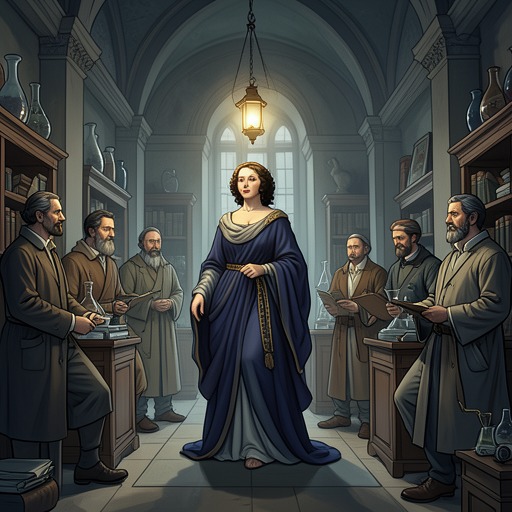
After organizing religious instruction in the Blazing-World, the Empress worries that her subjects might eventually tire of divine truth and follow their own desires. She has used sermons, the formation of a women’s congregation, and striking chapel displays to teach and sustain belief, but she turns next to the question of how to know the world she left behind. Since she sees no other way to learn about it, she summons the most learned members of her society and asks whether immaterial spirits exist there.
The spirits become informants about her former world, but their authority is not absolute. They tell the Empress about writers and experimental philosophers, and about attempts by Dr. Dee and Edward Kelly to discover the Kabbalah. Their account connects those claims to Ben Jonson’s play The Alchymist, while a discussion of what the spirits have forgotten exposes a limit in their knowledge: what is past remains available to memory only if it has been recorded. They explain that their foresight depends on comparing past and present actions, rather than on unlimited access to events. The conversation thus gives the Empress grounds to seek the spirits’ assistance without establishing that they possess complete knowledge.
That qualification matters when she asks whether they know what was in God, how divine faith arises, or whether spirits give motion to natural bodies. They deny possessing universal knowledge and say that, as incorporeal beings, they move by means of corporeal vehicles; pure spirits are immovable. Their own explanations distinguish natural knowledge from supernatural knowledge and reserve perfect understanding to God. When the Empress announces that she wants to make a Kabbalah, the spirits disappear. She briefly fears that her question has caused them to suffer, but the Fly-men and Worm-men locate them at the Antipodes, where the spirits are in good condition and willing to help. Their return offers a strikingly practical resolution to the episode’s supernatural interruption, but it does not answer the deeper question of whether their knowledge is sufficient for the task.
Choosing a Scribe
The spirits offer to dictate the work, while admitting that they cannot write unless they assume a hand or a whole human body. Asked whether she wants the soul of a living or dead person as scribe, the Empress considers famous ancient writers and then modern ones. The spirits dismiss these candidates as too attached to their own opinions or too self-conceited to serve as a woman’s secretary. Instead they recommend the Duchess of Newcastle: not as the most learned or eloquent writer, but as a plain and rational one whose work rests on sense and reason.
The Empress chooses her precisely because she is a woman, adding that the Emperor need not be jealous. The spirits answer by warning that Platonic lovers can be dangerous in their intimacy and subtle influence. When the Duchess’s soul arrives, the Empress greets her affectionately and asks if she can write. The Duchess says her characters are difficult for ordinary readers to understand, but that the Empress’s secretaries could learn to copy them. The Empress clarifies that the recommendation concerned the sense and reason of her writing, not its handwriting. The exchange makes authorship part of the proposed project from its outset: the Duchess is invited to help not because her script is immediately legible, but because her reasoning is thought fit for the work.
The Duchess’s Objections
The Duchess questions the Empress’s choice of subject before agreeing to serve it. For a Jewish Kabbalah, she recommends seeking the soul of Moses or of a learned Jewish sage, arguing that such an authority would be better equipped to instruct the Empress in the tradition. The Empress replies that no mortal knows where Moses is and trusts instead in instruction from spirits. The Duchess counters that created spirits, like mortals, lack general or absolute knowledge; they cannot know human thoughts or the Creator’s mysteries unless divine knowledge is granted to them. Her objection brings the spirits’ earlier admissions into direct relation with the practical risks of the Empress’s plan.
The Duchess then advises leaving the project alone. If the Empress is not of the Jewish religion, the work would bring no advantage to her or her people; even for a Jewish reader, the literal sense of Scripture would be more instructive and more credible than mystical interpretation. The Duchess argues that Moses, had a mystical explanation been necessary for later generations’ salvation, could have supplied one himself. She therefore favors the common literal reading over interpretations fashioned according to individual fancy and rejects the idea that salvation depends on possessing a mystical key to Scripture.
The Empress tests alternatives rather than immediately giving up. A philosophical Kabbalah, the Duchess replies, would add confusion to a subject already made difficult by infinite numbers. A moral Kabbalah is unnecessary because its central obligations are to fear God and love one’s neighbor. A political Kabbalah is no more needed, since government rests on reward and punishment. The sequence moves from a dispute about a particular religious tradition to a broader argument against multiplying interpretive systems where ordinary reason, moral duty, or established principles already suffice.
Abandonment and Friendship
The Duchess does leave one possibility open: if the Empress is determined to make a Kabbalah, she should make it poetic or romancical, using metaphors, allegories, and similitudes that may be interpreted as she pleases. The suggestion redirects the impulse to construct hidden meanings from theological or political authority toward imaginative invention. The Empress thanks the Duchess, embraces her soul, and says she will follow her counsel. She makes the Duchess her favorite and keeps her in the Blazing-World for a time before allowing her to return to her husband and kindred, on condition that her soul visit again.
The Kabbalah is never made in this episode. Its abandonment follows not from a demonstrated failure of spiritual communication, but from the Duchess’s judgment that the proposed work would not serve its readers and would rest on uncertain authority. The Empress’s willingness to accept advice from a visitor she has just chosen as a collaborator makes the encounter a scene of intellectual revision as well as supernatural consultation. Their subsequent meetings produce an intimate friendship, described as Platonic love between two women. The aborted project therefore leaves behind a different creation: a relationship sustained by conversation, mutual regard, and the Duchess’s role as an independent adviser rather than merely the Empress’s scribe.