The Empress’s establishment of learned societies
The Blazing WorldThe Empress’s establishment of learned societies turns the Blazing-World’s many kinds of inhabitants into a deliberately organized system of expertise. By assigning each people a profession and founding schools and societies, she encourages practical invention and investigation; by supervising their disputes, she also makes learning answerable to the peace and order of her rule.
Organization and Specialization
The Empress’s subjects include Bear-men, Worm-men, Fish-men, Bird-men, Fly-men, Ant-men, Geese-men, Spider-men, Lice-men, Fox-men, Ape-men, Jackdaw-men, Magpie-men, Parrot-men, Satyrs, and Giants, among others. She encourages each kind to pursue the profession suited to its nature, judging them ingenious in useful arts and sciences, and establishes schools and learned societies to support that work.
The occupational map is precise: Bear-men become experimental philosophers; Bird-men, astronomers; Fly-men, Worm-men, and Fish-men, natural philosophers; Ape-men, chymists; Satyrs, Galenick physicians; Fox-men, politicians; Spider-men and Lice-men, mathematicians; Jackdaw-men, Magpie-men, and Parrot-men, orators and logicians; and Giants, architects. The societies are therefore not simply a gathering of scholars: they distribute intellectual labor across the different peoples of the realm, while the Empress retains authority to define their roles and purposes.
Inquiry Under Sovereign Direction
The Empress first seeks accounts of religion and government, then turns to the societies’ work. After allowing them time to advance in their assigned employments, she convenes the Bird-men and directs them to report on the Sun and Moon. Their observations include rival explanations, and the later use of Telescopes intensifies disagreements rather than settling them: observers differ over the motions of the Sun and Earth, the number and size of stars, and the nature of the Moon’s spots.
The Empress judges the instruments by their failure to produce agreement. Calling the Telescopes false informers that delude the senses, she orders them broken and tells the observers to rely on natural eyes, sense, and reason. The Bear-men protest that the disagreement arises from differences in observers’ senses and reasoning, not from the glasses themselves. They also admit that they take more delight in artificial delusions than in natural truths: disputes give them work and pleasure, and a world without error would leave no occasion to contradict one another or claim greater wisdom.
The Empress ultimately permits the Telescopes to remain, but confines the societies’ quarrels to their schools so that they do not become factions or disturb the state. This compromise preserves the scholars’ instruments and occupations while drawing a firm political boundary around their arguments. The societies may continue disputing, but their disputes must not become a source of public disorder.
Learning, Exclusion, and Order
The arrangement sits within a polity that treats unity as a governing principle. Its statesmen defend having few laws because numerous laws breed divisions and factions, and defend monarchy as the political equivalent of a body with one head. The same preference for unity shapes religious life: the people profess one religion, while women are excluded from public congregations and worship at home. The institutional order thus combines intellectual specialization with strict limits on the kinds of diversity and participation it accepts.
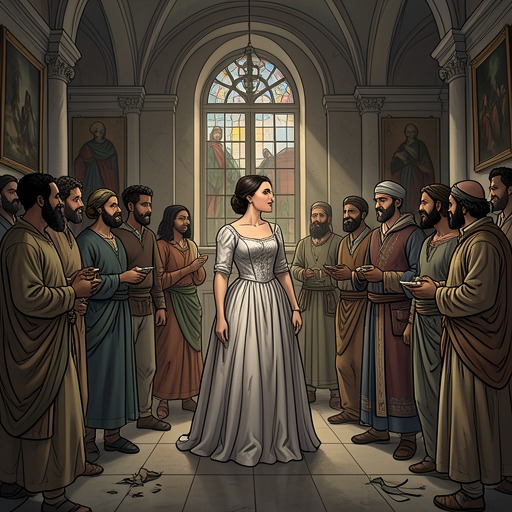
The Empress’s own conversion program makes that limit visible. Dissatisfied with her subjects’ understanding of divine truth, she builds churches and establishes a congregation of women, which she leads and instructs; their quick devotion wins her subjects’ affection. Female spiritual organization therefore appears under the Empress’s direct leadership even though women had previously been kept out of public worship. Her authority can open a new institutional space, but the episode does not establish equal access to public religious or political office.
Reform and the Societies’ Political Cost
When the Empress later consults the Duchess about growing unrest, she describes continual contention among the Worm-men, Bear-men, Fly-men, Ape-men, Satyrs, Spider-men, and others. The Duchess advises her to restore the earlier arrangement: one sovereign, one religion, one law, and one language, and recommends dissolving the societies because their intelligence is not worth the disorder their rivalries bring. In her account, scholars’ attachment to their opinions, competition to seem wiser, and reluctance to concede error can turn quarrels in schools into factions and, ultimately, war and the ruin of government.
This counsel sharpens the contradiction built into the Empress’s educational project. The societies are founded because their members can devise useful arts and sciences, yet the plural inquiry that makes their work possible also generates disagreement the state fears. The Empress’s earlier restriction of disputes to the schools offers containment rather than resolution; the later proposal to dissolve the societies carries that logic further, placing political quiet above their continued intellectual independence. The learned societies consequently stand both for organized ingenuity and for the danger the Blazing-World’s pursuit of unity sees in uncontrolled debate.