The Empress’s twin chapels
The Blazing WorldThe Empress’s twin chapels are an elaborate religious installation that turns doctrine into contrasting architectural experiences: one chapel figures Hell through flame, while the other figures Heaven through cool, radiant light. Built and set in motion by the Empress, they serve her campaign to convert the Blazing-World and show how she combines technical ingenuity with religious instruction and political order.
Construction and Setting
The Empress has two chapels built one above the other. She lines the first throughout with Diamonds—its roof, walls, and pillars—and places Fire-stone against that lining, since fire cannot harm Diamonds. Artificial pipes carry water into the room; when a tap is turned, water pours over the Fire-stone and makes the chapel appear to be engulfed in flame.
The second chapel is lined with Star-stone. Rather than burning, it casts a bright, comfortable light. Both chapels stand on pillars at the center of a round cloister as dark as night. Open on every side, they can be seen freely from within the cloister, and their construction allows them to revolve continuously around their own centers in opposite directions. The dark enclosure and the moving pair make the chapels’ distinct effects visible together: one produces apparent fire, the other light without heat.
Contrasting Lessons
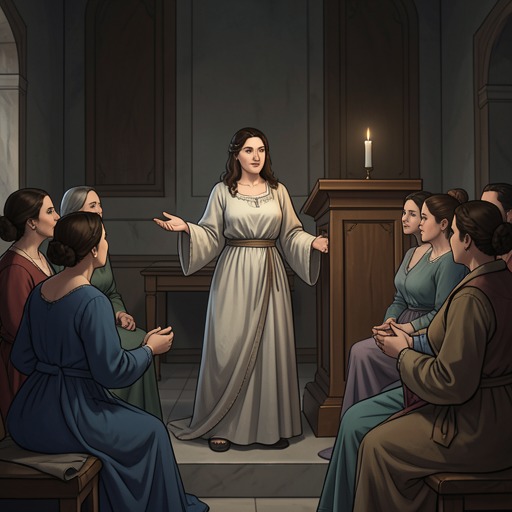
The Empress preaches sermons of terror in the Fire-stone chapel, warning the wicked of everlasting punishment after death. The Star-stone chapel is the setting for sermons of comfort to those who repent and grieve over their wrongdoing. Its light is described as so striking that the Empress appears angelic there; the chapel is explicitly presented as an emblem of Heaven, in contrast to the Fire-stone chapel’s emblem of Hell.
The effects are produced by materials and mechanisms rather than by an actual infernal fire. Though water makes the Fire-stone blaze, its flame is not so hot that the Empress cannot endure it. The account attributes this limited heat to the stone’s self-motion: the water becomes flame through the stone’s natural motions, making the fire weaker than one fed by other fuel. The Star-stone, meanwhile, gives off great light without heat. The two installations thus make punishment and consolation legible through opposed physical conditions.
Conversion and Political Meaning
The chapels arise from the Empress’s concern that the Blazing-World’s inhabitants might eventually tire of religious truth and follow their own desires. After considering how to secure the lasting effect of her instruction, she arranges for the chapels’ materials and has the buildings constructed as settings for teaching. Their spectacle gives shape to the religious ideas she preaches, joining persuasive instruction to carefully designed architecture.
The narrative presents the conversion as accomplished through the Empress’s art and ingenuity, without enforcement or bloodshed. She maintains that belief should be planted in people’s minds through gentle persuasion, not forced upon them, and contrasts the durability of love with obedience produced by fear. The chapels complicate that ideal in a revealing way: one is expressly used for sermons of terror, even as the Empress’s stated method is persuasion. Their double function—warning and consolation—embodies the tension between her appeal to voluntary belief and her effort to keep an entire world within a settled religious order.