The World Tributary Order Established by the Kingdom of Esfi
The Blazing WorldThe World Tributary Order Established by the Kingdom of Esfi turns the Empress’s intervention on behalf of her native country into a worldwide system of enforced subjection. What begins as a promise to defend a threatened nation culminates in the King of Esfi’s mastery of the seas and the submission of nearly every people in the world. Tribute is not secured by negotiation alone: the Empress uses fire-weapons, the destruction of shipping, and the threatened burning of towns to make refusal costly. Her declarations of protection and peace therefore accompany a stark expansion of imperial power.
From Assistance to Dominion
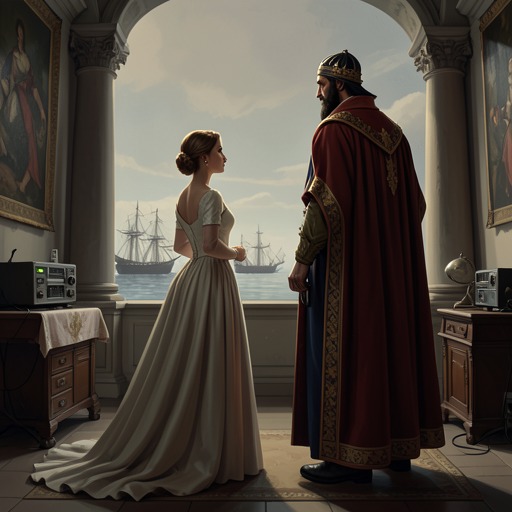
The order takes shape after the Empress offers to help her native country against its enemies. She writes to its commanders, identifying herself as a powerful princess who has come to assist them, and says she will wait for them to declare when they want her aid. When she later addresses her countrymen, she emphasizes that she is a native of their kingdom, though they do not know her, and says she has left behind the tranquility, riches, and pleasure of her own empire to prevent their destruction. She promises not merely to defend them but to make them the most powerful nation in the world.
That pledge changes the scale of the campaign. The Empress first destroys the enemy navies with Fire-stones carried by the Fish-men. The stones are uncovered and wetted beside enemy ships, which catch fire; when flames reach the gunpowder, the ships explode. Her countrymen see this victory as miraculous deliverance, and she refuses to return to the Blazing-World until she has compelled the rest of the world to submit to their nation. Assistance has become a project of universal dominion.
Tribute at Sea
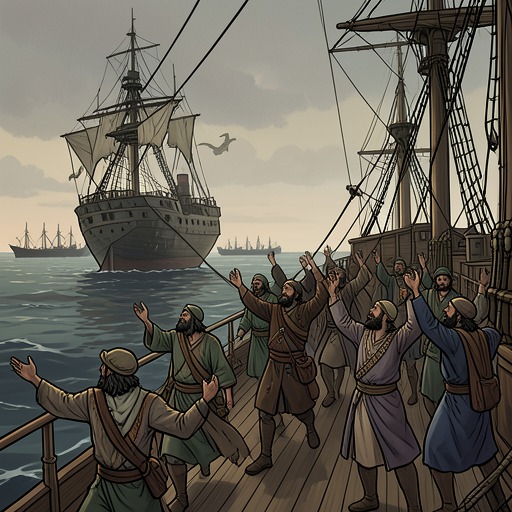
The King of Esfi tells the Empress that, despite the defeat of his enemies at sea, hostile powers still obstruct trade and commerce across his dominions. She answers by offering to burn and sink ships that do not pay him tribute. Neighboring nations reject her demand with scorn, so she orders the Fish-men to destroy foreign vessels trading on the seas. Faced with the destruction of their shipping, the nations seek terms; the Empress offers no alternative to submission and tribute to the King of Esfi. They eventually yield, and he becomes absolute master of the seas and, through control of maritime commerce, of the world.
That dependence on sea trade gives the policy its leverage. The Empress’s campaign does not have to occupy every territory before it can dictate terms: destroying the ships on which commerce depends disrupts the neighboring nations’ affairs and compels them to bargain from weakness. The King’s new authority is therefore both a political claim and a material advantage, secured by control over the routes linking nations and their markets.
The first submission does not end resistance. Neighboring nations later unite their forces against the King because they find themselves so heavily burdened by tribute that they can scarcely leave their own dominions without paying for it. The Empress again sends the Fish-men to destroy their remaining naval power, forcing them back into submission. Some peoples resist because they can live without foreign trade or rely on land commerce; against them, the order moves from maritime blockade to direct threats against their towns and cities.
Fire Against Refusal
To compel the land-based holdouts, the Empress threatens to burn their settlements. She orders the Bird-men and Worm-men to begin with smaller towns, sparing greater destruction unless resistance continues. The Worm-men can travel beneath the earth, while the Bird-men approach through the air; together they place Fire-stones under house foundations and on rooftops. The Empress has the Bear-men use Telescopes to identify which towns refuse submission, and the Bird-men are instructed to fly at night to avoid being seen.
The warning turns on a deliberate reversal: the Bird-men tell the inhabitants that rain will set their towns alight, an outcome they dismiss because they expect water to extinguish fire. When rain comes, the houses burn, and the more water is poured on them, the more fiercely they flame. The spectacle terrifies surrounding cities and kingdoms, which submit to the King of Esfi rather than risk the same destruction.
One country still refuses. It rarely receives rain and believes that dew would quickly be exhausted by a large fire. The Empress exploits a different feature of its environment: an annual tide that lasts for weeks. Because the houses stand on supports fixed in the ground, the Bird-men and Worm-men place Fire-stones at the supports’ bases. When the tide arrives, the houses catch fire; the heat turns the water into vapor and then air, destroying the buildings and leaving the country barren that year. The inhabitants submit after this attack. The campaign’s technical ingenuity is also its instrument of coercion: the Empress adapts the weapon to the local conditions until no refuge from the demand remains.
The Imperial Claim and Its Contradictions
After the victories, the Empress presents the King’s supremacy to the princes of the world as a just settlement. She says he was unjustly attacked over his hereditary rights and prerogatives in the Narrow Seas, and that Heaven rewarded him with absolute power, making him the world’s head monarch. She warns that resistance can bring only loss, while tribute will allow the princes to live peacefully and happily. The language of justice and heavenly reward recasts conquest as rightful sovereignty, even as the Empress’s fleets and Fire-stones enforce the terms.
The ending confirms both the reach and the spectacle of the new order. After making her native country an absolute monarchy over the world, the Empress receives the princes who wish to see her before her return to the Blazing-World. At sea, she appears in imperial jewels while her fleet enters the circle of ships without visible sails or aid, then sinks beneath the water. She addresses the assembled rulers as tributaries of the King of Esfi, urging them to pay what is due if they want peaceful and happy lives. Their submission has secured his dominion, but the scene makes plain that its guarantee is the Empress’s power to destroy whatever resists her.
The episode’s political logic also stands in contrast to the Blazing-World’s domestic arrangements. There, the Empress initially inherits a government with few laws, a single monarch, and a unified religion; the political account associates multiple laws with division, faction, and war. Later, when professional societies and disputes unsettle that polity, she is advised to restore a single sovereign, religion, law, and language. Yet the expedition abroad imposes unity by force: ships are burned, trade is crippled, and towns are destroyed until resistance ends. The aspiration to a peaceful, undivided order is thus inseparable from the violence used to establish the King of Esfi’s rule.
Wealth, Exchange, and Power
The tributary regime sits alongside a markedly different economy in the Blazing-World. That world contains immense quantities of gold and precious stones, but ordinary people are forbidden to wear gold or jewels; the privilege belongs to the imperial family, and trade takes place by exchanging commodities rather than using coin. Abundance does not erase hierarchy: access to conspicuous wealth is restricted, while political power determines who may display it.
The Duchess of Newcastle asks why the Empress does not use the passage between worlds to enrich her family, despite possessing enough wealth to enrich the entire world. The Empress replies that riches make individuals and nations seek one another’s destruction, and that increased wealth intensifies rather than satisfies covetousness. The Duchess counters that scarcity makes people eager for wealth; the Empress insists that covetousness is infinite. Their exchange illuminates a tension within the order the Empress creates: she distrusts riches as a source of conflict, yet secures the King’s supremacy by extracting tribute and commanding the commercial routes on which other nations depend.
The Empress’s own account of authorship sharpens the contrast. In describing her imagined world, the Duchess of Newcastle says she made one because Fortune and the Fates gave her none, and that she would desire only enough gold to repair her husband’s losses. The world-making that begins as a way to claim imaginative sovereignty becomes, in the Esfi campaign, a means of imposing sovereignty on others. The resulting order is expansive and effective, but its peace is not freely negotiated: it is the condition offered to those who submit and withheld from those who resist.