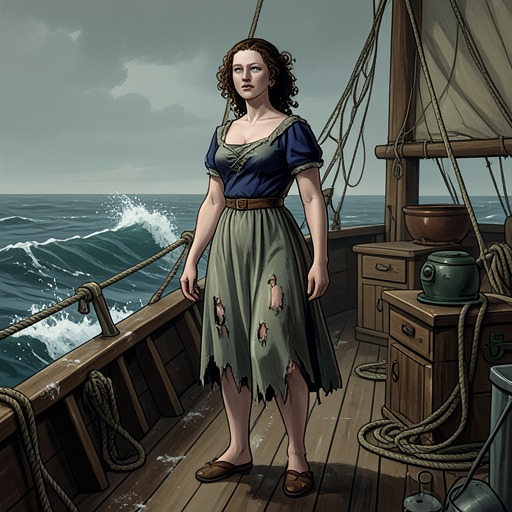
The young lady’s passage into the Blazing-World
The Blazing WorldThe young lady’s passage into the Blazing-World turns an abduction at sea into a passage between worlds. A storm drives the small vessel toward the North Pole and through the Icy Sea; while the men aboard perish in the cold, the young lady survives and reaches a shore where Bear-men take her in. The episode establishes the Blazing-World as a realm reached not by deliberate exploration but by a chain of physical forces and unexpected acts of reception.
From Abduction to Unintended Voyage
The voyage begins with a merchant who has abducted a young lady from the coast. His vessel is small, lightly built, and supplied for a journey that might be delayed by unforeseen events. Instead, a tempest takes command of its course. The narrative presents the storm as a consequence of Heaven’s displeasure at the merchant’s theft, sharply reversing his expectation of happiness: the plan to possess the young lady becomes a journey whose destination neither he nor his crew can control.
The wind drives the boat northward with extraordinary speed. It reaches the Icy Sea and is carried among immense pieces of ice. In this sequence, the vessel’s lightness is both a danger and a means of passage: exposed to the wind and the ice, it is nevertheless able to move through the icy barriers. The journey’s governing change is from a human scheme to an uncontrollable passage, with the young lady’s survival—not the merchant’s desire—becoming the event’s central outcome.
The Joined Poles and the Structure of Worlds
The account explains that the boat reaches the end of the Pole of one world and approaches the Pole of another, joined closely to it. At their conjunction, the cold has a doubled strength. The dead men’s fate is thus connected not only to the severe climate but to the peculiar meeting of two worlds. The young lady alone remains alive, attributed to her youth, beauty, and divine protection.
This geography also rules out a simple journey around the globe. The narrator explains that the poles of the two worlds prevent passage around either world in the direction from pole to pole: a traveller arriving at one of these poles must either turn back or enter another world. Each world has its own Sun, moving within its own circuit without obstructing the other. Their Suns may meet, but the nearer Sun makes the other difficult to perceive; skilled astronomers, using good Telescopes, have nevertheless observed two or three Suns at once. The passage therefore makes the young lady’s arrival part of a larger cosmology, in which worlds touch at their poles while retaining distinct celestial systems.
Survival and the Bear-men’s Welcome
After the men die, the cold initially preserves their bodies. When the boat moves into warmer conditions, they begin to thaw and decay. Unable to move them overboard, the young lady leaves the small cabin and goes onto the deck to escape their condition. There she sees land, still covered in snow, and the boat moving between two expanses of ice like a stream between banks. Her arrival is marked by a practical struggle for survival as well as by the transition into a new world.
Bear-men approach across the ice. Their appearance frightens the young lady, who expects that her life may be at risk, but their conduct overturns that expectation. They inspect the vessel, speak among themselves in a language she does not understand, carry her out, and sink the boat with the dead men. Unable to walk securely on the slippery ice, she is lifted and carried to their city, where the inhabitants live in underground caves rather than houses. Males and females, young and old, gather to look at her in astonishment, then she is placed in a spacious cave and entrusted to the care of the females.
A Change of Climate and Custody
The Bear-men treat the young lady kindly and give her their customary food, but they recognize that neither their climate nor their diet suits her constitution. Their hospitality therefore leads to another relocation rather than a settled arrival. They decide to take her to a warmer island inhabited by Fox-men, who walk upright like their Bear-men neighbours. The change of destination makes care practical as well as welcoming: the Bear-men acknowledge the limits of what their own environment can provide.
The Fox-men receive the Bear-men with civility and admire the young lady. After speaking together, the two peoples agree that she should be presented to the Emperor of their world. Following a short stay, they carry her across the island to a large, clear river, where numerous boats are waiting; she is taken aboard one while Bear-men and Fox-men attend her. The episode ends with her passage continuing under the care of others, now directed toward the Emperor rather than toward the place where the storm first brought her ashore. By joining danger, survival, and successive acts of hospitality, the narrative makes her involuntary arrival the opening to a wider encounter with the Blazing-World and its peoples.