Tributary subjection to the King of Esfi
The Blazing WorldTributary subjection to the King of Esfi is the political order the Empress establishes after intervening in a war against her native country. What begins as an offer of assistance becomes a demand for tribute from neighboring peoples, enforced through naval destruction and the threat, then the actuality, of burning settlements. The policy makes the King of Esfi the world’s absolute monarch, joining a rhetoric of protection and peace to the coercive machinery of imperial rule.
From aid to tribute
The Empress first presents herself to the besieged country as a native who has crossed from another world to help. She tells its commanders that she seeks no bargain or private gain, but intends to make their nation the most powerful in the world; the only return she asks is grateful acknowledgment of her love and loyalty. Her offer rests on extraordinary power: she promises to destroy the enemy fleets before nightfall and to assist against enemies on land as well. The country’s commanders respond with thanks, though their judgments of her appearance and power divide between calling her an angel, a sorceress, a goddess, or a devil in the shape of a beautiful woman.
The Empress makes the promise concrete by destroying the invading navies. Fish-men carry Fire-stones in diamond cases and uncover and wet them beside enemy ships; the resulting flames reach the gunpowder, and the fleets are destroyed. Her countrymen hail her as a deliverer. But rescue does not end with the removal of the immediate threat. When the King of Esfi explains that hostile powers still obstruct his dominions’ trade, the Empress declares that she will burn or sink ships that refuse to pay him tribute. The shift is decisive: military aid becomes a program for controlling commerce and extending the King’s authority.
Enforcement across the seas
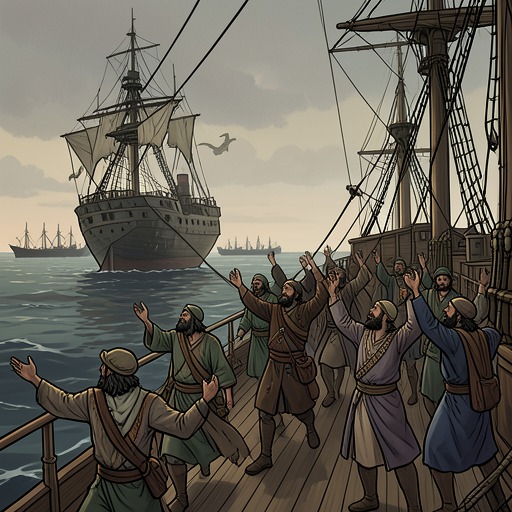
The Empress sends neighboring nations that trade by sea a demand to pay tribute to the King of Esfi. They reject it, so she orders her Fish-men to destroy foreign trading ships. The attack disrupts the nations’ affairs and plans; they seek negotiations, but the Empress offers no terms short of submission and payment. After a prolonged treaty, they yield. Because the nations depend on maritime as well as land commerce, the King thereby becomes master of the seas and, in the Empress’s account, of the world.
That submission proves unstable. The neighboring powers, finding themselves so heavily burdened that they can scarcely leave their own dominions without paying tribute, join forces against the King. The Empress again sends her Fish-men to destroy the remaining naval power, forcing the maritime opponents back into submission. She does not, however, treat all resistance as a naval problem: nations able to live without foreign trade, and those whose commerce is entirely by land, remain outside the tribute arrangement. To bring them in, she threatens to burn their towns and cities if they will not submit voluntarily.
Fire against inland resistance
The Empress chooses a staged demonstration of force. She tells the resistant princes that she will first burn smaller towns as a warning and turn limited losses into total ruin if they persist. She orders the Bird-men to travel by night and has the Bear-men use their Telescopes to identify the towns and cities that refuse submission. The Bird-men carry Fire-stones through the air; the Worm-men travel beneath the ground, where they can move as readily as people above it. Together, they place stones beneath house foundations and on rooftops. The Bird-men learn a few words of the local language and warn the inhabitants that rain will set their towns alight. The warning sounds absurd to people who know water as something that puts out fire.
When rain comes, the houses burst into flame, and added water makes the fire burn more intensely. Terror spreads from the affected towns to neighboring cities, nations, and kingdoms, which grant the Empress’s demand and submit to the King of Esfi. One country resists because it receives little rain, but the Empress exploits its annual tide instead. Her agents place Fire-stones at the bases of the supports on which its houses stand; when the tide rises, the buildings catch fire. The heat turns the water to vapor and then air, destroys the houses, and leaves the country barren for that year. It, too, submits. The campaign’s calculated progression—from ships, to smaller towns, to the exceptional country’s houses and livelihood—shows how the promise to avoid unnecessary destruction operates within, rather than against, an expanding program of coercion.
Sovereignty, peace, and imperial power
The Empress presents the settlement as a defense of hereditary rights. Addressing the assembled princes, she says that the King of Esfi was unjustly attacked by nations seeking to take his rights and prerogatives over the Narrow Seas. She asserts that Heaven has rewarded him with absolute power and warns that resistance will bring loss rather than victory. Her advice is to pay tribute so that the princes may live peacefully and happily. The speech recasts the outcome of conquest as a divinely sanctioned order, asking the defeated rulers to understand submission as the route to peace.
The book sets this foreign policy against the Blazing-World’s own ideal of political unity. Its statesmen justify one ruler by comparing the political body to a body with one head, and by analogy to the world’s worship of one God. Later, when factional conflict troubles the realm, the Duchess advises the Empress to restore one sovereign, one religion, one law, and one language, warning that multiplicity breeds division. The tribute system extends this preference for unity beyond the Empress’s own world, but its method is not persuasion or consensual agreement: refusing states are blockaded, their ships destroyed, and their settlements burned until they submit.
The Empress’s earlier assurance that she seeks no bargain and values her country’s safety above her own interest therefore acquires an unsettling double meaning. Her attachment to her homeland supplies the motive for intervention, while her superior force turns that loyalty into a claim over other peoples’ trade, territory, and political independence. Tribute becomes the mechanism that converts victory into durable hierarchy: the King’s command over commerce makes him master of the seas, and the destruction of inland settlements closes the remaining paths of refusal. The resulting world order is peaceful in the sense that resistance has been defeated, but its peace rests on the continuing threat and demonstrated use of overwhelming force.