War against the Empress's native country
The Blazing WorldThe war against the Empress’s native country transforms a private grief into an imperial expedition: the Empress sets out to rescue the land where her friends and relations live, but her victory culminates in the King of Esfi’s supremacy over the world and the forced payment of tribute. The narrative makes the change in scale unmistakable. What begins as a search for a way to help a threatened homeland ends with the Empress using the Blazing-World Expeditionary Fleet to destroy resistance, command commerce, and threaten the burning of cities.
Causes and the decision to intervene
The Immaterial Spirits bring the Empress news that the world from which she came is engulfed in war and that most of its nations have joined against her native country. The report affects her deeply: she weeps, and the Emperor, seeing her distress, asks what has happened. She explains that the country where her friends and relations live may be destroyed by its numerous enemies. The Emperor offers all the assistance the Blazing-World can provide, turning her wish to serve her homeland into a question of whether forces can cross between the two worlds.
The Empress first considers whether the Immaterial Spirits might fight on her country’s behalf, but rules out the idea. They cannot arm themselves or use artificial weapons, and their natural vehicles cannot make trenches and fortifications. Even if they occupied dead human bodies, the bodies would be difficult to gather and transport, would decay before they could form an army, and would be contested by the souls that rightfully belonged to them. The debate establishes a boundary between supernatural intelligence and military action: the Spirits can report the war, but cannot wage it. The Emperor therefore proposes seeking counsel from the Empress’s Platonick Friend, the Duchess of Newcastle.
The Duchess’s Soul arrives at the Empress’s request and agrees to consider how she might help. Her practical first step is to send the Fish-men to search for a passage between the worlds. They find only one: a narrow route through which no vessel larger than a packet-boat can pass, and one that sometimes freezes shut. The discovery makes the rescue seem precarious, but it also gives the expedition a possible route. The Duchess then asks the Giants, who serve as architects and shipwrights, whether they can build ships capable of travelling underwater, an invention she knows from her own world. They have never heard of it, but agree to try.
Passage and arrival
The Empress’s preparations bring together different subjects of the Blazing-World according to their established roles. Worm-men obtain Fire-stone; Fish-men are assigned to accompany her below the water; Bird-men are to travel through the air; and Bear-men and Worm-men are to go aboard ships. The Empress takes many vessels both to carry these loyal subjects and to provide for them. She also accepts further volunteers who petition to join her, unwilling to deny all those who wish to accompany her.
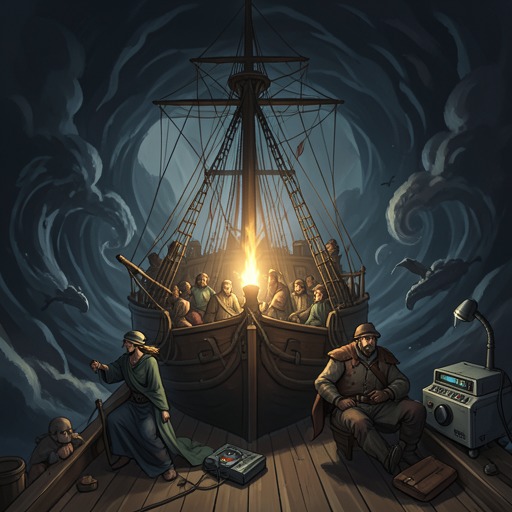
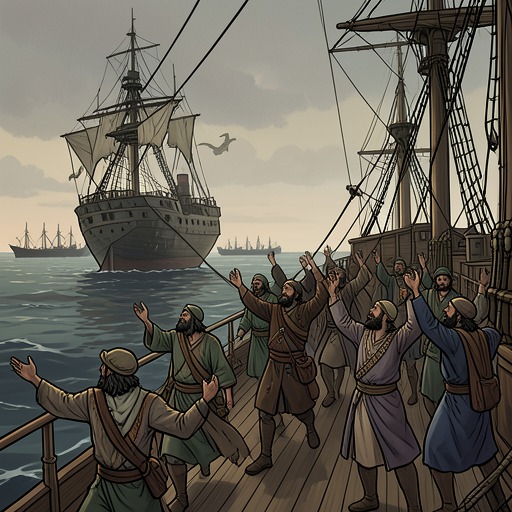
The passage requires an unusual method of travel. In the short stretch between the worlds, Fish-men draw the ships underwater with golden chains. The Giants have made them watertight and arranged for enough air to sustain the land animals aboard, so the passengers experience no inconvenience. After crossing the Icy Sea, the ships surface and continue toward the Empress’s homeland. Near it, the Bear-men observe through their Telescopes a large, well-equipped enemy fleet surrounding the country.
The Empress uses spectacle as well as force to shape the first encounter. Before approaching the enemy, she sends Fish-men and Bird-men to gather information about its numbers and position. At night, they carry thousands of Fire-stones, cut like torches or candles, with their tips wetted. The lights make the air and sea appear to be on fire; those who see them believe the Last Day has arrived and fall to their knees in prayer. At daybreak the lights are extinguished. The enemy then sees ships that appear to have no sails, guns, or weapons and seem to move by themselves. The vessels’ gold has been painted over in black or another dark color, so even the best Telescopes cannot reveal what they are. Terror at night gives way to bewilderment by day, and the enemy fleet is too frightened to move.
The homeland’s defense
The Empress sends a letter to the enemy’s general and senior commanders, identifying herself as a powerful princess who has come to help her country and asking when they want her assistance. Their council cannot agree quickly on a reply. Annoyed by its delay, she considers returning to the Blazing-World without helping, but the Duchess urges patience: large councils move slowly because their members hold different opinions and compete to appear wise. The Empress complains that long-winded counselors provide more words than advice, while the Duchess reminds her that this world’s inhabitants have duller understandings than those of the Blazing-World.
When a messenger finally asks who she is and how she can help, the Empress refuses to disclose where she came from. She promises instead to appear at one o’clock that night in a brilliant light surrounded by fire. At the appointed hour, she is borne above the water on the Fish-men’s heads and backs, while Bird-men and Fish-men carry lit Fire-stones in the air and above the sea. As her countrymen approach, she leaves the torches behind and appears only in her garments of light, like an angel or deity. She keeps far enough away that they can see her splendor but not inspect her clothes, then speaks where all can hear.
Her address defines the expedition as service to her birthplace. She says that although her countrymen do not know her, she is a native of their kingdom and has travelled from another world because its enemies seek to destroy or weaken it. She disclaims any bargain or greater concern for her own interest, promising to make them the world’s most powerful nation. In return, she asks only for grateful acknowledgment and recognition of her power, love, and loyalty. She also assures them that she will destroy the enemies at sea before the following night and help against enemies on land if necessary. The commanders thank her, but her appearance produces competing explanations: some call her an angel, others a sorceress or goddess, and some believe the Devil has deceived them in the shape of a beautiful woman.
At the battle, the Empress appears in imperial robes made of diamonds and carbuncles, carrying a shield of one whole carbuncle and a spear of one whole diamond. Her crown bears a star of Star-stone, and a half-moon made of the same material rests on her forehead. She directs the Fish-men to approach the enemy ships with Fire-stones concealed in diamond cases, uncovering and wetting them only when they are beneath or close beside the vessels. The stones set the ships alight; when the flames reach their gunpowder, the ships explode. In a short time the enemy navies are destroyed. Her countrymen acclaim her as an angel sent by God, and she remains rather than return to the Blazing-World, determined to make the rest of the world submit to their nation.
Victory and the tribute system
The naval victory does not end the conflict. The King of Esfi, the sovereign of the Empress’s native country, hears from his general about the fleet’s destruction and the Empress’s plan to make him the world’s most powerful monarch. The Empress then asks the King how she can serve him further. He thanks her but explains that surviving enemies still obstruct the trade and traffic of his dominions. She answers that she will sink or burn any ships that refuse to pay him tribute and sends demands to neighboring nations that trade by sea. They reject the demand, so she orders the Fish-men to destroy foreign ships. Faced with the loss of their maritime commerce, the nations eventually submit and pay tribute; the King thereby becomes master of the seas and, in the narrative’s account, of the world, whose nations cannot readily live without trade by sea as well as land.
That submission proves unstable. The neighboring nations soon find themselves so burdened that they can scarcely leave their own dominions without paying costly tribute. They unite their forces against the King, and the Empress again sends the Fish-men to destroy what remains of their naval power. Most are forced to submit once more. Nations that can live without foreign trade, or whose commerce travels only overland, continue to refuse. The Empress threatens to burn their towns and cities and reduce them by force to what they would not accept willingly.
She orders the Bird-men and Worm-men to begin with smaller towns, reserving greater destruction for continued resistance because she is reluctant to cause more devastation than necessary. The Worm-men say they can travel underground as readily as people move over the surface, solving the difficulty of transporting them into the resisting territories. Before the operation begins, the Bear-men use their Telescopes to identify the towns and cities that have refused submission. The Empress instructs the Bird-men and Worm-men where to strike and warns the rulers that burning their smaller towns is only a demonstration of power: persistence will turn a limited loss into total ruin. The sequence makes the expedition’s political consequence plain. The Empress’s initial promise of defense has expanded into an order in which refusal brings the destruction of shipping, the loss of trade, or the burning of settlements.
The King of Esfi and the meaning of the expedition
The Empress’s later audience with the princes gives the new hierarchy a public declaration. She tells the assembled rulers that she has come to aid the King of Esfi against nations that unjustly assaulted him and sought to take away his hereditary rights and prerogatives over the Narrow Seas. She presents his absolute power as a reward from Heaven and warns that resistance will bring loss rather than victory. Her counsel is that the princes pay tribute faithfully so they may live peacefully and happily and receive Heaven’s blessings. The rhetoric of peace now accompanies a demand backed by the demonstrated destruction of fleets and the threatened destruction of towns.
After speaking, the Empress asks the princes’ ships to move back. Her own fleet enters the circle without visible help from sails or tide; once she boards her vessel, the whole fleet sinks beneath the sea, leaving the spectators amazed. It remains underwater until it reaches the Blazing-World. The striking return closes the expedition’s public display, but not its political consequence: the King’s authority has been asserted before the rulers whose submission she demands.
The episode’s central reversal is that the Empress’s loyalty to her native country both motivates the intervention and gives it a language of selflessness, while the methods and outcomes extend far beyond immediate defense. She says she will sacrifice her tranquility, riches, and pleasure to save her birthplace, and her fleet does destroy the forces threatening it. Yet the campaign proceeds from relief to destruction of foreign shipping, from destruction to tribute, and from maritime coercion to threats against inland settlements. The narrative places benevolent protection and imperial subjection in the same arc: the homeland is rescued, but its king’s supremacy is secured through the Empress’s overwhelming power.