World-Making in the Mind
The Blazing WorldWorld-Making in the Mind is the power to create and govern an inhabited world within oneself, offered as an alternative to the risks and burdens of ruling a material empire. The Immaterial Spirits persuade the Duchess of Newcastle to abandon her ambition to conquer a world by showing how limited external sovereignty is beside the imaginative freedom of an inner one; after trying and rejecting several inherited philosophical models, she makes a world of her own invention, and the Empress of the Blazing-World makes one too. The episode joins a theory of self-moving matter to a political and imaginative experiment: what cannot be peacefully perfected in public government may be made coherent within the mind.
The Case for an Inward World
The Duchess initially entertains the possibility of becoming Empress of another world. The Spirits do not promise that conquest is easy or its rewards secure. They warn that conquerors, being more feared than loved, often meet an untimely end, and that Fame is as mortal as other forms of life: some reputations last, others soon disappear. The Duchess accepts that the shortest-lived Fame may outlast the longest human life, but the Spirits make clear that the opportunity for a glorious achievement cannot be guaranteed.
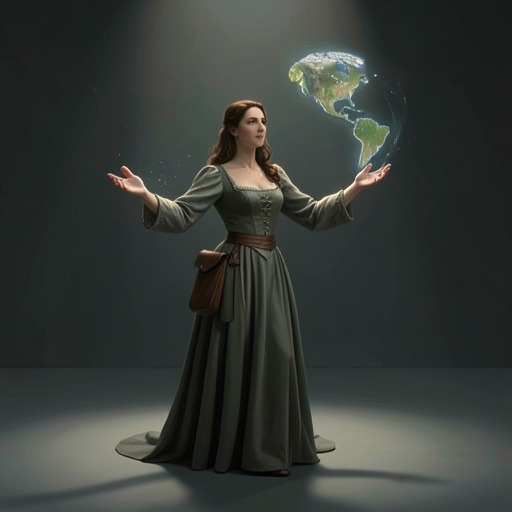
They answer her desire not with a safer territory to conquer but with a different account of what creation and possession can mean. Every human creature, they say, can form an immaterial world within the head, populate it with immaterial subjects, and determine its forms of government and motion. Such a world can contain different figures, colours, perceptions, whirlpools, lights, pressures, and reactions; it can be altered at will, or changed from a natural world into an artificial one. The list makes inner creation expansive rather than merely contemplative: the mind can shape both the constitution of its world and the processes by which that world moves.
The Spirits contrast this imaginative authority with the practical limits of material sovereignty. A ruler who possesses an entire world can enjoy only a portion of it; the Empress herself does not know every place, country, and dominion she governs. Subjects enjoy particular pleasures in particular places, while a sovereign bears the general trouble of rule. A kingdom cannot be enjoyed all at once by one person without travelling through it and enduring the difficulties of travel. Since glory depends on other people’s opinions and cannot guarantee peace of mind or bodily ease, the Spirits ask why the Duchess would exchange tranquillity for the cares of government when she can create and enjoy a world within herself.
The Duchess Tests Philosophical Systems
The Duchess is persuaded. She resolves to reject the worlds outside her and make one of her own, but first tests whether established philosophies can provide workable designs. Her attempts dramatize the distance between possessing a theory and being able to make it function as a world: each system imposes a different difficulty on the maker, and each imagined construction is eventually abandoned.
She begins with Thales, but Dæmons interfere with her ability to act according to her own will and compel her to obey their commands. She then turns to Pythagoras, only to become confused by the numbers needed to order and compose the world’s parts; lacking skill in arithmetic, she gives up. Plato’s system proves harder still. The numerous Ideas derive their motion from her mind, and animating each of them becomes, in the narrator’s comparison, like making a puppeteer move every puppet individually. The labour exhausts her patience, so she annihilates this world too.
The Epicurean attempt falters for another reason. The infinite Atoms produce a mist that blinds the Duchess’s perception; she cannot make a Vacuum to receive them or provide a place into which they can withdraw. With no satisfactory order or method, their confusion generates strange and monstrous figures that frighten rather than delight her and nearly dissolve her mind into chaos. She clears the dusty, misty particles and tries Aristotle’s system, but its principle that nothing can come from nothing conflicts with the mind’s presumed immateriality, so she must desist.
Modern systems do not solve the problem. Under Descartes’ model, the Duchess sets Æthereal Globules rotating through a strong and lively imagination, but their extraordinary speed makes her mind dizzy and her thoughts seem to stagger as if drunk. She dissolves that world and tries Hobbes. There, the parts press and drive against one another like wolves worrying sheep or dogs chasing hares; when pressure meets equal reaction, her mind feels squeezed until her thoughts can move neither forward nor backward. The resulting pain is so severe that dissolving the world does not immediately settle her mind. These failed trials make world-making an act with consequences for its maker: imagined systems are not neutral diagrams but demanding arrangements of motion, order, and perception.
Invention and Self-Moving Matter
After finding none of the inherited patterns adequate, the Duchess creates a world of her own invention. It consists of self-moving matter, described in terms of sensitive and rational degrees but composed only of the rational, the subtlest and purest degree. Sensitive matter sustains the perceptions and consistency of the body, while rational matter moves at the same time toward the creation of the imaginary world. Although the degrees are mixed, different parts may move in different directions simultaneously; the world’s making therefore depends on concurrent activity rather than a single, externally imposed motion.
The finished world is curious, varied, well ordered, and wisely governed. Its richness cannot be fully expressed in words, and the pleasure the Duchess takes in making it is likewise beyond verbal description. The contrast with her earlier attempts is decisive: instead of submitting her imagination to a philosophical template that confuses, exhausts, or pains her, she makes a world whose order and variety answer to her own invention. The scene presents imaginative freedom not as freedom from structure but as the capacity to compose a structure that can sustain both complexity and delight.
The Empress’s Parallel Creation
Meanwhile, the Empress has also been making and dissolving worlds in her mind without finding one in which she can settle. The Duchess brings her own world to the Empress and invites her to perceive its frame, order, and government. The Empress is so captivated by it that her soul wishes to live there; the Duchess instead advises her to make a similar world in her own mind, offering the rational motions of her mind as assistance through sensitive expressions. The exchange makes imaginative creation transmissible through friendship and instruction, even though each woman must form her own world.
The Empress follows the advice. She completes an imaginary world, frames creatures suited to it, strengthens it with good laws, and beautifies it with arts and sciences. The comparison with her actual dominion sharpens the achievement. The Blazing-World is already so well ordered that she sees little prospect of improving it, yet its government has been disturbed by secret and deceptive policy, ambition, factions, malicious detraction, civil dissension, religious division, and foreign wars. Her new world, by contrast, is described as a peaceful society marked by united tranquillity and religious conformity. Inward construction thus becomes a striking counter-image to political disorder, though it does not by itself resolve the problems of ruling the external world.
The contrast is not simply between an imperfect public world and an ideal private one. Earlier in the narrative, the Duchess advises the Empress to restore the Blazing-World’s original government: one sovereign, one religion, one law, and one language, with learned societies dissolved if their disputes threaten political unity. That advice reflects the same attraction to coherence visible in the imaginary world, but it is a political programme imposed through sovereign authority, not the private act of making. The novel’s account of inward world-making consequently holds two forms of order beside one another: self-directed imaginative construction and a public order maintained by the Empress’s power.
Matter, Life, and the Boundary of Creation
The world-making episode belongs to a broader argument about whether motion and life must be explained by immaterial agents. The Empress’s discussions with the Immaterial Spirits complicate the apparent division between mind and matter. The Spirits claim that, being incorporeal, they receive motion from their corporeal vehicles rather than moving those bodies themselves; they cannot speak or possess bodily senses without bodily organs, though they allow for supernatural knowledge without a body. Their vehicles are living because they are self-moving bodies, and the Spirits cannot leave them, although the vehicles change form as occasion requires.
The Spirits’ account of nature similarly refuses a clean separation of matter from life and perception. They describe Nature as one infinite, self-moving, living, and self-knowing body, composed of inanimate, sensitive, and rational matter intermingled so thoroughly that no part, not even an atom, lacks all three degrees. In that account, sensitive matter is life, rational matter is soul, and inanimate matter is body. Natural lives, forms, and matter are inseparable: a world cannot consist of lives and forms without matter, or matter without lives and forms. The Duchess’s invented world, made through rational matter’s motion while sensitive matter sustains bodily perception and consistency, gives this material philosophy an imaginative counterpart.
This framework makes the phrase “immaterial world” less straightforward than it first appears. The Spirits describe the worlds people create within their minds as immaterial and populated by immaterial creatures, yet the book’s material philosophy assigns movement, life, and cognition to matter itself. The dialogue does not erase that tension. Instead, it places the power of making a world at the meeting point of mind, bodily motions, and self-moving matter, while distinguishing the imaginative world’s freedom from the practical constraints that govern material rule.
World-making is therefore at once a philosophical claim and an alternative measure of power. The Duchess gives up the uncertain prospect of conquest not by relinquishing creation, but by turning creation inward; the Empress adds a second inward world to the one she governs externally. Their achievement offers a form of order that can be framed, altered, and enjoyed without the journeys, opposition, and public burdens of empire. Yet the episode leaves the contrast alive rather than dissolving it: private worlds can be made harmonious, while the Empress’s actual sovereignty remains vulnerable to political contention and the costs of enforcing unity.